As of January 2026, the artificial intelligence landscape has been fundamentally reshaped by the mass deployment of NVIDIA’s (NASDAQ: NVDA) Blackwell B200 GPU. Originally announced in early 2024, the Blackwell architecture has spent the last year transitioning from a theoretical powerhouse to the industrial backbone of the world's most advanced data centers. With a staggering 208 billion transistors and a revolutionary dual-die design, the B200 has delivered on its promise to push LLM (Large Language Model) inference performance to 30 times that of its predecessor, the H100, effectively unlocking the era of real-time, trillion-parameter "reasoning" models.
However, the hardware's success is increasingly inseparable from the complex geopolitical web in which it resides. As the U.S. government tightens its grip on advanced silicon through the recently advanced "AI Overwatch Act" and a new 25% "pay-to-play" tariff model for China exports, NVIDIA finds itself in a high-stakes balancing act. The B200 represents not just a leap in compute, but a strategic asset in a global race for AI supremacy, where power consumption and trade policy are now as critical as FLOPs and memory bandwidth.
Breaking the 200-Billion Transistor Threshold
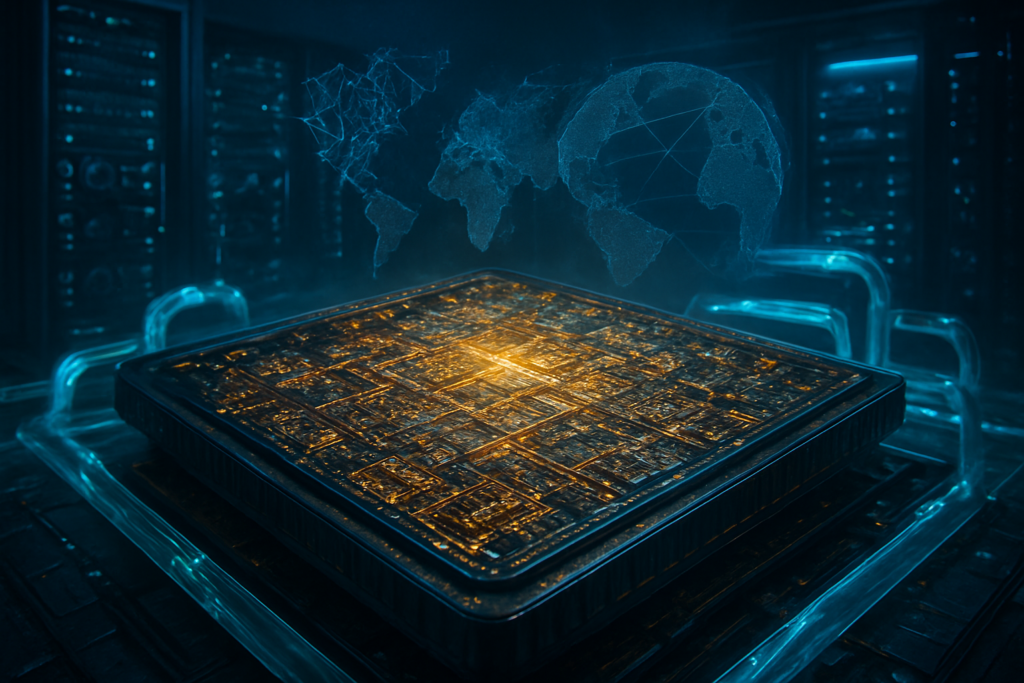
The technical achievement of the B200 lies in its departure from the monolithic die approach. By utilizing Taiwan Semiconductor Manufacturing Company’s (NYSE: TSM) CoWoS-L packaging technology, NVIDIA has linked two reticle-limited dies with a high-speed, 10 TB/s interconnect, creating a unified processor with 208 billion transistors. This "chiplet" architecture allows the B200 to operate as a single, massive GPU, overcoming the physical limitations of single-die manufacturing. Key to its 30x inference performance leap is the 2nd Generation Transformer Engine, which introduces 4-bit floating point (FP4) precision. This allows for a massive increase in throughput for model inference without the traditional accuracy loss associated with lower precision, enabling models like GPT-5.2 to respond with near-instantaneous latency.
Supporting this compute power is a substantial upgrade in memory architecture. Each B200 features 192GB of HBM3e high-bandwidth memory, providing 8 TB/s of bandwidth—a 2.4x increase over the H100. This is not merely an incremental upgrade; industry experts note that the increased memory capacity allows for the housing of larger models on a single GPU, drastically reducing the latency caused by inter-GPU communication. However, this performance comes at a significant cost: a single B200 can draw up to 1,200 watts of power, pushing the limits of traditional air-cooled data centers and making liquid cooling a mandatory requirement for large-scale deployments.
A New Hierarchy for Big Tech and Startups
The rollout of Blackwell has solidified a new hierarchy among tech giants. Microsoft (NASDAQ: MSFT) and Meta (NASDAQ: META) have emerged as the primary beneficiaries, having secured the lion's share of early B200 and GB200 NVL72 rack-scale systems. Meta, in particular, has leveraged the architecture to train its Llama 4 and Llama 5 series, with Mark Zuckerberg characterizing the shift to Blackwell as the "step-change" needed to serve generative AI to billions of users. Meanwhile, OpenAI has utilized Blackwell clusters to power its latest reasoning models, asserting that the architecture’s ability to handle Mixture-of-Experts (MoE) architectures at scale was essential for achieving human-level logic in its 2025 releases.
For the broader market, the "Blackwell era" has created a split. While NVIDIA remains the dominant force, the extreme power and cooling costs of the B200 have driven some companies toward alternatives. Advanced Micro Devices (NASDAQ: AMD) has gained significant ground with its MI325X and MI350 series, which offer a more power-efficient profile for specific inference tasks. Additionally, specialized startups are finding niches where Blackwell’s high-density approach is overkill. However, for any lab aiming to compete at the "frontier" of AI—training models with tens of trillions of parameters—the B200 remains the only viable ticket to the table, maintaining NVIDIA’s near-monopoly on high-end training.
The China Strategy: Neutered Chips and New Tariffs
The most significant headwind for NVIDIA in 2026 remains the shifting sands of U.S. trade policy. While the B200 is strictly banned from export to China due to its "super-duper advanced" classification by the U.S. Department of Commerce, NVIDIA has executed a sophisticated strategy to maintain its presence in the $50 billion+ Chinese market. Reports indicate that NVIDIA is readying the "B20" and "B30A"—down-clocked, single-die versions of the Blackwell architecture—designed specifically to fall below the performance thresholds set by the U.S. government. These chips are expected to enter mass production by Q2 2026, potentially utilizing conventional GDDR7 memory to avoid high-bandwidth memory (HBM) restrictions.
Compounding this is the new "pay-to-play" model enacted by the current U.S. administration. This policy permits the sale of older or "neutered" chips, like the H200 or the upcoming B20, only if manufacturers pay a 25% tariff on each sale to the U.S. Treasury. This effectively forces a premium on Chinese firms like Alibaba (NYSE: BABA) and Tencent (HKG: 0700), while domestic Chinese competitors like Huawei and Biren are being heavily subsidized by Beijing to close the gap. The result is a fractured AI landscape where Chinese firms are increasingly forced to innovate through software optimization and "chiplet" ingenuity to stay competitive with the Blackwell-powered West.
The Path to AGI and the Limits of Infrastructure
Looking forward, the Blackwell B200 is seen as the final bridge toward the next generation of AI hardware. Rumors are already swirling around NVIDIA’s "Rubin" (R100) architecture, expected to debut in late 2026, which is rumored to integrate even more advanced 3D packaging and potentially move toward 1.6T Ethernet connectivity. These advancements are focused on one goal: achieving Artificial General Intelligence (AGI) through massive scale. However, the bottleneck is shifting from chip design to physical infrastructure.
Data center operators are now facing a "time-to-power" crisis. Deploying a GB200 NVL72 rack requires nearly 140kW of power—roughly 3.5 times the density of previous-generation setups. This has turned infrastructure companies like Vertiv (NYSE: VRT) and specialized cooling firms into the new power brokers of the AI industry. Experts predict that the next two years will be defined by a race to build "Gigawatt-scale" data centers, as the power draw of B200 clusters begins to rival that of mid-sized cities. The challenge for 2027 and beyond will be whether the electrical grid can keep pace with NVIDIA's roadmap.
Summary: A Landmark in AI History
The NVIDIA Blackwell B200 will likely be remembered as the hardware that made the "Intelligence Age" a tangible reality. By delivering a 30x increase in inference performance and breaking the 200-billion transistor barrier, it has enabled a level of machine reasoning that was deemed impossible only a few years ago. Its significance, however, extends beyond benchmarks; it has become the central pillar of modern industrial policy, driving massive infrastructure shifts toward liquid cooling and prompting unprecedented trade interventions from Washington.
As we move further into 2026, the focus will shift from the availability of the B200 to the operational efficiency of its deployment. Watch for the first results from "Blackwell Ultra" systems in mid-2026 and further clarity on whether the U.S. will allow the "B20" series to flow into China under the new tariff regime. For now, the B200 remains the undisputed king of the AI world, though it is a king that requires more power, more water, and more diplomatic finesse than any processor that came before it.
This content is intended for informational purposes only and represents analysis of current AI developments.
TokenRing AI delivers enterprise-grade solutions for multi-agent AI workflow orchestration, AI-powered development tools, and seamless remote collaboration platforms.
For more information, visit https://www.tokenring.ai/.