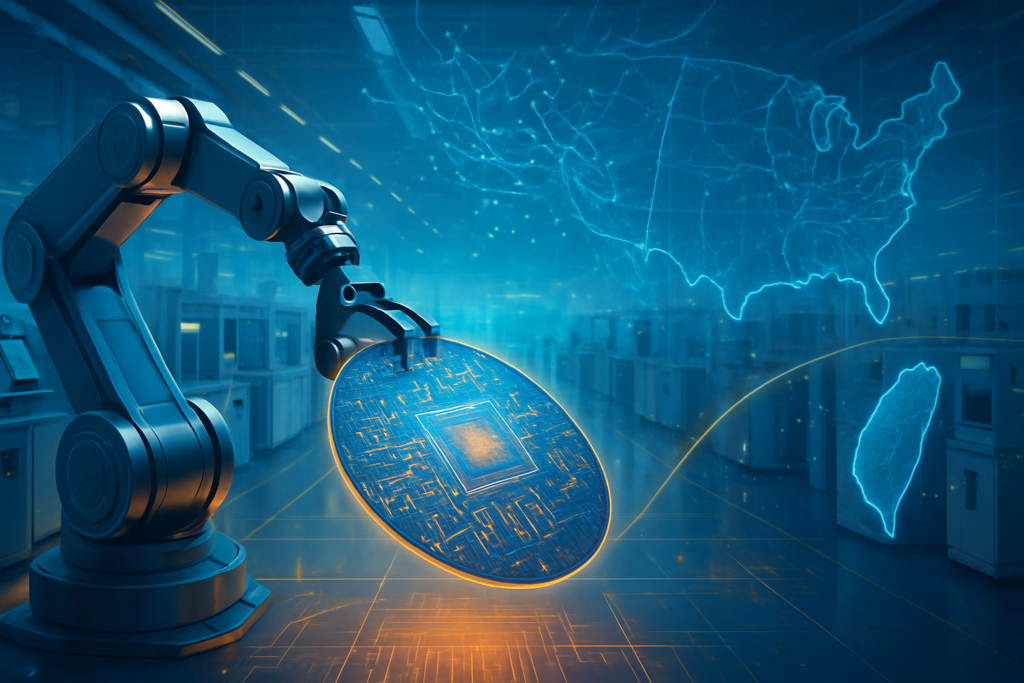
In a move that signals a seismic shift in the global technological landscape, the United States and Taiwan have officially entered into a landmark $500 billion semiconductor trade agreement. Announced this week in January 2026, the deal—already being dubbed the "Silicon Pact"—is designed to fundamentally re-shore the semiconductor supply chain and solidify the United States as the primary global hub for next-generation Artificial Intelligence chip manufacturing.
The agreement represents an unprecedented level of cooperation between the two nations, aiming to de-risk the AI revolution from geopolitical volatility. Under the terms of the deal, Taiwanese technology firms have pledged a staggering $250 billion in direct investments into U.S.-based manufacturing facilities over the next decade. This private sector commitment is bolstered by an additional $250 billion in credit guarantees from the Taiwanese government, ensuring that the ambitious expansion of fabrication plants (fabs) on American soil remains financially resilient.
Technical Milestones and the Rise of the "US-Made" AI Chip
The technical cornerstone of this agreement is the rapid acceleration of advanced node manufacturing at TSMC (NYSE: TSM) facilities in Arizona. By the time of this announcement in early 2026, TSMC’s Fab 21 (Phase 1) has already transitioned into full-volume production of 4nm (N4P) technology. This facility is now churning out the first American-made wafers for the Nvidia (NASDAQ: NVDA) Blackwell architecture and Apple (NASDAQ: AAPL) A-series chips, achieving yields that industry experts say are now on par with TSMC’s flagship plants in Hsinchu.
Beyond current-generation 4nm production, the deal fast-tracks the installation of equipment for Fab 2 (Phase 2), which is now scheduled to begin in the third quarter of 2026. This phase will bring 3nm production to the U.S. significantly earlier than originally projected. Furthermore, the pact includes provisions for "Advanced Packaging" facilities. For the first time, the highly complex CoWoS (Chip-on-Wafer-on-Substrate) packaging process—a critical bottleneck for high-performance AI GPUs—will be scaled domestically in the U.S. This ensures that the entire "silicon-to-server" lifecycle can be completed within North America, reducing the latency and security risks associated with trans-Pacific shipping of sensitive components.
Industry analysts note that this differs from previous "CHIPS Act" initiatives by moving beyond mere subsidies. The $500 billion framework provides a permanent regulatory "bridge" for technology transfer. While previous efforts focused on building shells, the Silicon Pact focuses on the operational ecosystem, including specialized chemistry supply chains and the relocation of thousands of elite Taiwanese engineers to Phoenix and Columbus under expedited visa programs. The initial reaction from the AI research community has been overwhelmingly positive, with researchers noting that a secure, domestic supply of the upcoming 2nm (N2) node will be essential for the training of "GPT-6 class" models.
Competitive Re-Alignment and Market Dominance
The business implications of the Silicon Pact are profound, creating clear winners among the world's largest tech entities. Nvidia, the current undisputed leader in AI hardware, stands to benefit most immediately. By securing a domestic "de-risked" supply of its most advanced Blackwell and Rubin-class GPUs, Nvidia can provide greater certainty to its largest customers, including Microsoft (NASDAQ: MSFT), Alphabet (NASDAQ: GOOGL), and Meta (NASDAQ: META), who are projected to increase AI infrastructure spending by 45% this year.
The deal also shifts the competitive dynamic for Intel (NASDAQ: INTC). While Intel has been aggressively pushing its own 18A (1.8nm) node, the formalization of the US-Taiwan pact places TSMC’s American fabs in direct competition for domestic "foundry" dominance. However, the agreement includes "co-opetition" clauses that encourage joint ventures in research and development, potentially allowing Intel to utilize Taiwanese advanced packaging techniques for its own Falcon Shores AI chips. For startups and smaller AI labs, the expected reduction in baseline tariffs—lowering the cost of imported Taiwanese components from 20% to 15%—will lower the barrier to entry for high-performance computing (HPC) resources.
This 5% tariff reduction brings Taiwan into alignment with Japan and South Korea, effectively creating a "Semiconductor Free Trade Zone" among democratic allies. Market analysts suggest this will lead to a 10-12% reduction in the total cost of ownership (TCO) for AI data centers built in the U.S. over the next three years. Companies like Micron (NASDAQ: MU), which provides the High-Bandwidth Memory (HBM) essential for these chips, are also expected to see increased demand as more "finished" AI products are assembled on the U.S. mainland.
Broader Significance: The Geopolitical "Silicon Shield"
The Silicon Pact is more than a trade deal; it is a strategic realignment of the global AI landscape. For the last decade, the industry has lived under the "Malacca Dilemma" and the constant threat of supply chain disruption in the Taiwan Strait. This $500 billion commitment effectively extends Taiwan’s "Silicon Shield" to American soil, creating a mutual dependency that makes the global AI economy far more resilient to regional shocks.
This development mirrors historic milestones such as the post-WWII Bretton Woods agreement, but for the digital age. By ensuring that the U.S. remains the primary hub for AI chip manufacturing, the deal prevents a fractured "splinternet" of hardware, where different regions operate on vastly different performance tiers. However, the deal has not come without concerns. Environmental advocates have pointed to the massive water and energy requirements of the expanded Arizona "Gigafab" campus, which is now planned to house up to eleven fabs.
Comparatively, this breakthrough dwarfs the original 2022 CHIPS Act in both scale and specificity. While the 2022 legislation provided the "seed" money, the 2026 Silicon Pact provides the "soil" for long-term growth. It addresses the "missing middle" of the supply chain—the raw materials, the advanced packaging, and the tariff structures—that previously made domestic manufacturing less competitive than its East Asian counterparts.
Future Horizons: Toward the 2nm Era
Looking ahead, the next 24 months will be a period of intensive infrastructure deployment. The near-term focus will be the completion of TSMC's Phoenix "Standalone Gigafab Campus," which aims to account for 15% of the company's total global advanced capacity by 2029. In the long term, we can expect the first "All-American" 2nm chips to begin trial production in early 2027, catering to the next generation of autonomous systems and edge-AI devices.
The challenge remains the labor market. Experts predict a deficit of nearly 50,000 specialized semiconductor technicians in the U.S. by 2028. To address this, the Silicon Pact includes a "Semiconductor Education Fund," a multi-billion dollar initiative to create vocational pipelines between Taiwanese universities and American technical colleges. If successful, this will create a new class of "silicon artisans" capable of maintaining the world's most complex machines.
A New Chapter in AI History
The US-Taiwan $500 billion trade deal is a defining moment for the 21st century. It marks the end of the "efficiency at all costs" era of globalization and the beginning of a "security and resilience" era. By anchoring the production of the world’s most advanced AI chips in a stable, domestic environment, the pact provides the foundational certainty required for the next decade of AI-driven economic expansion.
The key takeaway is that the "AI arms race" is no longer just about software and algorithms; it is about the physical reality of silicon. As we watch the first 4nm chips roll off the lines in Arizona this month, the world is seeing the birth of a more secure and robust technological future. In the coming weeks, investors will be closely watching for the first quarterly reports from the "Big Three" fab equipment makers to see how quickly this $250 billion in private investment begins to flow into the factory floors.
This content is intended for informational purposes only and represents analysis of current AI developments.
TokenRing AI delivers enterprise-grade solutions for multi-agent AI workflow orchestration, AI-powered development tools, and seamless remote collaboration platforms.
For more information, visit https://www.tokenring.ai/.