Ride sharing and on-demand delivery platform Uber (NYSE: UBER) met Wall Streets revenue expectations in Q4 CY2025, with sales up 20.1% year on year to $14.37 billion. Its non-GAAP profit of $0.71 per share was 11% below analysts’ consensus estimates.
Is now the time to buy Uber? Find out by accessing our full research report, it’s free.
Uber (UBER) Q4 CY2025 Highlights:
- Revenue: $14.37 billion vs analyst estimates of $14.34 billion (20.1% year-on-year growth, in line)
- Adjusted EPS: $0.71 vs analyst expectations of $0.80 (11% miss)
- Adjusted EBITDA: $2.49 billion vs analyst estimates of $2.47 billion (17.3% margin, 0.5% beat)
- Operating Margin: 12.3%, up from 6.4% in the same quarter last year
- Free Cash Flow Margin: 19.5%, up from 16.6% in the previous quarter
- Monthly Active Platform Consumers: 202 million, up 31 million year on year
- Market Capitalization: $161.9 billion
“Uber accelerated into another record-breaking quarter, with more than 200 million monthly users completing more than 40 million trips every day—our largest and most engaged consumer base ever,” said Dara Khosrowshahi, CEO.
Company Overview
Notoriously funded with $7.7 billion from the Softbank Vision Fund, Uber (NYSE: UBER) operates a platform of on-demand services such as ride-hailing, food delivery, and freight.
Revenue Growth
A company’s long-term performance is an indicator of its overall quality. Any business can put up a good quarter or two, but the best consistently grow over the long haul. Over the last three years, Uber grew its sales at a solid 17.7% compounded annual growth rate. Its growth beat the average consumer internet company and shows its offerings resonate with customers, a helpful starting point for our analysis.
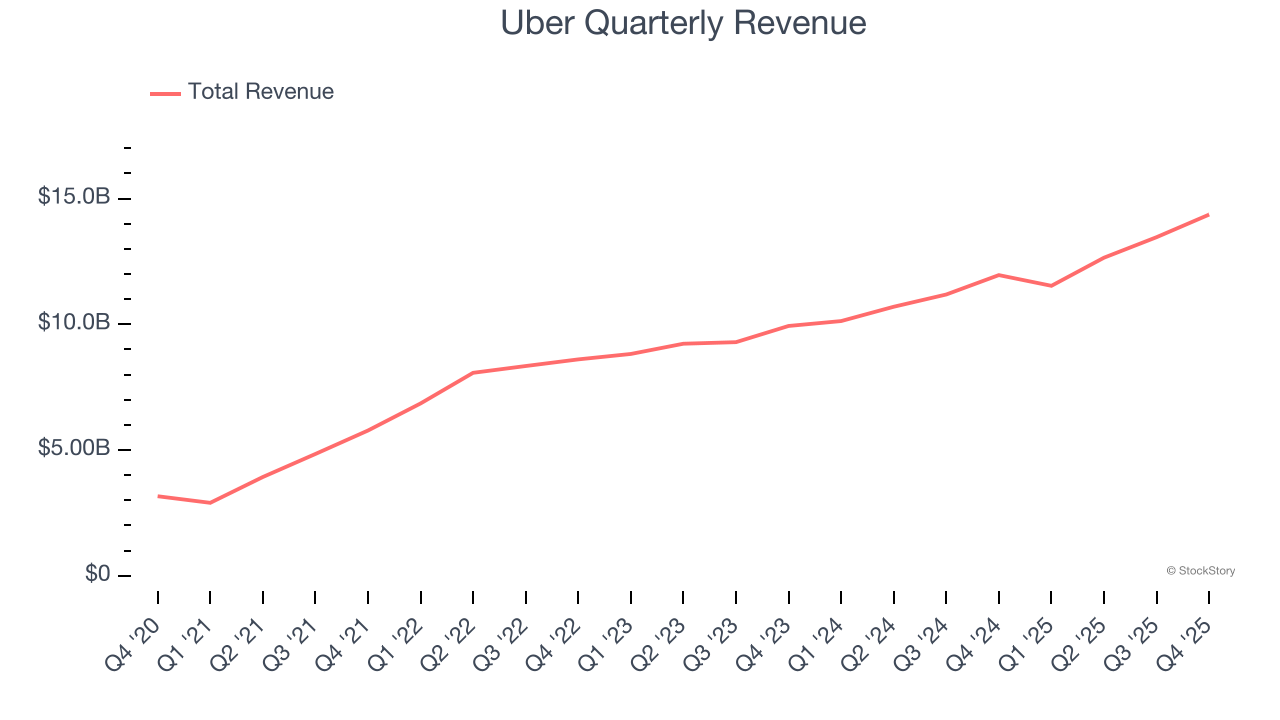
This quarter, Uber’s year-on-year revenue growth of 20.1% was excellent, and its $14.37 billion of revenue was in line with Wall Street’s estimates.
Looking ahead, sell-side analysts expect revenue to grow 16.7% over the next 12 months, similar to its three-year rate. We still think its growth trajectory is attractive given its scale and indicates the market is baking in success for its products and services.
The 1999 book Gorilla Game predicted Microsoft and Apple would dominate tech before it happened. Its thesis? Identify the platform winners early. Today, enterprise software companies embedding generative AI are becoming the new gorillas. a profitable, fast-growing enterprise software stock that is already riding the automation wave and looking to catch the generative AI next.
Monthly Active Platform Consumers
User Growth
As a gig economy marketplace, Uber generates revenue growth by expanding the number of services on its platform (e.g. rides, deliveries, freelance jobs) and raising the commission fee from each service provided.
Over the last two years, Uber’s monthly active platform consumers, a key performance metric for the company, increased by 15.1% annually to 202 million in the latest quarter. This growth rate is among the fastest of any consumer internet business and indicates its offerings have significant traction. 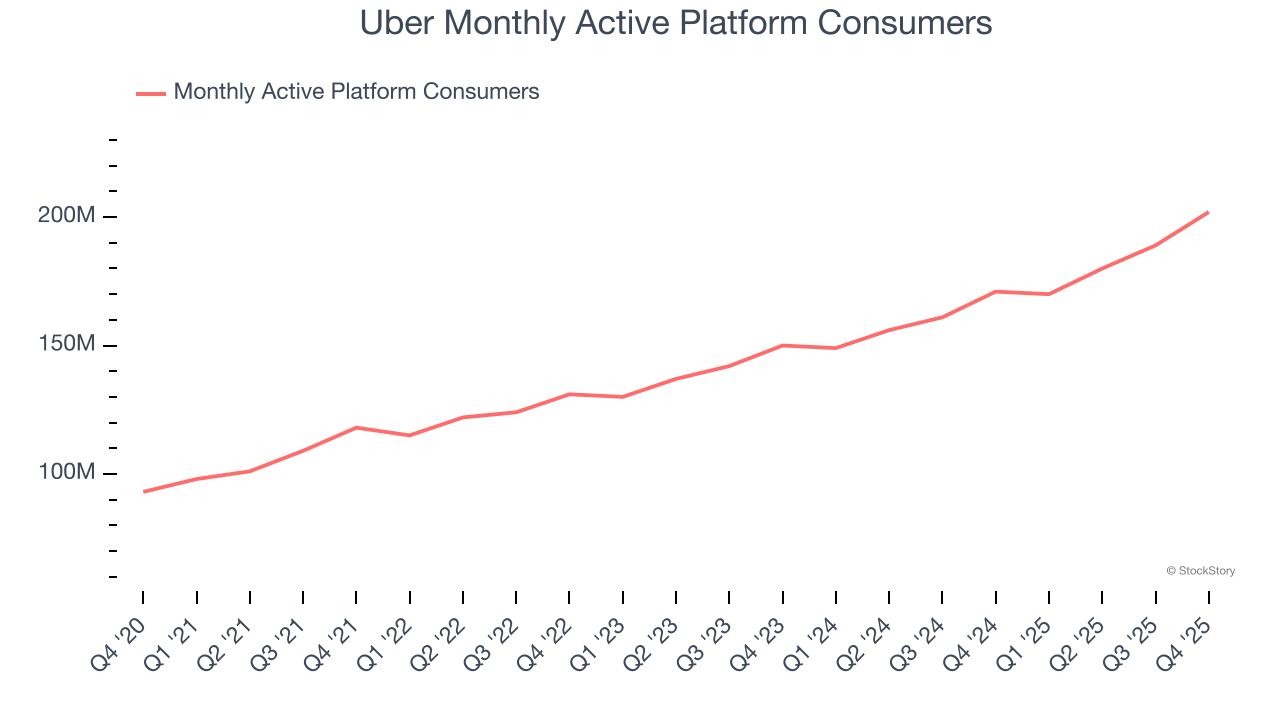
In Q4, Uber added 31 million monthly active platform consumers, leading to 18.1% year-on-year growth. The quarterly print was higher than its two-year result, suggesting its new initiatives are accelerating user growth.
Revenue Per User
Average revenue per user (ARPU) is a critical metric to track because it measures how much the company earns in transaction fees from each user. This number also informs us about Uber’s take rate, which represents its pricing leverage over the ecosystem, or "cut" from each transaction.
Uber’s ARPU growth has been subpar over the last two years, averaging 2.5%. This isn’t great, but the increase in monthly active platform consumers is more relevant for assessing long-term business potential. We’ll monitor the situation closely; if Uber tries boosting ARPU by taking a more aggressive approach to monetization, it’s unclear whether users can continue growing at the current pace. 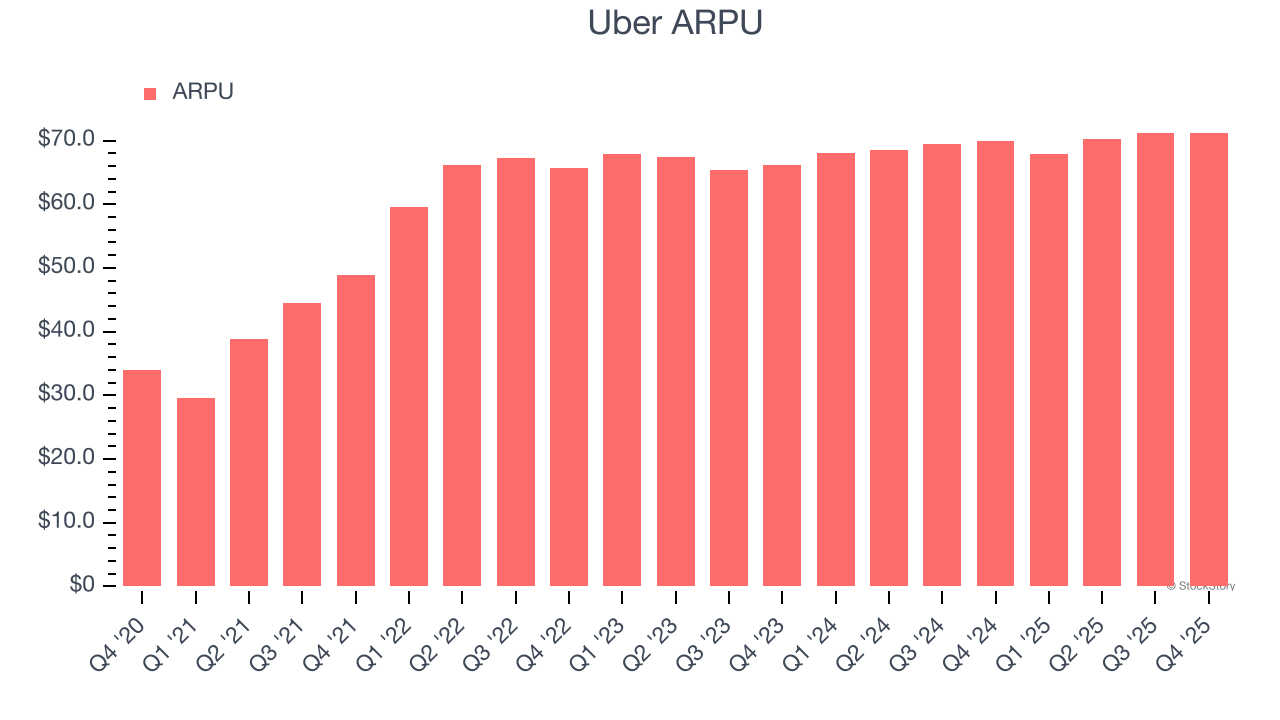
This quarter, Uber’s ARPU clocked in at $71.12. It grew by 1.7% year on year, slower than its user growth.
Key Takeaways from Uber’s Q4 Results
It was great to see Uber increase its number of users this quarter. We were also happy its number of monthly active platform consumers outperformed Wall Street’s estimates. On the other hand, revenue and EBITDA were both just roughly in line. The market seemed to be hoping for more, and the stock traded down 8.8% to $71.08 immediately following the results.
So should you invest in Uber right now? We think that the latest quarter is only one piece of the longer-term business quality puzzle. Quality, when combined with valuation, can help determine if the stock is a buy. We cover that in our actionable full research report which you can read here (it’s free).