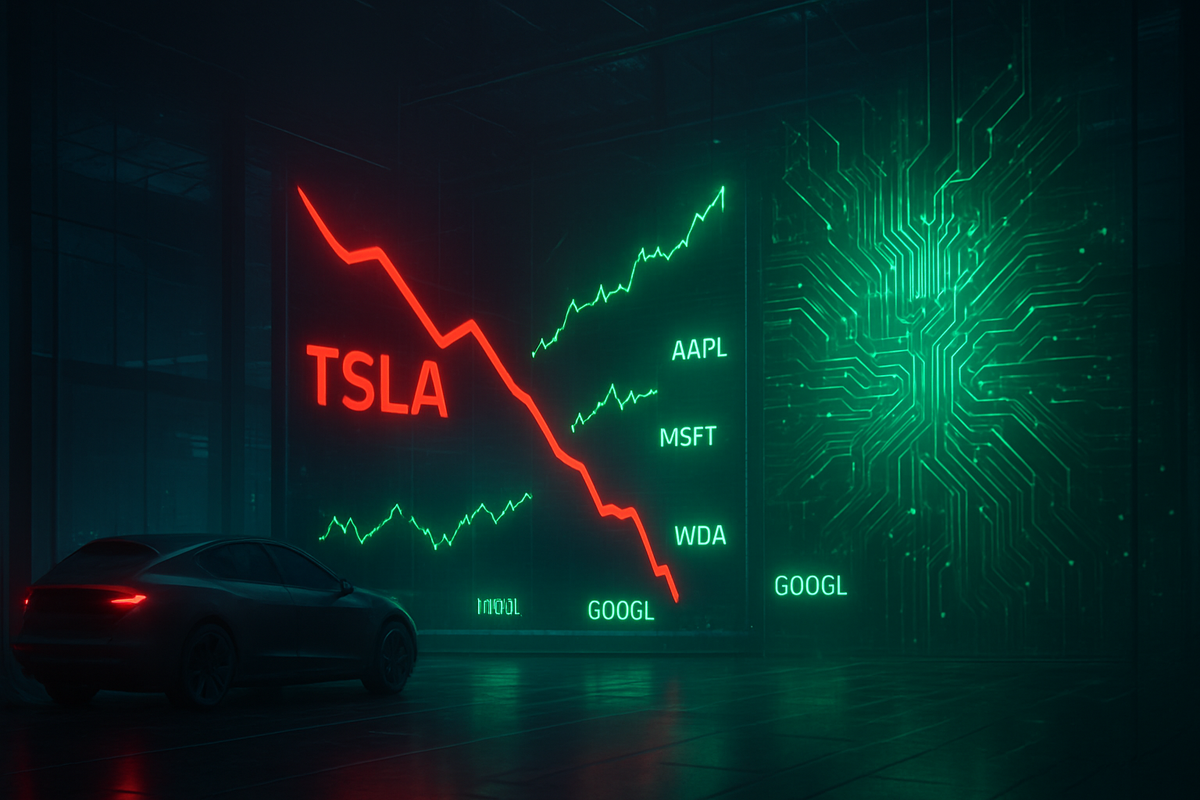
On February 10, 2025, the narrative of the "Magnificent Seven" faced its most significant stress test to date. While the broader technology sector enjoyed a robust rally fueled by artificial intelligence optimism and strong corporate earnings, Tesla (NASDAQ: TSLA) emerged as the glaring outlier. The electric vehicle pioneer saw its shares tumble by 3.0%, making it the sole decliner among its mega-cap peers on a day when the Nasdaq Composite and S&P 500 marched higher.
This divergence signaled a deepening "Great Decoupling" in the market. While companies like Nvidia (NASDAQ: NVDA) and Meta Platforms (NASDAQ: META) continued to ride the high-margin wave of AI monetization, Tesla found itself tethered to the harsh realities of the global automotive market. The 3% slide was not merely a daily fluctuation but a symptom of growing investor skepticism regarding Tesla's valuation in the face of cooling EV demand and competitive pressures from both domestic and international rivals.
A Day of Divergence: Inside the February 10 Sell-off
The trading session on February 10, 2025, began with an optimistic backdrop for technology. Nvidia (NASDAQ: NVDA) surged 2.9% following a glowing "Tactical Outperform" designation from Evercore ISI, while Meta Platforms (NASDAQ: META) gained 1.2%, extending its historic winning streak to 16 consecutive sessions. However, the mood for Tesla was somber from the opening bell. The primary catalyst for the sell-off was a series of devastating registration reports from Europe. Data revealed that Tesla’s January sales in Germany had plummeted by 60%, while registrations in Norway—a traditional stronghold for the brand—collapsed by a staggering 88%.
The timeline of this decline was compounded by a strategic downgrade from UBS analyst Joseph Spak, who slashed delivery forecasts for 2025 to 1.7 million units, citing an "aging fleet" and a saturated premium EV market. Throughout the day, the stock faced relentless pressure as investors processed the implications of Tesla’s shrinking market share. Simultaneously, a report surfaced indicating a 28% year-over-year decline in high-margin regulatory credit revenue, a vital profit driver that had historically buffered Tesla's bottom line. By the closing bell, Tesla had shed nearly $25 billion in market capitalization, while the rest of the Magnificent Seven added over $150 billion in combined value.
Winners, Losers, and the Shifting EV Landscape
The winners of the day were clearly defined by their proximity to the AI infrastructure boom. Nvidia (NASDAQ: NVDA) and Meta Platforms (NASDAQ: META) led the charge, with the former benefiting from increased production capacity at partner TSMC (NYSE: TSM) and the latter proving its ability to turn AI engagement into tangible advertising revenue. Interestingly, the day also saw a rare moment of divergence within the EV sector itself. While Tesla struggled, Rivian (NASDAQ: RIVN) actually rose 3.4%. Rivian’s gain was driven by the announcement that it would open its Electric Commercial Van (ECV) platform to all businesses, a move seen as a smart diversification away from the stalling consumer SUV market.
The primary losers were Tesla retail and institutional investors who had banked on the stock's "tech premium" remaining intact. For much of 2023 and 2024, Tesla had been traded as a high-growth software company. However, the events of early 2025 forced a painful re-evaluation. Traditional automakers like Volkswagen (OTC:VWAGY) and luxury brands like Porsche were beginning to eat into Tesla’s European dominance, leaving Tesla caught in a "no-man's-land" between a struggling car manufacturer and a yet-to-be-proven robotics company.
The "Great Decoupling": How the Magnificent Seven Became Six
The performance on February 10, 2025, fits into a broader trend that market analysts have dubbed the "Great Decoupling." For years, the Magnificent Seven moved in a semi-correlated pack, driven by low interest rates and the digital transformation. However, as 2025 progressed, a clear rift opened. The "Magnificent Six"—consisting of Apple (NASDAQ: AAPL), Microsoft (NASDAQ: MSFT), Alphabet (NASDAQ: GOOGL), Amazon (NASDAQ: AMZN), Meta, and Nvidia—remained tethered to the software and AI revolution, which boasted higher margins and clearer growth trajectories.
Tesla’s struggle mirrors historical precedents where a market leader fails to transition from its initial disruptive phase into a sustainable, multi-cycle giant. Much like Cisco in the post-dot-com era, Tesla is finding that hardware-centric businesses are susceptible to cyclicality and price wars in a way that software-as-a-service (SaaS) or chip-design businesses are not. This event forced major index funds and institutional desks to begin discussing the "Magnificent Seven ex-Tesla" as the new benchmark for tech performance, effectively demoting the EV giant to a specialized industrial play in the eyes of many.
Looking Ahead: Can Tesla Reclaim Its Tech Crown?
In the short term, Tesla faces a grueling climb to restore investor confidence. The company's pivot toward "Physical AI"—specifically the Optimus humanoid robot and the Cybercab autonomous taxi—remains a high-stakes gamble. For Tesla to reclaim its position alongside Nvidia and Meta, it must prove that its AI efforts can generate the same immediate cash-flow results as Meta's ad algorithms or Microsoft's Azure AI services. Many analysts believe the company will require a significant strategic pivot, perhaps through a lower-priced "Model 2" to recapture market share in the budget-conscious $25,000–$30,000 segment.
Long-term, the challenge is regulatory and operational. While Elon Musk’s involvement in government efficiency initiatives has gained headlines, the core of the business remains dependent on manufacturing and global logistics. Should the Cybercab face further regulatory delays or should European tariffs on EVs intensify, Tesla may find itself further isolated from the broader tech rally. The market is no longer willing to grant Tesla an infinite "growth pass"; it is now demanding the same fundamental execution seen in the rest of the tech elite.
Final Verdict: The 2025 Market Reset
The events of February 10, 2025, serve as a stark reminder that the "Magnificent Seven" was never a permanent monolith. The 3% drop in Tesla (NASDAQ: TSLA) shares, contrasted with the record-breaking streaks of Meta (NASDAQ: META) and the relentless climb of Nvidia (NASDAQ: NVDA), highlighted a fundamental shift in what the market values: high-margin, scalable AI. Tesla’s struggle to maintain pace with the "Sensational Six" underscores the difficulty of scaling a hardware-intensive business in an increasingly software-dominated investment climate.
Moving forward, investors should watch for Tesla's upcoming quarterly margins and the progress of its Full Self-Driving (FSD) adoption rates. If FSD revenue does not begin to offset the decline in vehicle hardware margins, the decoupling seen in early 2025 could become a permanent divorce. For the broader market, the lesson is clear: even the most dominant market leaders are not immune to the gravitational pull of fundamental earnings reality and regional economic headwinds.
This content is intended for informational purposes only and is not financial advice.