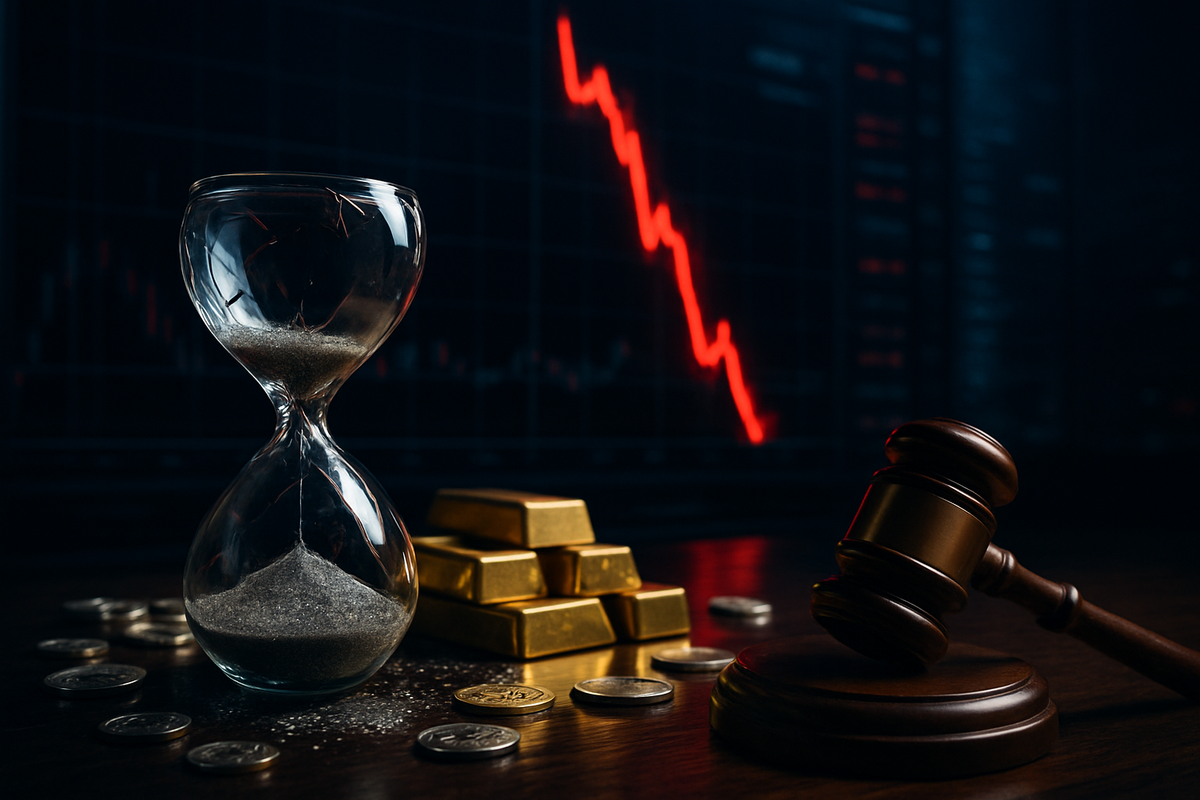
The global financial landscape was rocked on Friday, January 30, 2026, by a violent "flash crash" in the precious metals markets, wiping out trillions in paper wealth in a matter of hours. Gold, the perennial safe-haven asset, plummeted a staggering 9.5% to settle at $4,861 per ounce, while silver suffered an even more brutal fate, crashing 27% to $84 per ounce. This seismic shift represents the worst single-day decline for both metals since the infamous 1980 "Silver Thursday," sending shockwaves through Wall Street and Main Street alike.
The carnage was triggered by President Trump’s high-stakes nomination of Kevin Warsh as the next Chair of the Federal Reserve. Markets immediately interpreted the move as a decisive pivot toward a "hard money" regime and a terminal blow to the "debasement trade" that had fueled a multi-year rally in non-yielding assets. As the news hit the wires, a massive liquidation cascade ensued, forcing leveraged investors to flee positions as the prospect of a hawkish, Volcker-esque central bank became the new reality.
The "Warsh Washout": A Timeline of the Collapse
The session began with a sense of nervous anticipation as rumors swirled regarding the successor to the Federal Reserve chairmanship. At approximately 1:30 PM ET, the official announcement of Kevin Warsh’s nomination crossed the Bloomberg terminals. Warsh, a former Fed Governor known for his critical stance on quantitative easing and his advocacy for balance sheet discipline, was viewed as the ultimate "monetary hawk." For a market that had spent the last two years betting on continued fiscal deficits and monetary accommodation—the so-called "debasement trade"—this was a worst-case scenario.
Within minutes of the announcement, the iShares Gold Trust (NYSEARCA: GLD) and the iShares Silver Trust (NYSEARCA: SLV) saw unprecedented sell-side volume. As the price of gold broke through key technical support levels near $5,200, automated trading algorithms and margin calls accelerated the decline. Silver, which is notoriously more volatile due to its smaller market cap and industrial applications, saw a total "air pocket" in liquidity. The metal fell from over $115 to $84 in a dizzying descent that left floor traders stunned.
By the time the closing bell rang on Friday, the scale of the destruction was clear. The CME Group was forced to implement multiple circuit breakers to halt the slide, but the damage was done. Analysts noted that the crash was not merely a technical correction but a fundamental repricing of risk. The era of "easy money" and the fear of currency devaluation, which had pushed gold to record heights, appeared to have vanished in a single afternoon of aggressive selling.
Winners and Losers: Mining Giants and Financial Safe Havens
The mining sector bore the brunt of the immediate equity fallout. Industry leader Newmont Corporation (NYSE: NEM) saw its shares dive as investors recalculated the net present value of its future production at significantly lower price points. Similarly, Barrick Gold Corporation (NYSE: GOLD) faced intense selling pressure, dropping double digits as its high-cost projects suddenly looked less viable in a sub-$5,000 gold environment.
The silver miners were hit even harder. Pan American Silver Corp. (NASDAQ: PAAS) and First Majestic Silver Corp. (NYSE: AG) saw their valuations crater, with some junior miners across the sector losing nearly a third of their market cap in a single session. These companies, which act as leveraged plays on the underlying metal, found themselves in the crosshairs of a market that was no longer willing to pay a premium for speculative growth in the metals space.
Conversely, the U.S. Dollar Index (DXY) surged to multi-year highs as the nomination signaled a return to a stronger currency policy. Large-cap financial institutions, such as JPMorgan Chase & Co. (NYSE: JPM) and Goldman Sachs Group Inc. (NYSE: GS), saw their stock prices stabilize or rise as the prospect of higher interest rates and a more traditional monetary framework promised better net interest margins. Investors began shifting capital away from "hard assets" and back into interest-bearing dollar-denominated securities, effectively reversing the capital flows of the previous 24 months.
A Historical Pivot: Beyond the Debasement Trade
To understand the magnitude of the January 30 crash, one must look back to the 1980 silver crisis involving the Hunt brothers. Like that historic event, the 2026 crash was a product of a "crowded trade" meeting a sudden shift in regulatory and monetary sentiment. However, while 1980 was driven by a small group of individuals, the 2026 "Warsh Washout" was a systemic rejection of the narrative that the U.S. dollar was in a state of terminal decline.
For several years, the "debasement trade" had been the dominant theme for hedge funds and retail "gold bugs" alike. The theory was simple: as the U.S. debt ballooned, the Fed would be forced to keep rates low and print money to keep the system solvent, making gold and silver the only reliable stores of value. Kevin Warsh’s nomination effectively "killed" this narrative. By appointing a hawk who is willing to prioritize price stability over debt monetization, the administration signaled a willingness to accept short-term market pain for long-term fiscal discipline.
This event is likely to have ripple effects across all asset classes, including the cryptocurrency market. Bitcoin, which many had labeled "digital gold," also saw a significant pullback on Friday as the "hard money" mantle was reclaimed by the Fed itself. The policy implications are clear: the Federal Reserve is preparing to take a much more aggressive stance on inflation and the money supply, a move that could fundamentally alter the correlation between traditional and alternative assets for years to come.
What Comes Next: Navigating the New Monetary Reality
In the short term, market participants should prepare for continued volatility as the "paper" markets for gold and silver seek a new equilibrium. Margin calls are likely to continue through early February, potentially leading to further "forced selling" as hedge funds liquidate other assets to cover their losses in precious metals. Strategic pivots will be required for institutional portfolios that were heavily overweight in the "debasement" theme; we may see a massive rotation into value stocks and short-duration Treasuries.
Long-term, the focus will shift to Kevin Warsh’s confirmation hearings and his first official statements as Fed Chair-designate. If he maintains his hawkish rhetoric, gold and silver may enter a prolonged "bear market" similar to the 1980s and 90s. However, some contrarian analysts suggest that if the aggressive tightening leads to a broader economic slowdown, the demand for gold as a recession hedge could eventually return—albeit from a much lower price base.
The "Warsh Washout" has created a high-stakes environment for miners. Companies like Newmont and Barrick will likely need to focus on cost-cutting and dividend protection to maintain investor confidence. The era of aggressive expansion based on $6,000 gold projections is over. Efficiency and balance sheet strength will be the new watchwords for the mining industry in this leaner, more disciplined era.
Closing Thoughts: A Regime Change for the Markets
The events of January 30, 2026, will be remembered as a turning point in financial history. The 9.5% drop in gold and the 27% collapse in silver were more than just price movements; they were a vote of confidence in a new direction for American monetary policy. By nominating Kevin Warsh, the administration has signaled that the period of runaway fiscal and monetary expansion has reached its limit.
For investors, the key takeaway is that the "rules of the game" have changed. The tailwinds that pushed precious metals to record highs have turned into fierce headwinds. Moving forward, the strength of the U.S. dollar and the trajectory of real interest rates will be the primary drivers of market sentiment. The "debasement trade" may not be dead forever, but it is certainly in a deep hibernation.
As we move into the coming months, all eyes will be on the Federal Reserve and the data coming out of the U.S. Treasury. Investors should watch for signs of systemic stress caused by the crash, but they should also be alert to the opportunities created by this massive repricing. The gold and silver markets have been reset; whether this is a "buying opportunity" or the start of a multi-decade decline remains the most critical question in finance today.
This content is intended for informational purposes only and is not financial advice.