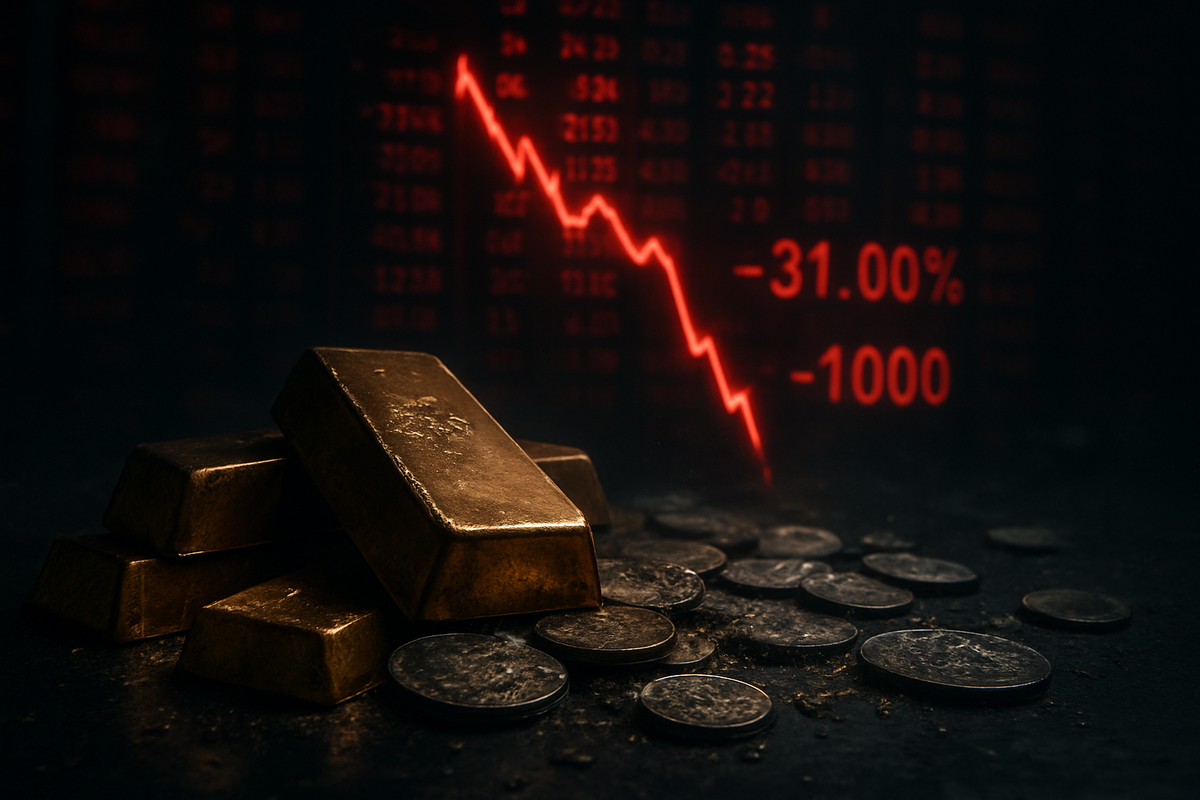
The global financial markets were rocked on February 2, 2026, as a historic "parabolic" rally in precious metals came to a violent and sudden end. Gold, which had shattered records to reach a peak of over $5,600 an ounce in late January, experienced a breathtaking $1,000-per-ounce collapse, while silver suffered a record-breaking 31% single-day decline. The twin pillars of the 2025 "anti-fiat" trade crumbled under the weight of a hawkish shift in Federal Reserve leadership and aggressive regulatory intervention, leaving investors scrambling to assess the wreckage of a $15 trillion market-value liquidation.
The magnitude of the sell-off has sent shockwaves across global exchanges, marking the most volatile 48-hour period for bullion since the Hunt Brothers' silver cornering attempt in 1980. For silver, the drop to approximately $83 per ounce from its high of $122 represents a total reset of the year’s gains, while gold’s retreat to the $4,400–$4,600 range has forced a massive re-evaluation of the "de-dollarization" narrative that fueled the asset's 65% rise in 2025. This "February Massacre" has effectively ended the speculative mania that characterized the market for the past six months, signaling a new, more sober era for hard assets.
The Perfect Storm: Margin Hikes and the Hawkish Pivot
The catalyst for the meltdown was a "one-two punch" of monetary policy and regulatory tightening. On the morning of February 2, 2026, the CME Group (NASDAQ: CME) announced an unprecedented 36% hike in maintenance margins for silver futures and a 33% hike for gold. This forced over-leveraged speculators—many of whom had entered the market during the FOMO-driven rally of late 2025—to liquidate their positions instantly to meet margin calls. This created a classic "selling begets selling" cascade, as stop-loss orders were triggered across the board, sucking liquidity out of the market in a matter of minutes.
Simultaneously, the political landscape in Washington shifted the market's fundamental outlook. The nomination of Kevin Warsh to succeed Jerome Powell as Federal Reserve Chair caught markets off guard. While many investors had expected a more dovish appointee who would succumb to political pressure for rate cuts, Warsh is widely viewed as a hawkish institutionalist. His nomination signaled to the market that the era of "easy money" and the Fed's tolerance for high inflation might be ending sooner than anticipated. The U.S. Dollar Index (DXY) surged in response, providing the final shove to gold prices that were already teetering on a technical precipice.
This correction followed a period of extreme "crowdedness" in the precious metals trade. By mid-january 2026, sentiment indices showed that positioning in gold was at an 8-year high, with retail investors pouring into the iShares Silver Trust (NYSE Arca: SLV) and physical bullion at record rates. The market had become highly sensitive to any macro shift, and the "Warsh Surprise" provided the exact shock needed to burst the speculative bubble.
Mining Giants and Industrial Beneficiaries: Winners and Losers
The immediate losers of the crash are the major gold and silver producers, whose valuations were tied to the astronomical prices of late 2025. Newmont (NYSE: NEM), led by CEO Natascha Viljoen, saw its stock pull back significantly from its $150 peak, though the company remains a cash-flow powerhouse due to its "Project Catalyst" initiative, which has kept all-in sustaining costs (AISC) relatively low. Similarly, Barrick Gold (NYSE: GOLD) faced a double-digit percentage decline in its share price, despite its strategic pivot toward copper production at its Reko Diq and Lumwana mines, which provided some buffer against the precious metals rout.
Conversely, the industrial sector may find a silver lining in the lower metal prices. Companies in the artificial intelligence and green energy sectors have been struggling with soaring input costs. Silver is a "non-negotiable" component in AI data center hardware and solar photovoltaic cells. For a company like First Solar (NASDAQ: FSLR), the 31% drop in silver prices offers much-needed relief for their manufacturing margins. Similarly, tech giants like NVIDIA (NASDAQ: NVDA), which rely on silver for high-conductivity components in AI GPUs, could see a reduction in supply chain costs if these lower prices stabilize.
Institutional "bears" who had been sidelined during the rally are also emerging as winners. Hedge funds that held short positions or stayed in cash are now looking at the correction as a generational entry point. While the "paper" market for gold and silver has been decimated, the underlying structural demand for physical metal remains tight, suggesting that those with long-term horizons and deep pockets are poised to benefit from the current panic.
A Historical Echo and the End of the Parabolic Move
The events of February 2, 2026, draw stark parallels to the silver crash of 1980 and the gold correction of 2011. In both historical instances, a period of unsustainable price appreciation was met by central bank tightening and exchange-level margin hikes. This event fits into a broader industry trend where "anti-fiat" assets become victims of their own success; as they rise high enough to threaten monetary stability, regulators and central banks inevitably move to cool the market.
The crash also highlights the fragility of the "de-dollarization" trade. While BRICS+ nations and central banks have been aggressive buyers of gold over the last two years, the sudden resurgence of the U.S. Dollar under a potentially hawkish Warsh-led Fed proves that the Greenback's demise may have been greatly exaggerated. This shift has massive ripple effects on global trade and commodity pricing, potentially slowing the momentum of the de-dollarization movement as emerging market currencies feel the heat of a stronger dollar once again.
Furthermore, the "silver squeeze" of early 2026, exacerbated by China’s stringent export controls on the metal, has now been neutralized by the price collapse. This regulatory environment remains a wild card; while prices have dropped, the physical shortage of silver for industrial use persists. The divergence between the "paper" price on the COMEX and the physical reality in industrial warehouses could lead to future volatility and potential regulatory probes into market manipulation.
The Road Ahead: Consolidation or Further Collapse?
In the short term, market analysts expect a period of "digestion." Most technical experts, including those at Fairlead Strategies, suggest that the market could face 8 to 12 weeks of sideways or slightly lower movement as it builds a new base. The "parabolic" move has been broken, and the market must now find a new equilibrium price that reflects both the hawkish Fed outlook and the reality of industrial demand. Investors should expect high volatility to continue as the market tests support levels around $4,200 for gold and $65 for silver.
Long-term, however, the fundamental bull case for precious metals is not entirely dead. JPMorgan and other major institutions maintain year-end gold targets as high as $6,000, citing the $340 trillion in global debt and the persistent structural deficit in silver mining. The current crash may be viewed in hindsight as a "healthy" correction that flushed out weak hands and prepared the market for a more sustainable, albeit slower, upward trajectory.
The strategic pivot for investors now involves moving away from speculative ETFs and toward "quality" mining stocks with strong balance sheets. The market has sent a clear message: the easy money has been made, and the next phase of the precious metals cycle will require a much more disciplined approach to risk management.
Summary and Investor Outlook
The "February Massacre" of 2026 will be remembered as the moment the precious metals super-cycle hit a wall of reality. With silver down 31% in a single day and gold losing $1,000 from its peak, the immediate takeaway is the danger of "crowded" trades and the power of the Federal Reserve to dictate market sentiment. Key players like Newmont (NYSE: NEM) and Barrick Gold (NYSE: GOLD) remain fundamentally strong but must navigate a much lower price environment in the coming quarters.
Moving forward, investors should watch for the official confirmation of Kevin Warsh as Fed Chair and any subsequent policy statements that could further strengthen the dollar. Additionally, monitoring the "physical-to-paper" premium in silver will be crucial for understanding if the industrial shortage will eventually force prices back up. For now, the market is in a "wait-and-see" mode, and caution is the order of the day.
This content is intended for informational purposes only and is not financial advice.