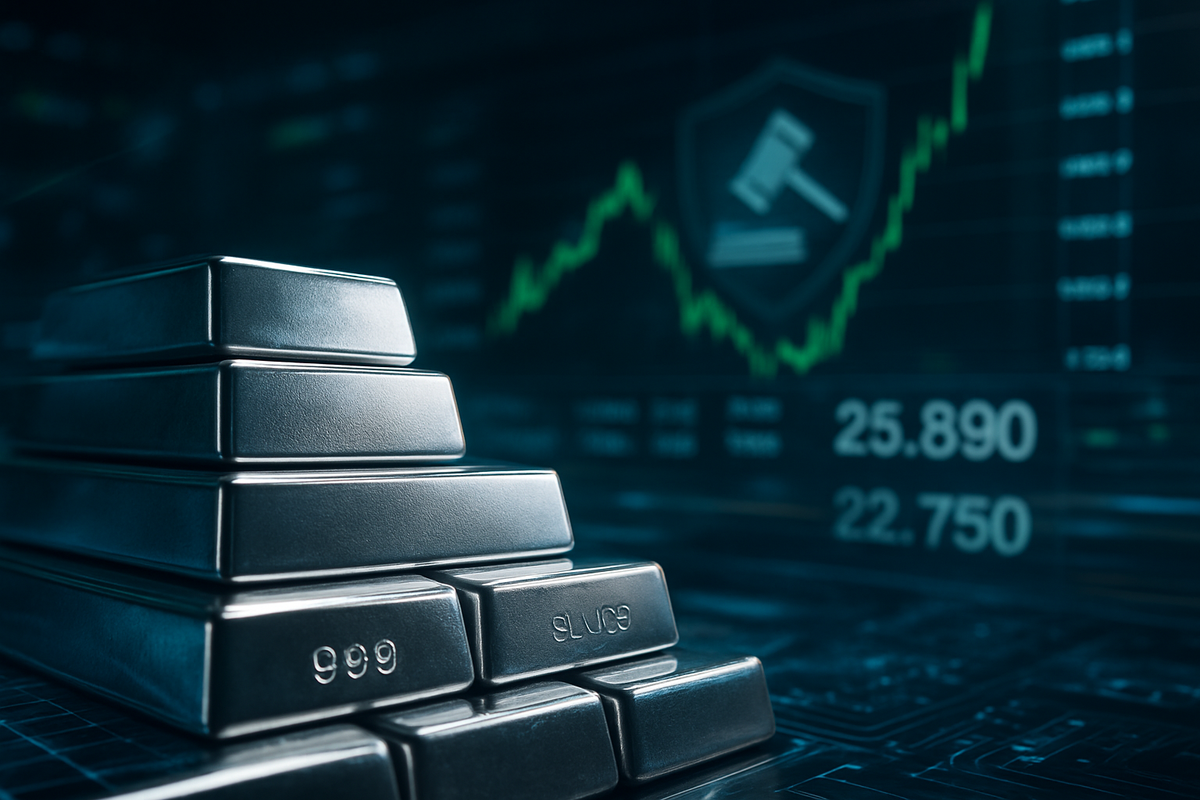
The silver market witnessed a historic and highly volatile trading session between January 6 and January 7, 2026, as spot prices breached the $80 mark for the first time in history. Driven by a "perfect storm" of geopolitical upheaval and a crippling supply shock from China, the white metal surged over 6% in the New York session on Tuesday, only to experience a "whipsaw" overnight rally that briefly touched $82.585 per ounce. This dramatic action has left investors in the iShares Silver Trust (NYSE Arca: SLV) and major mining stocks grappling with extreme price swings and aggressive regulatory interventions.
As the New York pre-market opened on the morning of January 7, the rally faced a sudden "liquidity vacuum," with prices retreating to $79.155 by 4:30 AM EST. This overnight volatility stood in stark contrast to the broader equity markets, where the S&P 500 continued its steady climb toward the 7,000-point milestone. The divergence highlights silver’s unique position as both a safe-haven asset and a critical industrial commodity, now caught in the crosshairs of global trade tensions and a frantic short squeeze.
A Night of Records and Regulatory Repercussions
The timeline of this historic surge began in earnest on the evening of January 6, 2026. Following news of the U.S. capture of Venezuelan President Nicolás Maduro, a global safe-haven frenzy sent precious metals higher. However, silver quickly outpaced gold, closing the New York session at $80.64. The momentum carried into the overnight Asian and London sessions, where silver futures on the COMEX reached an intraday high of $82.585. Simultaneously, on India’s Multi Commodity Exchange (MCX), prices hit a historic all-time high of Rs 2,59,692 per kilogram.
The catalyst for this unprecedented move was not just geopolitical; a fundamental supply shock provided the fuel. On January 1, 2026, China implemented a new, restrictive export licensing regime for silver, effectively "strangling" the global supply chain for the solar and artificial intelligence (AI) industries. As industrial users scrambled to secure physical bullion, "paper" speculators were caught in a massive short squeeze. To maintain market stability, the CME Group (NASDAQ: CME) intervened on the morning of January 7, implementing a massive 30% increase in maintenance margins for silver futures. This raised the requirement to $32,500 per contract—the fifth such hike in just nine days—designed to force speculative liquidations and protect bullion banks from systemic risk.
Winners and Losers in the Silver Squeeze
The primary beneficiaries of the price surge have been the "pure play" silver producers. First Majestic Silver Corp. (NYSE: AG), which derives nearly 60% of its revenue from silver, saw its stock price surge 9.86% on January 6 as investors sought direct exposure to the metal's breakout. Similarly, Pan American Silver Corp. (NYSE: PAAS) rose 4.48%, while junior explorer Silver North Resources Ltd. (TSXV: SNAG) emerged as a standout performer, jumping 16.3% on speculation that its high-grade deposits could become essential as the global supply deficit widens.
Conversely, the "losers" in this scenario include institutional short-sellers and industrial consumers who failed to hedge their silver requirements. Bullion banks, which often hold large short positions against retail and ETF buying, faced significant margin pressure. Even some major producers struggled; Fresnillo plc (OTC: FNLPF) saw its shares drop 3% on January 7 as the broader pullback in the London commodity sector and concerns over rising operational costs weighed on the stock. Furthermore, the iShares Silver Trust (NYSE Arca: SLV) exhibited significant "gap" behavior, closing at $73.68 on January 6 but gapping down to $71.45 in the January 7 pre-market, illustrating the risks of holding silver-linked ETFs during periods of extreme overnight volatility.
Broader Significance and Historical Precedents
This event marks a significant departure from traditional market correlations. While gold (NYSE Arca: GLD) also touched near-record highs of $4,500, silver’s "high-beta" nature resulted in much larger swings, reminding veteran traders of the 1980 Hunt brothers' attempt to corner the market and the 2011 price spike. However, the current environment is distinct due to the role of green energy and AI. Unlike previous spikes driven purely by inflation fears, the 2026 surge is underpinned by a structural deficit as China’s export restrictions collide with the massive silver demand required for high-efficiency solar panels and AI-optimized data centers.
The regulatory response from the CME Group also signals a new era of active market management. By aggressively hiking margins, regulators are attempting to prevent a repeat of the 2022 nickel market collapse on the LME. This "managed volatility" may prevent a total market meltdown, but it also creates a "liquidity trap" where only the most well-capitalized players can maintain positions. This could lead to a permanent shift in how silver is traded, moving away from speculative paper contracts toward physical delivery and private off-take agreements between miners and tech giants.
The Road Ahead: $100 Silver on the Horizon?
In the short term, the silver market is expected to remain a "battleground" of high volatility. The CME's margin hikes may cool the speculative fever temporarily, but they do nothing to address the underlying supply shortage caused by China’s trade policies. Market analysts are now looking toward the $100 per ounce mark as a psychological and technical target, provided the industrial demand remains inelastic. Companies in the solar and electronics sectors may be forced to announce strategic pivots, such as "thrifting" (using less silver) or seeking alternative materials, though such transitions often take years to implement.
For the remainder of early 2026, the market will likely see a consolidation phase as traders digest the recent gains. However, any further geopolitical escalations or additional supply-side constraints could easily reignite the rally. Investors should watch for potential "dip-buying" from institutional players who view the $75–$78 range as a new floor for the metal. The long-term trajectory appears skewed to the upside, but the path will likely be fraught with the same "whipsaw" action seen over the last 48 hours.
Final Assessment for Investors
The events of January 6 and 7, 2026, will be remembered as the moment silver finally decoupled from its historical "little brother" status to gold, asserting itself as a critical strategic asset. The key takeaway for investors is that the silver market has entered a regime of structural scarcity. While the overnight surge was breathtaking, the subsequent pullback serves as a stark reminder of the risks inherent in leveraged commodity trading and the power of exchange-mandated liquidations.
Moving forward, the market will be defined by the tension between industrial necessity and regulatory control. Investors should keep a close eye on China’s export data and any further margin adjustments from the CME. While the volatility is daunting, the fundamental supply-demand imbalance suggests that the "silver era" may only be beginning. For those holding long-term positions in miners like First Majestic or ETFs like SLV, the coming months will require a high tolerance for turbulence and a keen eye on the evolving geopolitical landscape.
This content is intended for informational purposes only and is not financial advice