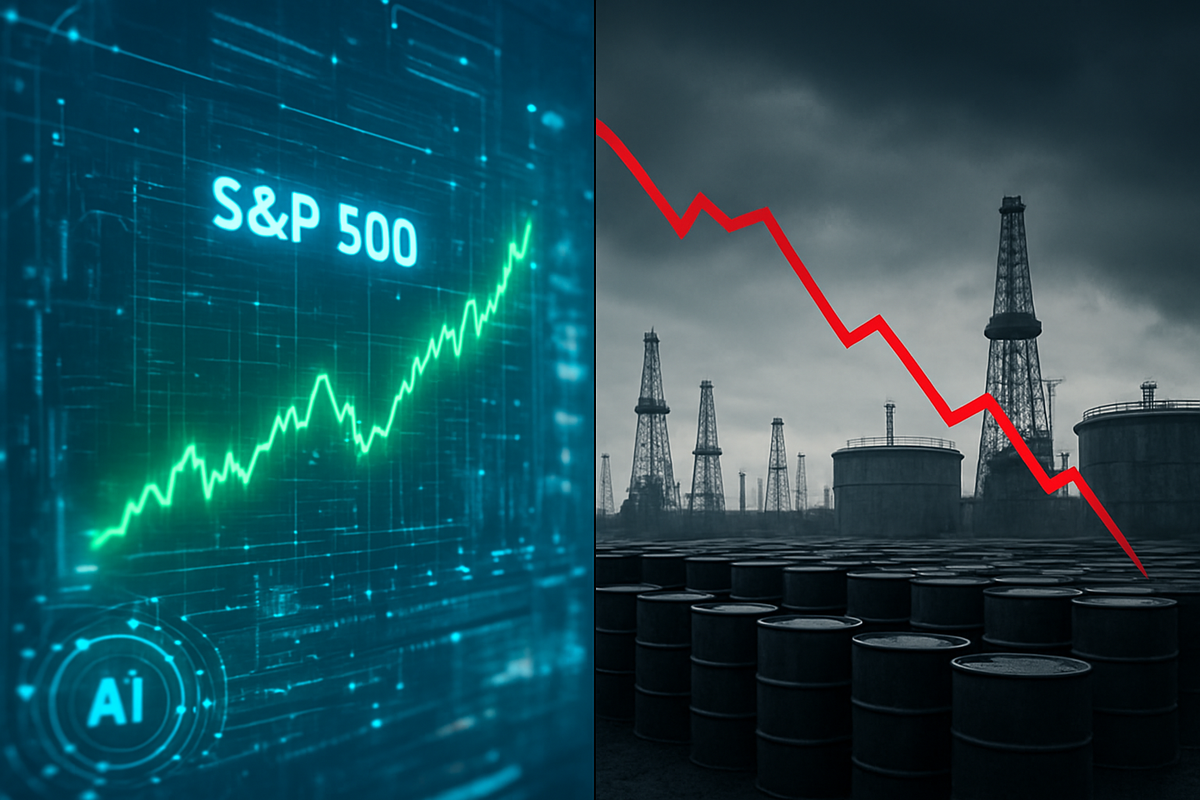
As of January 6, 2026, the American financial landscape presents a startling paradox. The S&P 500 has surged to a historic milestone, closing at an all-time high of 6,944.82, fueled by a relentless "Phase 2" AI revolution that has redefined market leadership. Yet, while tech giants and healthcare innovators propel the broader index to triple-digit gains, the energy sector remains a ghost at the feast. Once the powerhouse of the global economy, the Energy Select Sector SPDR (NYSE: XLE) has seen its influence dwindle to a near-record low of just 2.8% of the S&P 500’s total weight, struggling under the weight of a massive global supply glut and a structural decline in demand.
The immediate implications for investors are profound. The traditional "reflation trade" that often accompanies a booming stock market has decoupled from fossil fuels. Instead, capital is rotating from "barrels to electrons," as the market prioritizes the electricity needed to power AI data centers over the gasoline needed for internal combustion engines. Even a dramatic geopolitical shock in the first week of 2026—the U.S. military capture of Venezuelan President Nicolás Maduro—has only managed to provide a volatile, short-term spike to an otherwise moribund sector, highlighting just how much "black gold" has lost its luster in a rapidly decarbonizing world.
The Dynamics of Oversupply
The energy sector's current malaise is the result of a multi-year collision between record-breaking production and a fundamental shift in global consumption. Throughout 2025, the sector was the primary laggard in the market, with earnings per share (EPS) falling by approximately 9.2% even as the broader S&P 500 grew by 15%. This decline was driven by a relentless supply surplus that analysts at the International Energy Agency (IEA) now project will reach 3.8 to 4.1 million barrels per day (bpd) in 2026. This represents nearly 4% of global demand, a surplus level not seen since the height of the 2020 pandemic lockdowns.
The timeline leading to this imbalance began in late 2024 and accelerated through 2025 as U.S. shale producers defied expectations. Despite lower prices, the United States solidified its role as the world’s leading producer, reaching a record high of 13.61 million bpd in late 2025. This surge in domestic output effectively neutralized the efforts of OPEC+, which spent much of the last year in a "strategic pause." By January 2026, OPEC+ has been forced to roll over production quotas and halt planned output increases just to defend a price floor in the low-$60s for Brent crude, while West Texas Intermediate (WTI) continues to hover precially near $55.
The market reaction has been one of deep skepticism. While the first week of January 2026 saw a sudden 5% jump in the XLE following the news from Venezuela, the rally felt more like a "dead cat bounce" than a structural reversal. Investors quickly realized that while management of Venezuela’s reserves might shift to American hands, the global market is already awash in oil. The initial euphoria of the "Maduro capture" has given way to the reality that more supply—even from a stabilized Venezuela—only exacerbates the long-term glut.
Winners and Losers in a Saturated Market
In this environment of oversupply, the "winners" and "losers" are defined by their exposure to the changing energy mix. Chevron (NYSE: CVX) emerged as a rare short-term beneficiary of the recent geopolitical volatility, seeing its stock jump 6.5% on January 5 due to its existing operational footprint and historical ties to Venezuelan production. As the U.S. government looks to stabilize the region, Chevron is widely viewed as the primary vehicle for rehabilitating Venezuela’s aging infrastructure. Similarly, diversified energy service giants like SLB (NYSE: SLB) may find new life as they are called upon to modernize South American oil fields.
Conversely, pure-play upstream producers like Occidental Petroleum (NYSE: OXY) and ExxonMobil (NYSE: XOM) face a more challenging path. With WTI prices struggling to maintain levels above $60, profit margins for high-cost shale projects are being squeezed. ExxonMobil, despite its massive scale, has seen its stock underperform the S&P 500 by nearly 20% over the past 12 months as investors question the long-term value of its massive Permian Basin holdings in a world of "Peak Oil." These companies are now being forced into a "maintenance mode," prioritizing share buybacks and dividends over the aggressive growth that once defined the sector.
The broader market "winners" are arguably the tech titans like Microsoft (NASDAQ: MSFT) and Alphabet (NASDAQ: GOOGL), which benefit from the lower inflationary pressures that cheap energy provides. Furthermore, the shift in investor sentiment has favored the Utilities Select Sector SPDR (NYSE: XLU). As AI data centers demand unprecedented amounts of 24/7 power, investors are treating utility companies—particularly those with nuclear or renewable portfolios—as the "new energy" stocks, leaving traditional oil and gas companies in the rearview mirror.
A Structural Shift: The "Peak Oil" Reality
The wider significance of this divergence cannot be overstated; it marks a structural transition in the global economy. For the first time, the world is witnessing "Peak Oil" demand in its most critical growth market: China. As of early 2026, electric vehicles (EVs) account for over 50% of all new car sales in China, a milestone that has permanently eroded gasoline demand growth. The IEA reports that EVs are currently displacing approximately 1 million bpd of oil globally, a figure expected to quintuple by the end of the decade. This is not a cyclical downturn; it is a fundamental re-rating of fossil fuels as a sunset industry.
This trend mirrors the historical precedent of the coal industry’s decline in the early 21st century. Much like coal, oil is being marginalized not by a lack of supply, but by the arrival of cheaper, cleaner, and more efficient alternatives. The "Power Crunch" of 2026—where the demand for electricity is surging while the demand for transport fuel is stagnating—has created a ripple effect across the regulatory landscape. Governments are increasingly focusing on grid modernization and carbon capture rather than subsidizing new drilling, further isolating traditional energy companies from the policy tailwinds they once enjoyed.
Furthermore, the decoupling of energy prices from the S&P 500 suggests that the "old economy" rules of inflation are changing. Historically, high stock prices and a strong economy were synonymous with high oil prices. In 2026, the S&P 500’s record highs are being driven by productivity gains from AI and software, which are far less energy-intensive in terms of physical fuel than the industrial booms of the 20th century. This shift reduces the "geopolitical premium" that oil used to command, making the sector more sensitive to oversupply than to regional conflicts.
The Road Ahead: Consolidation and Adaptation
Looking ahead, the energy sector must undergo a period of painful consolidation. In the short term, we can expect a wave of M&A activity as larger players like ExxonMobil and Chevron use their remaining cash reserves to swallow up smaller, distressed shale producers. The goal will be "efficiency through scale," as companies attempt to lower their break-even prices to survive in a $50-$60 oil environment. Strategic pivots are already underway, with many firms rebranding themselves as "energy technology" companies, investing heavily in hydrogen and carbon sequestration to remain relevant to ESG-conscious institutional investors.
The long-term possibility remains that the energy sector will become a "utility-like" niche within the market—low growth, high dividend, and low valuation. The market opportunity is no longer in finding new oil, but in managing the decline of existing assets while capturing the "electron" market. For the energy sector to regain its status, a massive, unforeseen supply disruption would be required, or a total failure of the global EV transition—neither of which appears likely given current technological and political trajectories.
Final Assessment: A Sector in Transition
In summary, the energy sector’s struggle in the face of a record-breaking S&P 500 is a clear signal of a changing guard. The combination of record U.S. production, a strategic impasse by OPEC+, and the structural decline of demand in China has created a "hard ceiling" for oil prices that even significant geopolitical turmoil cannot easily shatter. The key takeaway for investors is that the energy sector is no longer a proxy for global economic health; it is a sector in transition, fighting to find its footing in an increasingly electrified world.
Moving forward, the market will likely continue to reward the "Power Crunch" winners—those providing the electricity and infrastructure for the AI age—while treating traditional oil stocks with caution. Investors should watch for the Brent price floor and the pace of EV adoption in emerging markets as the primary indicators of the sector's health. While the 2026 Venezuela shock provided a brief moment of excitement, the long-term trend remains clear: the age of oil dominance is fading, and the era of the electron has arrived.
This content is intended for informational purposes only and is not financial advice.