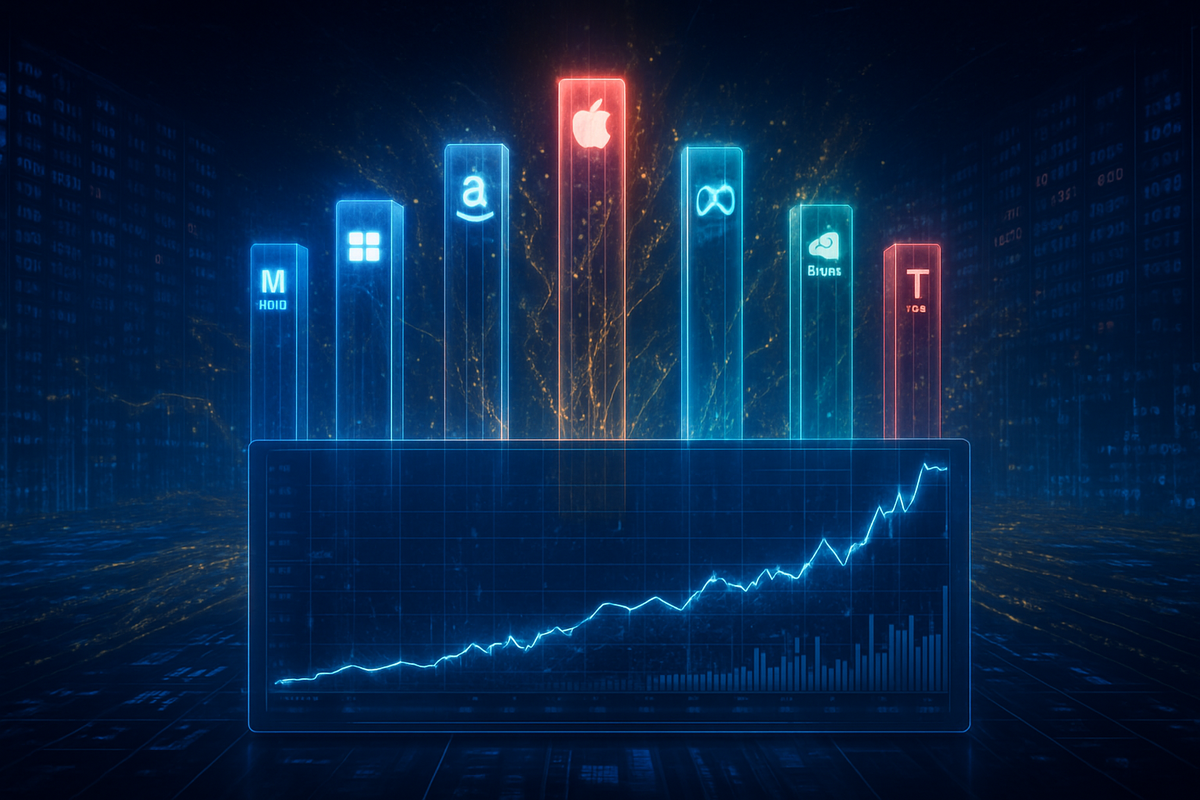
The "Magnificent Seven" technology titans enter the final week of January 2026 facing a paradox of their own making: while their financial might has never been greater, the expectations for their performance have reached a fever pitch. As of January 28, 2026, these seven firms now command a staggering 35% of the total market capitalization of the S&P 500. This unprecedented concentration has effectively turned the index into a high-stakes bet on the long-term viability of the Artificial Intelligence (AI) revolution, with the market’s direction tethered more tightly than ever to the results of a handful of corporate boardrooms.
The stakes for this Q4 2025 earnings cycle are exceptionally high as revenue growth across the group is projected to reach its most robust levels since the post-pandemic boom of 2022. While the broader market is searching for signs of a "soft landing" and continued disinflation, the Magnificent Seven are under pressure to prove that their massive capital investments in AI infrastructure are finally yielding tangible returns. For investors, the question is no longer whether these companies can grow, but whether they can grow fast enough to justify valuations that have decoupled from the rest of the equity market.
The Revenue Renaissance and the 35% Threshold
The current earnings season serves as a critical litmus test for the "AI ROI" (Return on Investment) thesis that dominated market sentiment throughout 2025. Leading the charge are Apple Inc. (NASDAQ: AAPL), Microsoft Corp. (NASDAQ: MSFT), Alphabet Inc. (NASDAQ: GOOGL), Amazon.com Inc. (NASDAQ: AMZN), NVIDIA Corp. (NASDAQ: NVDA), Meta Platforms Inc. (NASDAQ: META), and Tesla Inc. (NASDAQ: TSLA). Collectively, these firms are expected to post aggregate earnings growth of 20.4% for the fourth quarter of 2025, a figure that dwarfs the 4% growth projected for the remaining 493 companies in the S&P 500.
This divergence, often referred to by analysts as the "Profit Gap," has propelled the group’s weight in the S&P 500 to a record 35%. The timeline leading to this moment has been defined by a relentless accumulation of market share. In 2025 alone, the Magnificent Seven were responsible for nearly 50% of the index’s total returns. As of today’s reporting cycle, revenue growth for the broader S&P 500 is estimated at 8.4%, the highest level since the third quarter of 2022. This acceleration is largely credited to the "diffusion" of AI technology from the hardware layer—dominated by Nvidia—to the software and services layers where the rest of the group operates.
Early reactions from the trading floor suggest a "show me" attitude among institutional investors. While the 2023-2024 period was characterized by euphoria over AI’s potential, 2026 is being hailed as the "Year of Monetization." Market participants are scrutinizing not just the top-line revenue beats, but the sustainability of margins as these companies scale their AI-driven products.
The Winners and Losers of the AI Infrastructure Race
As the results trickle in this week, a clear hierarchy is emerging among the tech elite. Meta Platforms Inc. (NASDAQ: META) reported today, exceeding expectations with $59.9 billion in revenue, driven by a surge in AI-targeted advertising. However, the stock saw a muted reaction as the company signaled a massive 2026 capital expenditure (CAPEX) forecast of up to $135 billion, sparking fears about the sheer cost of maintaining an AI edge. Similarly, Microsoft Corp. (NASDAQ: MSFT) continues to see record demand for its Azure AI services, yet it remains hampered by capacity constraints, forcing it to project its own $100 billion CAPEX cycle for the coming year.
On the other hand, Tesla Inc. (NASDAQ: TSLA) provided a surprise beat earlier today, reporting $24.9 billion in revenue. While vehicle deliveries saw a slight decline, the company’s pivot toward its "Optimus" robotics program and autonomous "Robotaxis" appears to be stabilizing margins at 20.1%. Meanwhile, NVIDIA Corp. (NASDAQ: NVDA), the primary beneficiary of the hardware build-out, is transitioning from a "growth leader" to what many are calling a "foundational utility" for the global economy. Investors are now looking to its upcoming February 25 report to see if the demand for its latest generation of Blackwell chips can sustain its triple-digit growth trajectory.
The potential "losers" in this environment are not necessarily failing companies, but those whose growth rates are merely "excellent" rather than "extraordinary." Alphabet Inc. (NASDAQ: GOOGL) and Amazon.com Inc. (NASDAQ: AMZN) both face immense pressure to show that their proprietary AI models—Gemini and Olympus, respectively—are gaining market share against independent competitors. For these firms, anything short of a record-breaking quarter could trigger a "sell on the news" event as the market rebalances toward value-oriented sectors.
Broader Significance: The Risk of Concentration and the "Diffusion Phase"
The current market structure poses a significant systemic risk. With 35% of the S&P 500 concentrated in seven stocks, any earnings miss from a heavyweight like Apple Inc. (NASDAQ: AAPL) or Microsoft Corp. (NASDAQ: MSFT) can drag down the entire index, regardless of the health of the other 493 companies. This concentration is reminiscent of the Dotcom era, though proponents argue that, unlike the 2000s, today’s tech giants are backed by massive cash flows and fortress-like balance sheets.
The broader industry trend is shifting toward what economists call the "Diffusion Phase." As the Magnificent Seven spend an estimated $470 billion on AI infrastructure in 2026—up from $350 billion in 2025—the ripple effects are beginning to reach sectors like Energy (due to data center power needs), Utilities, and Healthcare. This "universal participation" is a healthy sign for the economy, but it creates a competitive "arms race" that may lead to regulatory pushback. In Europe and the U.S., antitrust regulators are increasingly wary of the "Big Four" hyperscalers—Amazon, Microsoft, Google, and Meta—and their ability to vertically integrate every layer of the AI stack.
Historically, periods of extreme market concentration have ended in one of two ways: a broad-based market correction or a "catch-up" rally where the laggards begin to outperform the leaders. The current expectation for revenue growth to reach 2022 levels suggests the latter is more likely, provided the Federal Reserve maintains its path of monetary normalization throughout 2026.
Looking Ahead: The Pivot to AGI and Regulatory Scrutiny
As we look toward the remainder of 2026, the strategic pivot for the Magnificent Seven will involve moving beyond "Generative AI" and toward "Artificial General Intelligence" (AGI) and autonomous agents. This transition will require even more capital, potentially squeezing margins for the next 18 to 24 months. The challenge for companies like Apple Inc. (NASDAQ: AAPL) will be integrating these advanced capabilities into consumer hardware in a way that sparks a new multi-year upgrade cycle, particularly in crucial markets like China.
In the short term, the market will likely see increased volatility as "priced for perfection" valuations—averaging 27x forward earnings for the group—clash with the reality of high interest rates and geopolitical uncertainty. Strategic adaptations will be required; we may see these giants engage in more aggressive stock buybacks or dividend increases to satisfy investors if AI growth begins to plateau in the latter half of the year.
Long-term scenarios suggest a world where these seven companies effectively become the "operating system" for the global economy. However, the emergence of sovereign AI projects in regions like the Middle East and Southeast Asia could present a new challenge to their dominance, forcing a shift from global expansion to defensive domestic strategies.
Wrap-Up: A Market at a Crossroads
The January 2026 earnings season for the Magnificent Seven is more than just a quarterly financial update; it is a defining moment for the modern equity market. The group's 35% weight in the S&P 500 signifies a level of dominance that makes them unavoidable for any serious investor. The key takeaway is that while revenue growth is returning to its 2022 peak, the cost of achieving that growth—the "Capex Reckoning"—is the new metric by which they will be judged.
Moving forward, the market’s health will depend on whether the "Profit Gap" between the tech elite and the rest of the index continues to narrow. If the "S&P 493" can sustain its projected recovery, we may see a healthy rotation of capital. However, if the Magnificent Seven are the only ones capable of producing double-digit growth, the market’s vulnerability to a single "black swan" event in the tech sector will remain at record highs.
Investors should watch for three things in the coming months: the specific guidance on AI monetization from Amazon and Alphabet, the impact of iPhone 17 sales on Apple’s services ecosystem, and any shifts in the Federal Reserve’s tone that could re-rate the high-multiple valuations of the group. For now, the "Magnificent Seven" remain the undisputed kings of Wall Street, but their crowns have never been more expensive to maintain.
This content is intended for informational purposes only and is not financial advice.