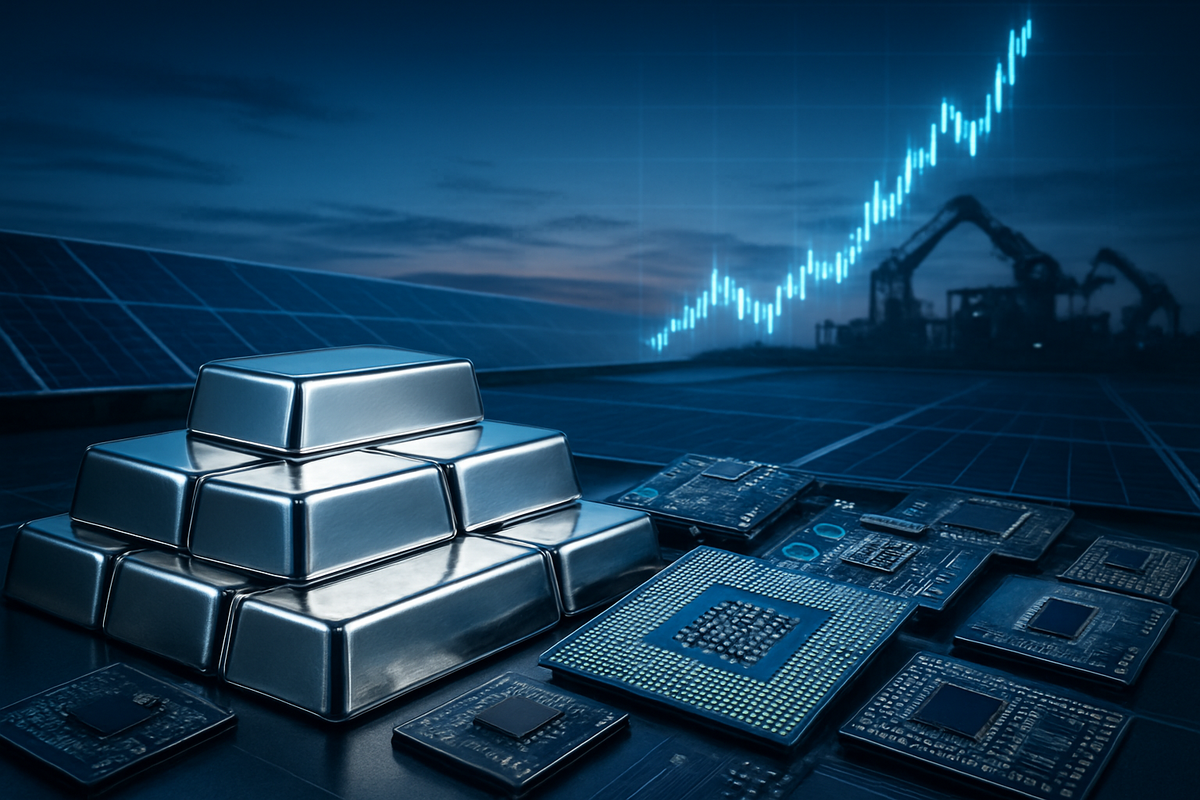
As of January 15, 2026, the global silver market has entered an unprecedented era of volatility and growth, culminating in what analysts are calling a "perfect storm" of supply and demand. Driven by a massive structural deficit and a pivot toward high-tech industrial applications, silver has decoupled from traditional market cycles. Over the past twelve months, the white metal has posted a staggering 180% gain, dwarfing the performance of gold and forcing institutional investors to re-evaluate the metal’s role as both an industrial essential and a monetary hedge.
The immediate implications are profound: physical silver inventories at major exchanges like the COMEX have reached decade lows, while the industrial sector—ranging from solar energy to artificial intelligence—is scrambling to secure long-term supply. With silver currently trading near $92 per ounce, the market is on a collision course with a triple-digit price point, a milestone that seemed nearly impossible just two years ago.
The Anatomy of a Deficit: How We Got Here
The current crisis is rooted in a persistent 200-million-ounce annual deficit that has plagued the market for five consecutive years. Global mine production has remained stagnant, hovering between 820 and 840 million ounces annually, largely because nearly 75% of silver is produced as a byproduct of lead, zinc, and copper mining. This means that even as silver prices skyrocket, supply cannot simply "turn on the tap" without a corresponding increase in the mining of base metals.
The timeline of this squeeze accelerated in late 2024 and throughout 2025 as the energy transition moved into high gear. Solar photovoltaics now account for approximately 15% to 20% of global silver supply, driven by the adoption of TOPCon cell technology, which requires 50% more silver than older models. Simultaneously, the explosion of artificial intelligence has made silver indispensable. As the most conductive metal on earth, silver is the "lifeblood" of the high-performance GPUs and tensor processing units produced by companies like Nvidia (NASDAQ: NVDA) and AMD (NASDAQ: AMD).
Market reaction has been swift and aggressive. Since January 2025, silver’s 180% rally has significantly outpaced gold’s 70% gain. This outperformance has caused the gold-to-silver ratio to collapse from nearly 100:1 to a tight 50:1 range. Investors who previously viewed silver as "gold’s volatile little brother" are now treating it as the premier asset for the green and digital revolution.
Winners and Losers in a Triple-Digit World
In this high-price environment, the primary winners are the "pure-play" miners. First Majestic Silver (NYSE: AG), which derives nearly 60% of its revenue from silver, has seen its valuation surge as its profit margins expand exponentially. Similarly, Pan American Silver (NYSE: PAAS) and Hecla Mining (NYSE: HL) are reaping the rewards of their massive reserve bases. These companies, along with Coeur Mining (NYSE: CDE), have seen record-breaking free cash flows, allowing them to accelerate exploration projects that were previously deemed uneconomical.
On the losing side of the ledger are the industrial consumers who failed to hedge against rising input costs. Solar giant First Solar (NASDAQ: FSLR) is facing a significant margin squeeze, as the silver paste used in its panels has become one of its most expensive components. In the automotive sector, Tesla (NASDAQ: TSLA) is feeling the pinch; a standard electric vehicle (EV) requires up to 50 grams of silver for its power electronics and sensors. The rising cost of silver is effectively adding hundreds of dollars to the production cost of every vehicle, complicating the industry’s push for more affordable mass-market EVs.
Technology giants like Samsung (KSE:005930) and Apple (NASDAQ: AAPL) are also under pressure. These firms are reportedly moving away from "just-in-time" inventory models for silver, instead opting for long-term supply contracts directly with miners to avoid production delays for their high-end electronics and burgeoning solid-state battery programs.
Beyond the Chart: Wider Industry Significance
The current silver rally is more than just a price spike; it represents a structural shift in how the world values industrial commodities. This event fits into a broader trend of "resource nationalism." On January 1, 2026, China implemented refined silver export curbs, further tightening the global market. This move has mirrored previous restrictions on rare earth elements, signaling that critical metals are now being used as geopolitical leverage.
Historically, silver has undergone massive "squeezes"—most notably the Hunt Brothers' attempt to corner the market in 1980. However, the 2026 squeeze differs because it is driven by industrial consumption rather than purely speculative hoarding. Unlike the 1980 event, where silver was largely used in photography and jewelry, today’s demand is "inelastic." You cannot build a high-efficiency solar grid or an AI data center without silver, regardless of the price.
This shift has significant regulatory implications. Governments in the U.S. and EU are now discussing whether silver should be added to their "Critical Minerals" lists, which would unlock federal subsidies for domestic mining and recycling. The ripple effect is also being felt in the recycling industry, where the "urban mining" of old electronics for silver content has suddenly become a multi-billion-dollar opportunity.
The Road to $110: What Comes Next?
Looking ahead, the market is laser-focused on the forecasts coming out of major financial institutions. Citigroup (NYSE: C) recently released a report projecting that silver could hit $100 per ounce by March 2026, with the potential to reach $110 per ounce by the second half of the year. This forecast is predicated on the continued drain of exchange inventories and the lack of new mining projects coming online in the short term.
In the near term, industrial users will likely attempt "thrifting"—the process of using less silver by substituting it with copper or aluminum. However, these substitutes often result in a loss of efficiency, which is unacceptable in the competitive AI and solar markets. Strategic pivots are already emerging; some EV manufacturers are exploring silver-free battery chemistries, though these technologies remain years away from commercial viability.
The potential for a "blow-off top" remains a risk. If silver hits $100 by March, a wave of retail speculation could drive the price even higher before a correction occurs. However, with a 200-million-ounce deficit still looming, any price dip is likely to be met with aggressive buying from industrial giants looking to secure their future production lines.
Final Assessment: The New Silver Reality
The silver market of 2026 is a far cry from the sleepy commodity market of the early 2000s. The metal has successfully transitioned from a secondary precious metal to a primary strategic asset. The key takeaway for investors is that the "perfect storm" of supply constraints and high-tech demand is not a temporary phenomenon but a structural reality that could persist for the remainder of the decade.
Moving forward, the market will be defined by its scarcity. Investors should keep a close watch on COMEX inventory levels and any further export restrictions from major producers like China and Mexico. As silver attempts to breach the $100 mark this spring, it will serve as a bellwether for the broader energy transition.
The era of cheap silver is over. Whether it settles at $90 or rockets to $110, the "perfect storm" has fundamentally re-anchored the value of this indispensable metal in the modern economy.
This content is intended for informational purposes only and is not financial advice.