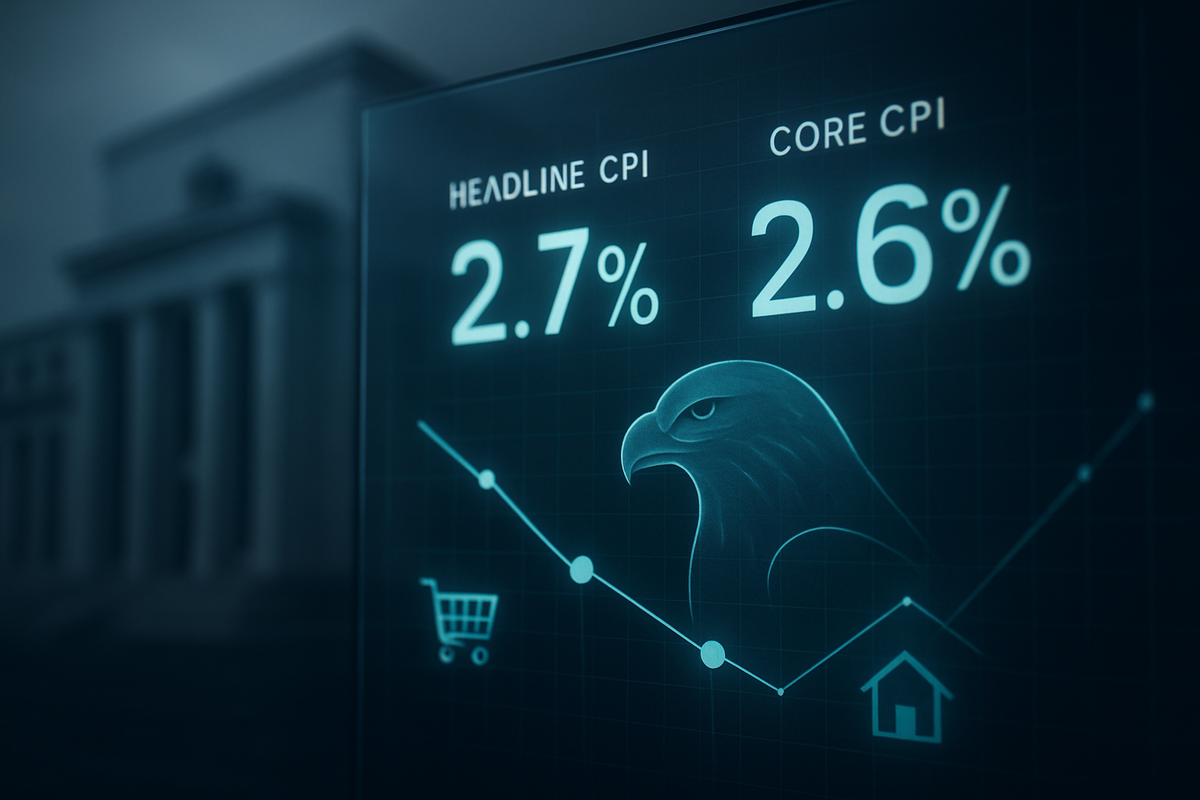
The latest inflation data has arrived, offering a nuanced picture of the American economy as it enters a pivotal year. On January 13, 2026, the Bureau of Labor Statistics released the Consumer Price Index (CPI) for December 2025, revealing that while price pressures are cooling, they remain stubbornly above the Federal Reserve’s long-term targets. Headline inflation held steady at 2.7% year-over-year, matching the previous month’s rate, while the closely watched Core CPI—which excludes volatile food and energy costs—dipped to 2.6%. This "beat" on the core front has provided a temporary sigh of relief for markets, yet it has not been enough to convince a divided Federal Reserve to accelerate its rate-cutting cycle.
The immediate implication of this release is a reinforced 'hawkish pause' from the central bank. After a series of three 'insurance cuts' in late 2025, the Federal Open Market Committee (FOMC) has signaled a desire to hold interest rates in the 3.50% to 3.75% range. For investors, the December report confirms that the 'Goldilocks' environment of 2025—characterized by falling inflation and supportive policy—is transitioning into a more complex 'Show-Me' market in 2026. The Fed is now walking a tightrope, attempting to prevent a labor market slowdown without reigniting inflation in sectors where costs remain elevated.
Steady Prices and Internal Friction: Breaking Down the December Data
The December CPI data showed a monthly increase of 0.3% in headline prices, driven largely by persistent costs in the service sector. Specifically, the shelter index rose 3.2% year-over-year, continuing its role as the primary engine of inflation. Surprisingly, a record 1.2% monthly jump in the recreation index also contributed to the upward pressure, suggesting that consumer demand for experiences remains robust despite higher borrowing costs. These gains were partially offset by a 2.3% decline in energy price inflation and a 1.1% drop in used vehicle prices, providing the 'core' moderation that the market celebrated.
This data follows a particularly contentious December FOMC meeting, where the central bank's leadership showed rare signs of public fracture. While the Fed delivered its third consecutive 25-basis-point cut to bring the benchmark rate to its current 3.50% – 3.75% range, the decision was met with three formal dissents. Governor Stephen Miran advocated for a more aggressive 50-basis-point cut to stave off labor weakness, while regional presidents Austan Goolsbee and Jeffrey Schmid argued for holding rates steady, citing the risk of a premature declaration of victory over inflation. This internal division highlights the uncertainty facing the committee as it enters the new year.
The market reaction to the January 13 release was relatively muted but tinged with caution. The Dow Jones Industrial Average shed 400 points on the day of the release, though much of this was attributed to a 4.2% slide in shares of JPMorgan Chase & Co. (NYSE: JPM) following its Q4 earnings report, rather than a direct rejection of the CPI data. Treasury yields edged slightly lower, with the 10-year yield settling near 4.18%, as bond traders priced in a slower, more deliberate path for the Fed in 2026 compared to the rapid easing seen in the latter half of 2025.
Corporate Divergence: Winners and Losers in a High-Rate World
The current interest rate path has created a bifurcated landscape for public companies. In the banking sector, JPMorgan Chase & Co. (NYSE: JPM) saw its stock decline despite record profits, as management warned that a narrowing Net Interest Margin (NIM) and a 'hawkish pivot' in 2026 could create headwinds. Conversely, retail-heavy giants like Bank of America Corp. (NYSE: BAC) and Wells Fargo & Co. (NYSE: WFC) are finding it increasingly difficult to navigate a flattening yield curve, where the spread between short-term and long-term rates remains historically tight.
In the housing market, homebuilders are experiencing a unique set of circumstances. D.R. Horton Inc. (NYSE: DHI) saw a 7.5% sentiment boost in early January following an executive order aimed at lowering mortgage rates through government-backed security purchases. However, the sector remains under pressure from an 'Institutional Buyer Exit' policy proposal, which threatens the rental segments of companies like Lennar Corp. (NYSE: LEN). These firms are now forced to balance high construction costs against the need to offer price incentives to maintain sales volume in a 6%+ mortgage rate environment.
The clear winners in this environment appear to be 'Consumer Defensive' stocks. Walmart Inc. (NYSE: WMT) and Costco Wholesale Corp. (NASDAQ: COST) have emerged as top picks for 2026, as they capture 'trade-down' traffic from higher-income households looking to mitigate the impact of rising utility and insurance costs. In the technology sector, the narrative has shifted toward 'duration risk.' While AI powerhouses like NVIDIA Corp. (NASDAQ: NVDA) and Meta Platforms Inc. (NASDAQ: META) continue to report massive earnings, their high valuations make them sensitive to any delay in rate cuts. Meanwhile, high-growth software firms like Snowflake Inc. (NYSE: SNOW) have faced sell-offs as investors prioritize immediate free cash flow over distant growth potential.
Historical Precedents and the 'Insurance Cut' Strategy
The Federal Reserve’s actions in late 2025 and early 2026 bear a striking resemblance to previous 'mid-cycle adjustments.' In 1995 and 2019, the Fed implemented three 'insurance cuts' to prevent a slowing economy from sliding into recession. In both instances, these moves successfully engineered a 'soft landing,' allowing the equity markets to soar in the subsequent years. However, the 2026 scenario differs in one critical way: the national debt load and the 'stickiness' of core inflation are significantly higher today than they were during the Greenspan or early-Powell eras.
This historical comparison suggests that the Fed’s ability to further lower rates may be constrained. Unlike 1995, where inflation was swiftly brought to heel, the 2.6% Core CPI in December 2025 indicates that the 'last mile' of the inflation fight is proving difficult. Furthermore, the massive $200 billion liquidity injection into the mortgage market represents an unconventional fiscal-monetary overlap that could complicate the Fed’s efforts to keep the money supply in check. This 'K-shaped' recovery—where the wealthy benefit from asset appreciation while the lower-income brackets struggle with service-cost inflation—is a trend that could dominate the regulatory discourse for the remainder of the year.
The Path Forward: Powell’s Transition and the 2026 Outlook
The most significant variable for the remainder of 2026 is the leadership transition at the Federal Reserve. Chair Jerome Powell’s term is set to expire in May 2026, and the process of appointing his successor is already injecting volatility into the markets. Candidates ranging from the growth-oriented Kevin Hassett to the more pragmatic Kevin Warsh are being vetted, each bringing a different philosophy toward inflation management. A move toward a more 'dovish' chair could lead to more aggressive cuts, but it also risks unanchoring inflation expectations if the 2% target remains elusive.
In the short term, investors should prepare for a 'hawkish pause' through at least the first half of the year. The median FOMC 'dot plot' suggests only one more 25-basis-point cut in 2026, which would bring the terminal rate to a range of 3.25% to 3.50%. However, if the recreation and shelter indices do not begin to cool by the spring, the possibility of no further cuts—or even a 'technical hike' in 2027—cannot be ruled out. Companies will likely continue to pivot toward efficiency and debt reduction to navigate this 'higher-for-longer' reality.
Summary and Investor Takeaways
The December CPI release has confirmed that while the worst of the inflationary surge is over, the path back to 2% is neither straight nor certain. The Federal Reserve has successfully cushioned the economy with its late-2025 cuts, but the 'insurance' policy has now been fully utilized. Moving forward, the market will be driven by corporate earnings and the Fed’s willingness to stay the course in the face of political pressure and a looming leadership change.
For investors, the key themes for 2026 will be quality and resilience. Watching the performance of high-cash-flow companies like Palantir Technologies Inc. (NYSE: PLTR) and the retail giants will provide clues as to how the consumer is holding up. Additionally, the bond market’s reaction to the May 2026 Fed Chair appointment will be the most critical event of the second quarter. As the 'Goldilocks' era fades, the ability to identify companies that can thrive without the tailwind of falling rates will be the hallmark of a successful 2026 strategy.
This content is intended for informational purposes only and is not financial advice.