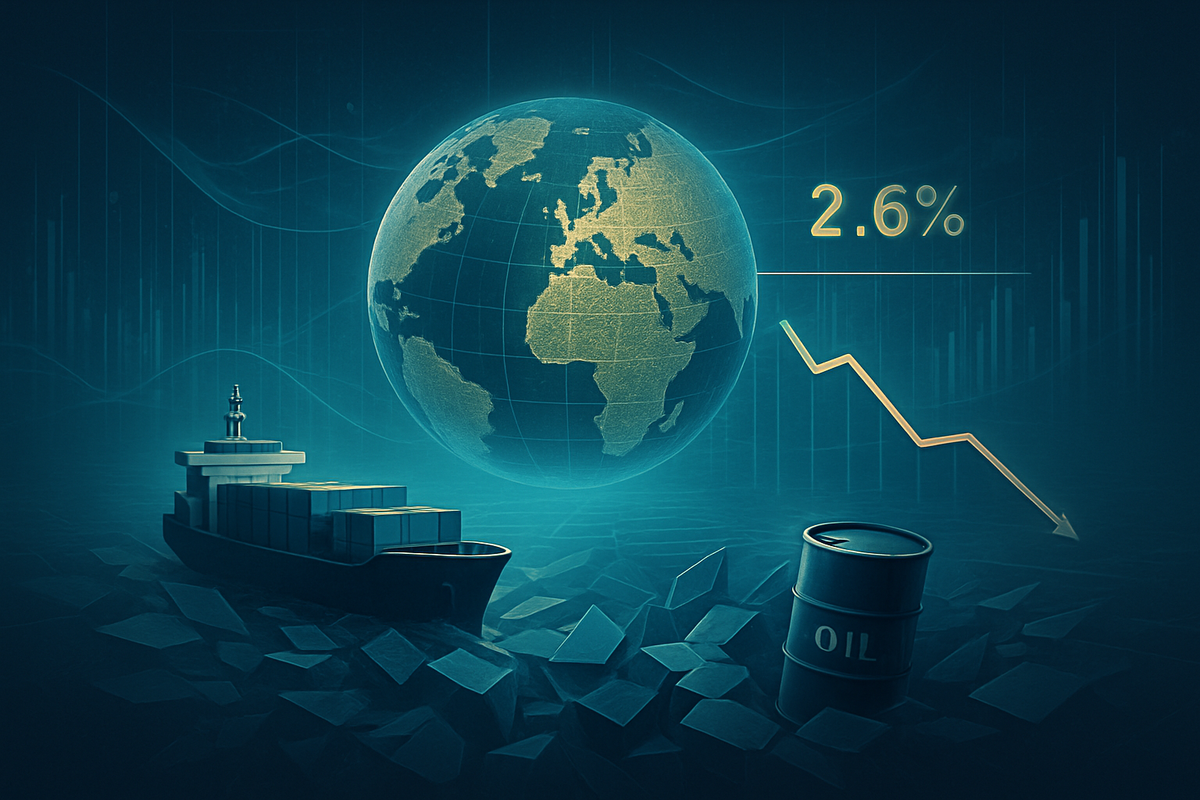
The global economy is entering a period of "tepid resilience," according to the World Bank’s January 2026 Global Economic Prospects report released today. The report projects that global GDP growth will stabilize at 2.6% in 2026, a slight upward revision from previous estimates that nonetheless underscores a decade of historically weak performance. While the United States continues to defy gravity with "shock-proof" momentum, the Bank warns that a "hangover" from 2025’s trade front-loading and persistent policy uncertainty could stifle long-term investment.
Immediate implications of the report have already rippled through the bond and commodity markets. As the World Bank predicts a six-year low for commodity prices—led by a projected drop in Brent crude to $60 per barrel—investors are recalibrating their portfolios away from traditional energy plays and toward consumer staples and high-efficiency tech. The report paints a picture of a world that has learned to live with volatility but remains haunted by the specter of a "lost decade" for developing nations.
A Tepid Plateau: The 2026 Growth Narrative
The January 13, 2026, report highlights a global economy that has effectively plateaued. After the rollercoaster of the post-pandemic recovery and the inflationary spikes of 2023-2024, the 2.6% growth rate for 2026 represents a return to a slow-motion equilibrium. This stabilization is largely credited to the United States, which the World Bank expects to hold at 2.2% growth, accounting for nearly two-thirds of the global upward revision. This resilience comes despite the "Trump 2.0" trade policies that saw effective U.S. tariff rates climb to between 14% and 16% over the past year.
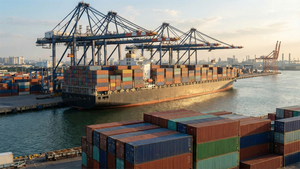
The timeline leading to this moment was defined by a massive "front-loading" of global trade in late 2025. Anticipating a more protectionist U.S. stance and the potential for broad reciprocal tariffs, multinational corporations accelerated shipments of electronics, machinery, and consumer goods. While this provided a temporary boost to 2025 GDP figures, the World Bank notes that 2026 is now facing the inevitable "hangover" as inventories remain high and new trade barriers become entrenched. Consequently, global trade growth is expected to soften significantly in the coming quarters.
Key stakeholders, including World Bank Chief Economist Indermit Gill, have expressed concern that while the global economy has become "seemingly more resilient to policy uncertainty," the underlying foundation is fragile. The report emphasizes that per capita income growth in one-quarter of developing economies is still lower than it was in 2019. This widening gap between the "shock-proof" advanced economies and the debt-burdened Global South remains the primary risk to long-term global stability.
Initial market reactions to the report were mixed. Treasury yields dipped slightly as the forecast of 2.6% global inflation bolstered hopes for continued central bank easing. However, the "Commodity Markets Outlook" portion of the report sent shockwaves through the energy sector, as the Bank confirmed that an abundant oil surplus—driven by rising EV adoption and increased OPEC+ supply—would likely keep energy prices depressed throughout the year.
Winners and Losers in a Low-Commodity World
The World Bank’s projection of a six-year low for commodity prices creates a stark divide between market winners and losers. Retail giants like Walmart (NYSE: WMT) and Amazon (NASDAQ: AMZN) stand to benefit significantly from this environment. Lower energy costs reduce logistics and shipping overhead, while easing food prices (expected to drop by 1% in 2026) help preserve the purchasing power of the U.S. consumer, who remains the primary engine of global growth.
Conversely, the energy sector is facing a period of forced austerity. With Brent crude projected to average $60 per barrel, integrated oil majors like ExxonMobil (NYSE: XOM) and Chevron (NYSE: CVX) may see compressed margins and a slowdown in new exploration projects. The "oil surplus" narrative suggests that the geopolitical premium once attached to crude has been largely eroded by diversified supply chains and the rapid greening of the European and Chinese economies.
The logistics and shipping industry also faces a complex 2026. A.P. Møller - Mærsk A/S (CPH: MAERSK-B) and other global carriers are navigating the "softening" of trade volumes as the 2025 front-loading surge dissipates. While lower fuel costs are a plus, the reduction in total volume and the increasing "fracturing" of trade routes—as companies move toward "friendshoring"—could lead to excess capacity in the shipping industry, putting downward pressure on freight rates.
In the mining sector, the outlook is bifurcated. Companies heavily reliant on iron ore and industrial metals, such as Rio Tinto (NYSE: RIO), may struggle with the cooling demand from China’s still-fragile property sector. However, precious metals miners like Newmont (NYSE: NEM) could see continued strength. The World Bank expects gold and silver to remain near record highs as "safe havens" against the "historic" trade policy uncertainty that continues to dominate the headlines.
The NAVI World: Policy Fracturing and the USMCA Review
The 2026 report introduces the concept of a "NAVI" world—one that is Non-linear, Accelerated, Volatile, and Interconnected. This event fits into a broader trend where geopolitics is no longer a "tail risk" but a core determinant of market pricing. The "Donroe Doctrine" in the Western Hemisphere, which seeks to reassert U.S. influence over critical minerals in Latin America, is a prime example of how trade policy is being used as a tool of national security.
A major ripple effect looming over 2026 is the scheduled review of the United States-Mexico-Canada Agreement (USMCA). With the U.S. seeking further concessions in the automotive and agricultural sectors, the World Bank warns that North American supply chains could face significant disruption. This uncertainty is already forcing companies like Apple (NASDAQ: AAPL) to further accelerate their diversification of manufacturing away from any single trade bloc, moving toward a "local-for-local" production model that prioritizes proximity to the end consumer over raw labor costs.
Historically, this period draws comparisons to the 1970s in terms of geopolitical shifts, but with a crucial difference: the "AI Multiplier." The World Bank notes that productivity gains from Artificial Intelligence are acting as a "headwind-offsetter," allowing advanced economies to maintain growth even as trade barriers rise. This technological surge is perhaps the only reason the 2020s haven't already slipped into a period of prolonged stagnation.
Regulatory implications are also shifting. As the "Khaki Deal" replaces the "Green Deal" in Europe, the focus has moved from pure decarbonization to "energy sovereignty." This means that policies are increasingly designed to support military and supply chain resilience, rather than just environmental goals. This shift is likely to benefit domestic manufacturing and defense contractors at the expense of globalized, low-cost producers.
What Comes Next: The 2026 Pivot points
Looking ahead, the short-term focus for investors will be on the "Great Soft Landing" and whether central banks can successfully navigate the final mile of inflation control. With global inflation projected to hit 2.6% in 2026, the Federal Reserve and the European Central Bank may have the room to pivot toward more aggressive rate cuts by mid-year. This could provide a much-needed boost to the housing and construction sectors, which have been dormant under high interest rates.
However, the long-term challenge remains the "2026 U.S. Midterm Elections." The outcome of these elections will determine whether the current executive-led tariff regime continues unabated or if the U.S. Congress moves to rein in the President’s authority under the International Emergency Economic Powers Act (IEEPA). A legislative shift could lead to a sudden de-escalation of trade tensions, providing a massive "risk-on" signal for global markets.
Strategic pivots will be required for companies operating in the "middle ground." Emerging markets that are not aligned with either the U.S. or China—such as India and Vietnam—may find themselves in a "Goldilocks" position, benefiting from the EU’s pursuit of strategic autonomy. The upcoming EU-India Free Trade Agreement summit in late January 2026 will be a key indicator of whether these "non-aligned" powers can fill the void left by the fracturing of U.S.-China trade.
Summary: A World of Resilient Fragility
The World Bank’s 2026 Global Economic Prospects report confirms that while the "Great Stabilization" is underway, it is a fragile peace. The projected 2.6% growth is a testament to the resilience of the U.S. consumer and the productivity gains of the AI era, but it masks deep-seated structural issues in the Global South and a "hangover" in global trade.
Moving forward, the market will likely be characterized by a "low-commodity, high-uncertainty" environment. Investors should move away from broad index-tracking and toward "thematic" investing—focusing on companies that can thrive in a fragmented trade landscape or those that benefit from lower input costs. The era of easy, globalized growth is over; the era of strategic, localized resilience has begun.
In the coming months, the key metrics to watch will be the USMCA renegotiation talks, the Brent crude price floor, and the impact of the 2025 tariff "front-loading" on Q1 2026 corporate earnings. While the world has avoided a hard landing, the flight path ahead remains narrow and fraught with geopolitical turbulence.
This content is intended for informational purposes only and is not financial advice.