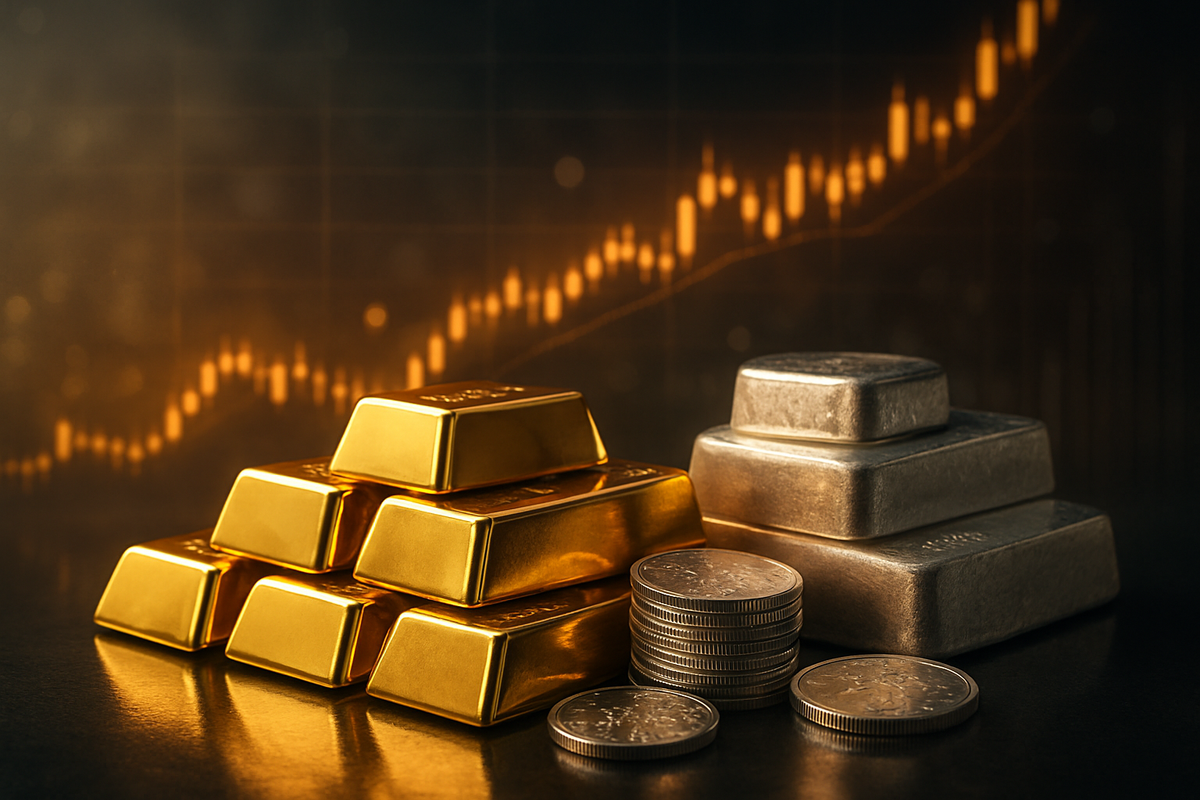
In an extraordinary display of market momentum, gold and silver prices surged to unprecedented heights this week, shattering previous records and fundamentally altering the landscape for global commodities. On January 12, 2026, spot gold prices broke through the psychological $4,600 per ounce barrier for the first time in history, while silver eclipsed $86 per ounce, marking a monumental shift in investor sentiment as traditional currency trust wavers.
The rally, which has been building throughout 2025, is being fueled by a "perfect storm" of macroeconomic and geopolitical factors. Solid central bank appetite, particularly from emerging markets, and a frantic rush toward safe-haven assets amid domestic political uncertainty in the United States have created a structural price floor that analysts believe may hold for the foreseeable future. As the market digests these new peaks, the implications for inflation hedging and institutional portfolio allocation are becoming the primary focus of Wall Street and global financial centers.
A Timeline of the "Perfect Storm"
The climb to these historic levels was not an overnight phenomenon but the culmination of a volatile 18-month period. Leading up to the January 13, 2026, milestone, the precious metals market was already on a tear, with gold having risen 70% in 2025 alone—its largest annual increase since 1979. The immediate catalyst for this week's surge was a series of "black swan" events, including reported civil unrest in Iran and a military raid in Venezuela, which sent the global risk premium skyrocketing.
Domestically, the U.S. financial system faced a shock on January 12 when news surfaced regarding a criminal investigation into Federal Reserve Chair Jerome Powell by the U.S. Justice Department. This unprecedented development sparked immediate fears regarding the independence of the Federal Reserve and the future of the U.S. dollar, leading to a massive rotation into "trust-based" hard assets. By the time markets closed on Monday, gold had reached an intraday peak of $4,640.50, and silver contracts touched $86.34.
Central banks have played the role of the ultimate "whale" in this market. In 2025, the official sector purchased over 1,000 tonnes of gold, the fourth consecutive year of massive accumulation. The National Bank of Poland emerged as a key player, adding 95 tonnes in the latter half of 2025 as part of a strategic shift to reach a 30% gold allocation in its reserves. This institutional backing has provided a relentless bid that retail investors and hedge funds have now joined in force.
Winners and Losers in the Commodities Surge
The primary beneficiaries of this price explosion have been the major exchange-traded funds and large-cap mining corporations. The SPDR Gold Shares (NYSE Arca: GLD) hit an all-time high closing price of $422.38 on January 12, 2026, reflecting a year-to-date gain of over 3% in just two weeks following a 68% return in 2025. Similarly, the iShares Silver Trust (NYSE Arca: SLV) reached a 52-week high of $72.38, though Goldman Sachs has warned that the silver market remains prone to extreme volatility due to supply shortages in London and surging industrial demand from the solar and electric vehicle sectors.
Major mining companies have seen their valuations soar as profit margins expand exponentially. Newmont Corporation (NYSE: NEM) and Barrick Gold Corporation (NYSE: GOLD) have both reported significant boosts to their free cash flow projections for the 2026 fiscal year. Other notable winners include Agnico Eagle Mines Limited (NYSE: AEM) and Wheaton Precious Metals Corp. (NYSE: WPM), the latter of which benefits from its streaming model that provides high-margin exposure to both metals. Silver-focused producers like Pan American Silver Corp. (NYSE: PAAS) have also seen renewed interest as silver's 140% rise over the past year outpaces even gold’s impressive performance.
Conversely, industries reliant on these metals as raw materials are facing significant headwinds. Electronics manufacturers and solar panel producers are seeing their input costs balloon, which may lead to inflationary pressure on consumer goods. Jewelry retailers are also struggling to adjust to a world where a standard gold band now costs nearly double what it did two years ago, potentially leading to a shift toward alternative materials or synthetic options.
De-dollarization and the Global Shift
The wider significance of this rally lies in the accelerating trend of "de-dollarization." As central banks in the "Global South" and Eastern Europe diversify away from the U.S. dollar, gold has re-emerged as the ultimate neutral reserve asset. This shift is not merely speculative; it represents a fundamental change in how nations view sovereign risk and the long-term stability of the dollar-denominated financial system. The Globe and Mail has noted that this trend is likely a permanent fixture of the new multipolar economic order.
Furthermore, the current price action reflects a deep-seated concern over the Federal Reserve's ability to manage inflation while under political fire. With the market pricing in multiple rate cuts for 2026, real yields are expected to fall, further decreasing the "opportunity cost" of holding non-yielding metals. Historically, gold has performed best during periods of negative real interest rates and high geopolitical tension, both of which are currently present in abundance.
The industrial role of silver also marks a departure from past cycles. Unlike previous rallies driven purely by monetary fear, the 2026 silver surge is underpinned by a structural deficit. The green energy transition has made silver an indispensable industrial commodity, and as supply from mines fails to keep pace with the demand for photovoltaic cells and EV components, the "silver squeeze" has moved from a social media meme to a tangible market reality.
The Road to $5,000 Gold
Looking ahead, the short-term outlook remains bullish but cautious. Analysts from J.P. Morgan and Societe Generale have suggested that if the current geopolitical tensions do not abate, gold could test the $5,000 per ounce mark by the end of the second quarter of 2026. Silver, meanwhile, is being eyed for a potential run toward $100 per ounce, provided the industrial supply-demand gap remains unaddressed.
However, the market is currently in "overbought" territory, and some strategists are calling for a healthy correction. A potential pivot back to a hawkish Fed stance—if the investigation into Chair Powell is resolved quickly and seen as a non-event—could lead to a sharp pullback. Investors should also be wary of potential regulatory changes; as precious metals become more central to global finance, some governments may consider windfall taxes on mining profits or stricter reporting requirements for large bullion holdings.
In the long term, the strategic pivot for investors will involve balancing the high cost of entry at these levels with the potential for gold to serve as a permanent hedge against a devalued dollar. The emergence of digital gold products and blockchain-based silver tokens may also provide new avenues for liquidity, though they have yet to be tested in a sustained high-price environment.
Market Assessment and Investor Takeaways
The events of early 2026 mark a watershed moment for the commodities market. Gold and silver have transitioned from defensive hedges to aggressive performance leaders, driven by a combination of central bank policy, industrial necessity, and a breakdown in traditional geopolitical norms. The primary takeaway for investors is that the "floor" for these metals has likely moved significantly higher, supported by the massive institutional accumulation seen over the last four years.
Moving forward, the market will be hyper-sensitive to any news regarding the Federal Reserve's leadership and the ongoing tensions in the Middle East and South America. While the headline numbers of $4,600 gold and $86 silver are staggering, they are a reflection of a world searching for stability in an era of unprecedented uncertainty.
Investors should watch for the quarterly earnings reports of the major miners like Newmont and Barrick in the coming months to see how much of this price surge is being captured as bottom-line profit. Additionally, the flow of capital into ETFs like GLD and SLV will serve as a barometer for whether the retail public is finally entering the fray or if this remains a rally driven primarily by the "smart money" of central banks and institutional giants.
This content is intended for informational purposes only and is not financial advice.