In the most recent quarterly earnings call for Tesla (TSLA), CEO Elon Musk made a case for building data centers in space. Shedding light on the savings that will ensue due to “effortless” cooling, he argued for sending millions of satellites into space for this. Alongside this, the huge spending increase and the administration's focus on defense only bode well for a company like the recently listed York Space Systems (YSS).
About York Space Systems
Founded in 2012, York Space Systems builds mission-focused, lower-cost satellites at scale for national security and commercial customers. It designs and manufactures small satellites and spacecraft platforms and provides mission integration and launch support while also providing ground-side software/antenna network services. Its customer base primarily includes U.S. defense and national security agencies, including the Space Development Agency (SDA), U.S. Space Force, and Army Space & Missile Defense Command, along with some civil/commercial work.
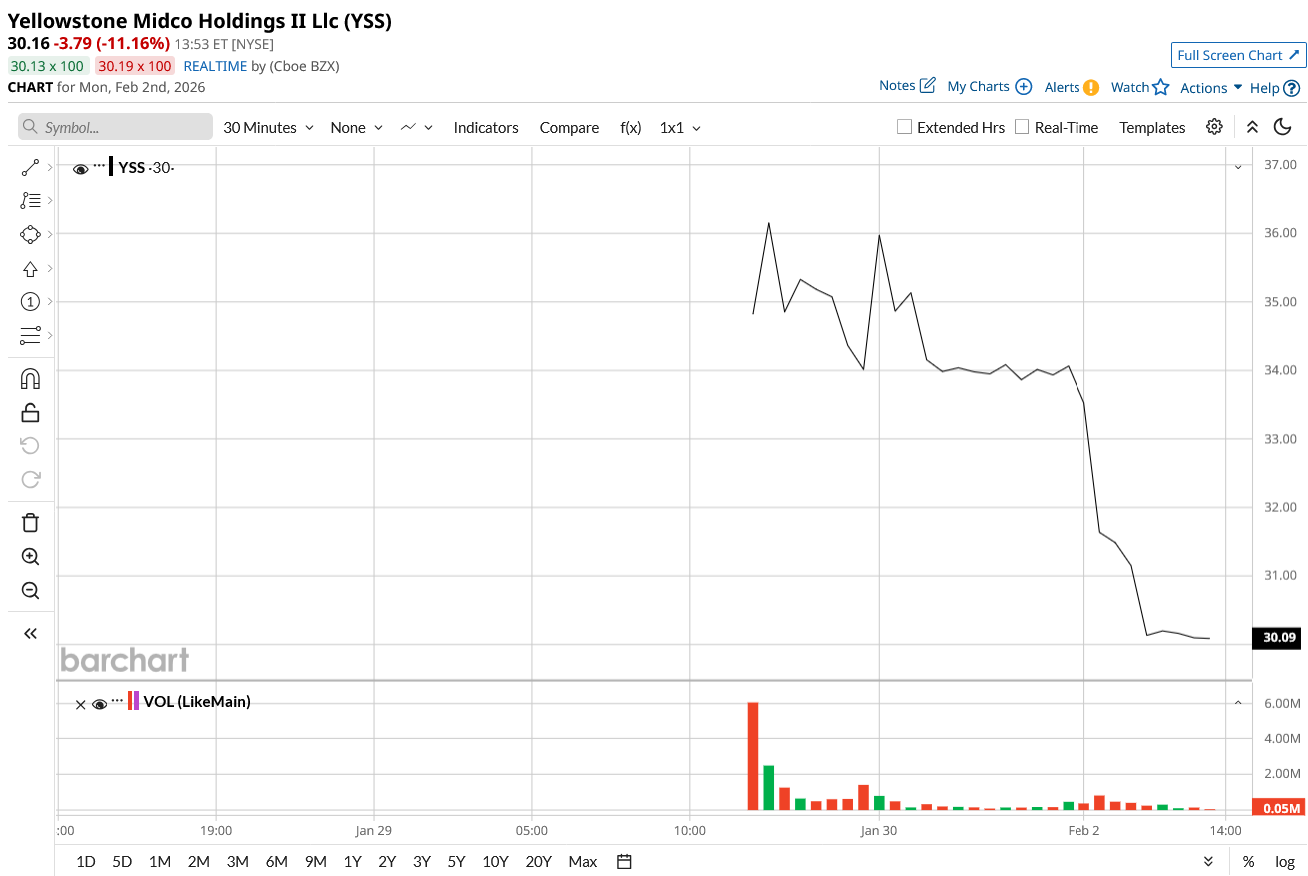
Initially planning to issue 16 million shares at a price range of $30-$34, the company eventually offered 18.5 million shares. The stock made a strong debut on the bourses, climbing more than 7% before dipping 11% by this afternoon. Its valuation stands at close to $5 billion now.
So, following a showing of relative strength with its IPO, will it be a case of morning showing the day for YSS? Or, will it be prudent to exercise some caution? Let's find out.
Financials Getting There
Just like the process of developing satellites is a complex and capital-intensive process, the financial management of such a company is equally an arduous task. How is York faring then? Not badly, but as it is with any early-stage company, there remains massive room for improvement, which will come if the company's slew of products and services continue to meet the standards of its biggest and most critical customer: the government.
For the moment, it is a relief to know that the company's revenues are increasing and losses are narrowing. Revenues for the nine months ended Sept, 30, 2025, were $280.9 million, as losses narrowed to $56 million from $73.6 million in the same period a year ago. The full year 2024 saw the company record revenues of $253.5 million, up 6% from the previous year. However, 2024 saw net losses widening to $98.9 million from $29.7 million in 2023.
The rise in revenues in 9M25 can then be attributed to the fulfillment of orders, as the backlog reduced to $642 million as of Sept. 30, 2025, from $861.7 million at the start of the year. Moreover, the YSS's contribution margin, a good indicator of what will be the long-term profits of the company, is hovering around 30%, which is decent, but not spectacular.
Coming to cash flows, the picture is again mixed, but with a positive bent. In 2024, York reported net cash from operating activities of $31.6 million, more than doubling from 2023. However, in the first nine months of 2025, the same turned into an outflow of $88.2 million from $35.9 million in the year-ago period. Overall, the company closed the September '25 quarter with a cash balance of $22.5 million, which was much lower than its net long-term debt levels of $182.2 million at the beginning of the year.
YSS: A Good Space to Be In?
Well, to answer the question in the macro sense, yes, satellite manufacturing is a good space to be in. The global market is projected to reach $57.2 billion by 2030, growing at a CAGR of 16.1% between 2025 and 2030. But how is York looking to make a mark? By positioning itself as the "industrialized" alternative to traditional aerospace primes, York Space Systems is pursuing a distinctly different path from legacy contractors such as Lockheed Martin (LMT), which concentrate on large-scale, highly bespoke programs. Instead, York emphasizes standardized designs, vertical integration, and rapid scaling tailored to defense priorities.
The company's proprietary S-CLASS and M-CLASS satellite buses enable the reuse of more than 75% of previously flight-proven components across multiple missions. This approach allows York to offer pricing approximately 50% below that of conventional providers. On the other hand, following the successful Dragoon mission, the firm has further refined its production processes, shortening satellite manufacturing timelines from several years to roughly seven months. In the longer term, management aims to scale output from the current level of about 300 satellites annually toward four-digit annual production.
Also, to address the growing requirements of orbital AI and advanced sensing payloads, York introduced the M-CLASS platform in late 2025. This bus supports a 1,000 kg payload capacity and up to 8 kW of peak power, providing the energy and mass budgets necessary for high-performance edge-computing hardware that smaller satellite designs cannot accommodate.
In relation to the Trump administration's “Golden Dome” initiative, York CEO Dirk Wallinger has highlighted the company's ability to integrate disparate systems effectively. Notably, York has already showcased this capability by establishing the first inter-vendor laser communication link in low Earth orbit between a York-built satellite and a SpaceX-built platform, validating its potential to support the complex networking demands of a layered missile defense architecture.
Notwithstanding these strengths, several risks warrant attention. The company remains dependent on a concentrated group of customers, operates in a highly competitive landscape, faces the possibility of technical setbacks, relies heavily on fixed-price contracts, and is subject to uneven revenue patterns typical of project-based work.
Final Take
The looming IPO of Musk-backed SpaceX hovers over York. Needless to say, competition will be fierce from a company backed by the world's richest man, while established players will not cede space so easily. However, York seems to be a solid company with a demonstrated ability to manufacture satellites that work (with 74 missions to space), as evidenced by its close relationship with the government. Further, fiscally, York is improving its fundamentals, with profitability at the gross level already achieved. Thus, before the circus comes to town with SpaceX, investors can test the space waters with a solid company like York, but in a limited manner.
On the date of publication, Pathikrit Bose did not have (either directly or indirectly) positions in any of the securities mentioned in this article. All information and data in this article is solely for informational purposes. For more information please view the Barchart Disclosure Policy here.
More news from Barchart