From a New Jersey exotic car empire to the FBI's Most Wanted list to the Nevada ballot. The unvarnished, unbelievable, undeniably American story of Bobby Khan and why Las Vegas can't stop talking about him.
LOS ANGELES, CA, March 16, 2026 /24-7PressRelease/ -- There are stories that sound too wild to be true until you look them up, and then they sound even wilder. Bobby Khan's story is one of those. A boy born in Edinburgh, Scotland, who came to America and built an international exotic car empire straight out of high school exporting hyper cars across the globe before most people his age had a savings account. Then: a dispute with a bank he believes should have stayed in civil court, a $20,000 FBI reward, six years as a fugitive, the loss of a son he still grieves every single day, prison, an ankle monitor, and now, a congressional campaign in Las Vegas that is turning heads across the state of Nevada.
None of it is fiction. All of it is Bobby Khan.
Born in Scotland, Built in America
Bobby Khan born in Edinburgh, Scotland came to America and wasted no time. Where other young men were still figuring out what they wanted to be, Khan already knew. He graduated high school and went straight to work. No long detour through academia, no years spent finding himself. He found himself in the exotic car business, and he was good at it immediately.
In his early twenties, he was already exporting exotic cars internationally on his own, for himself before most of his peers had figured out their first real job. He wasn't working for someone else's dealership. He was building his own world, deal by deal, car by car, across borders and time zones. He could tell a Bentley from a Rolls-Royce blindfolded, by the smell of the leather. He spoke the language of speed and luxury fluently, and his clients; Wall Street bankers, celebrities, even royalty believed every word.
By 28, he held the exclusive Zenvo franchise, a hyper car so rare most people have never seen one in person. He appeared on Real Housewives of New Jersey, where some cast members were among his clients. Emporio Motor Group in Ramsey, New Jersey, was his showroom and his stage. For a kid who once couldn't afford the cars he was dreaming about, it must have felt like winning.
"I've been in prison, I've been in jail. I know what people go through, I know what the families go through. I can actually talk about prison reform better than any politician out there."
— Bobby Khan, Las Vegas Review-Journal
The Fall
In 2014, the federal government came after Bobby Khan. Charges were filed in connection with his dealership charges he has always disputed. In his telling, a trusted associate ran the business into the ground, and what should have been resolved through civil courts became, in the hands of a motivated Department of Justice, something much larger and more punishing.
Khan has been consistent about what he admits to: he owed money to the bank and he maintains the bank could have settled the matter in civil court. He does not accept the broader allegations lodged against him. A few years earlier, he says, he had been falsely accused in a separate case, spent 11 months in jail awaiting trial, and walked out after a jury cleared his name.
What is undisputed is what happened next. A federal arrest warrant was issued in October 2014. Bobby Khan with his wife Stephanie and their two daughters left the United States. The FBI placed a $20,000 reward for information leading to his arrest. His story ran on CNBC's American Greed. His face appeared on the FBI's Most Wanted list. And for six years, he was gone.
March 4th, 2013 and the Years That Followed
The years in exile were not glamorous. Stephanie Khan, his wife an Italian American who has stood by her husband through every chapter of this story struggled with constant pain. Their two daughters were homeschooled by Stephanie, who also handmade their toys and clothes, the family caught between two worlds with no country to call their own. Khan has said openly that his kids did not see a physician for the five years they were on the run. It is the part of the story that cuts deepest, and Khan does not flinch from it.
And then, before any of the legal chaos began, came the loss that reshaped everything. On March 4th, 2013, Bobby and Stephanie lost their son at birth. No autopsy was ever done. He would have been 13 years old this year. Bobby has two daughters now 16 and 11 and he carries that absence with him every day. He has described his son's passing as the beginning of his whirlwind the grief that clouded his judgment in the years that followed, the wound underneath all the legal battles and headlines that no court document has ever captured. It is the human cost behind the story, the part that turns a fugitive into a father, and a defendant into a man.
Khan says he spent years trying to negotiate his return to the United States. He claims he reached out repeatedly to U.S. authorities offering to surrender, that recordings exist of those attempts, and that the government refused to accept his return on terms that would allow his family to come home with him without facing a $60,000 fine for overstayed visas. On January 21, 2020, he walked into the U.S. Embassy in the United Arab Emirates and, as he has described it, demanded they arrest him. They did.
"If I could save a handful of people's lives from ever going through what I went through and what my wife and kids went through, I did my part."
— Bobby Khan, Las Vegas Sun
Prison, an Ankle Monitor, and a Decision
He was returned to the United States in shackles and held in Bergen County Jail for eight months without bail. He then pleaded guilty to one count of wire fraud and served eight months in prison, followed by 32 months on an ankle monitor banned during that entire period from working to support his family.
He has described what he saw inside rehabilitation programs that existed on paper but not in practice, people signing documents certifying they attended classes they never took, men leaving prison with as little as $0.35 an hour in earnings and no real path forward. He watched people get broken by a system that, in his view, was designed to punish rather than rebuild. He took notes.
When he was released in 2023, Khan moved to Las Vegas. He has said he had visited many times before and felt something in the city a particular energy that matched his own. Still on supervised release, still carrying a felony conviction, he started over. He became a consultant for law firms. He built a following on social media nearly 90,000 Instagram followers and he began to think about running for Congress.
"I would never in my wildest dreams think I was ever going to run for office," he has said. But the more he looked at Washington, the career politicians, the disconnected establishment, the system he had survived from the inside the more he felt he had no choice.
Wanted for Congress
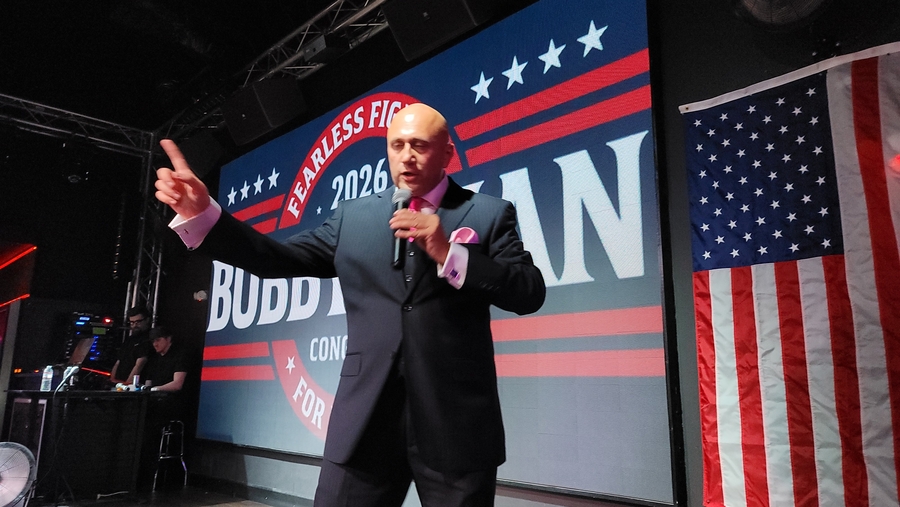
In August 2025, Bobby Khan announced his candidacy for Nevada's 1st Congressional District the seat held by long-serving Democrat Dina Titus. His campaign branding is impossible to ignore: "Wanted for Congress" posters styled like old FBI bulletins. Photos of him in both a business suit and an orange jumpsuit. A campaign website that opens with the line "From FBI's Most Wanted to Congressional Candidate" and doesn't apologize for a single chapter of the story.
He is blunt about his record. "I am a convicted felon," he has said publicly, without hesitation. "There are 80 million Americans in this country with a criminal record. I know what it takes to fight, and that's what people need. People need people that are real." He compares his status to the former president's, noting that both he and Donald Trump would need to check whether they could meet given their shared standing as felons.
His platform is a direct translation of his biography into policy. Zero taxes on veteran income. An end to civil asset forfeiture without conviction. Justice and prison reform including tax credits to bring manufacturing into prisons so incarcerated people can earn meaningful wages and leave with something. Affordable housing. Zero taxes on gambling winnings. And a cause that has drawn unexpected celebrity attention: ending the federal wild horse roundups in Nevada, a campaign that earned him the backing of Yellowstone actress Dawn Olivieri and the public support of Nevada GOP Chairman Michael McDonald.
The People's Favorite
Something is happening in Las Vegas that the political establishment didn't see coming. Bobby Khan is becoming a favorite, not among the party insiders or the donor class, but among the people. His rallies draw Republicans, Democrats, and independents alike. His events including intimate "After Dark" gatherings featuring live music, cigars, and unscripted conversation sell out. People line up not just to hear him speak, but to tell him their own stories.
He describes a single mother who told him she works two jobs, still can't cover rent, and has had to choose between groceries and gas. "That hit me hard," he said, "because I've lived it." That is the core of his appeal not polished talking points, but lived experience. He does not need a pollster to tell him what working families are going through. He has been on the receiving end himself. And the people of Las Vegas, a city built on the labor of workers who know exactly what it is to hustle and struggle, seem to recognize something real when they hear it.
Even his battles outside the campaign trail have resonated. When MGM Resorts banned him from every one of its Las Vegas properties in March 2026 the Bellagio, Aria, Cosmopolitan, MGM Grand, Mandalay Bay, and even the T-Mobile Arena after he publicly called out the company's CEO over what he described as price gouging and poor service, the response from his supporters was immediate. The ban didn't silence him. It amplified him. "I've never gambled or even caused an inconvenience at any of those properties," he said. He vowed to fight it all the way to the Supreme Court.
That is very Bobby Khan, the man who walked into a U.S. Embassy and demanded to be arrested. Who stood before a federal judge not asking for mercy, by his own account, but demanding justice. Who launched a congressional campaign while still on supervised release and put his mugshot on his own campaign flyer. He is not interested in playing it safe. He never has been.
"I'm not here to make friends. I'm here to win. I'm here to fight for the people. I don't care about the establishment. I'm here for the people."
— Bobby Khan
A Las Vegas Story
Las Vegas has always had a soft spot for the improbable. For the person who arrives with nothing, takes the long odds, and refuses to quit. For the comeback. For the fighter who gets knocked down and gets up one more time than the city thought possible. Bobby Khan fits that tradition like a tailored suit.
His story is not clean. It is not a sanitized political biography written by a consultant. It is a story with real wreckage in it a business that collapsed, a family that spent years in legal limbo, a son who didn't survive, a wife who endured years of uncertainty and pain. Bobby Khan does not ask you to forget any of that. He asks you to see the whole picture: the rise, the fall, the prison cell, the ankle monitor, the grief, and the man who came out the other side still standing, still fighting, and now improbably, characteristically asking Nevada to send him to Washington.
"I don't care about what people have to say about my past," he told the Las Vegas Review-Journal. "I know what it takes to fight, and that's what people need."
Las Vegas is listening. And increasingly, it likes what it hears.
---
Press release service and press release distribution provided by https://www.24-7pressrelease.com