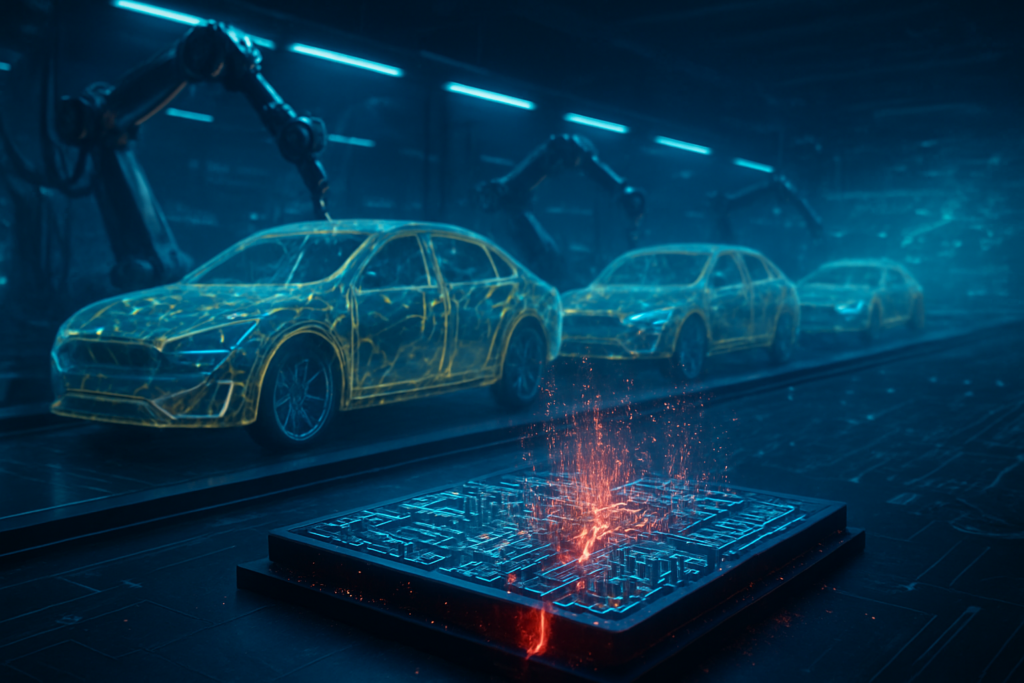
The global automotive industry has been plunged into a fresh crisis as a bitter geopolitical and contractual feud between Honda Motor Co. (NYSE: HMC) and semiconductor giant Nexperia triggered a wave of factory shutdowns across three continents. What began as a localized dispute over pricing and ownership has escalated into a systemic failure, highlighting the extreme vulnerability of modern vehicles—increasingly reliant on sophisticated AI and electronic architectures—to the supply of foundational "legacy" chips. As of December 19, 2025, Honda has been forced to slash its global sales forecast by 110,000 units, a move that underscores the high stakes of the current semiconductor landscape.
The immediate significance of this development lies in its timing and origin. Unlike the broad shortages of the post-pandemic era, this disruption is a targeted consequence of the "chip wars" reaching a boiling point. With production lines at a standstill from Celaya, Mexico, to Suzuka, Japan, the incident serves as a stark warning: even the most advanced AI-integrated vehicle systems are rendered useless without the basic power semiconductors that manage their energy flow. The shutdown of Honda’s high-volume plants, including those producing the HR-V and Accord, marks a critical failure in the "just-in-time" manufacturing philosophy that has governed the industry for decades.
The Anatomy of a Supply Chain Fracture
The crisis was precipitated by a dramatic geopolitical intervention on September 30, 2025, when the Dutch government invoked emergency laws to seize control of Nexperia from its Chinese parent company, Wingtech Technology (SSE: 600745). This move, aimed at curbing technology transfers to China, sparked an immediate internal war within the company. By late October, Nexperia’s global headquarters suspended wafer shipments to its assembly plant in Dongguan, China, citing contractual payment failures. In a swift retaliatory strike, Beijing blocked the export of Nexperia-made components from China, causing the price of essential chips to surge tenfold—from mere cents to as high as 3 yuan per unit.
Technically, the dispute centers on "legacy" semiconductors—specifically power MOSFETs, diodes, and logic chips. While these are not the high-end 3nm processors used in cutting-edge data centers, they are the indispensable foundation of automotive electronics. These components are responsible for power management in everything from electric windows to high-voltage battery systems in EVs. Crucially, they serve as the electrical backbone for Honda’s "Sensing" suite, the AI-driven driver-assistance system that requires stable power distribution to function. Without these "unsexy" chips, the sensors and actuators that feed the vehicle's AI "brain" cannot operate, effectively lobotomizing the car’s advanced safety features.
Industry experts have reacted with alarm, noting that this differs from previous shortages because it is driven by deliberate state intervention and corporate infighting rather than raw material scarcity. The "automotive-grade" certification process further complicates the issue; automakers cannot simply swap one supplier’s MOSFET for another’s without months of rigorous safety testing. This technical rigidity has left Honda with few immediate alternatives, forcing the suspension of operations at its GAC Honda joint venture in China and its primary North American assembly hubs.
Market Turmoil and the Competitive Shift
The fallout from the Honda-Nexperia feud is reshaping the competitive landscape for automotive and tech giants alike. Honda (NYSE: HMC) is the most visible casualty, facing a significant hit to its 2025 revenue and a potential loss of market share in the critical compact SUV and sedan segments. However, the ripple effects extend to Wingtech Technology (SSE: 600745), which faces a massive valuation hit as its control over Nexperia evaporates. Meanwhile, competitors like Toyota Motor Corp (NYSE: TM) and Tesla (NASDAQ: TSLA) are watching closely, accelerating their own "de-risking" strategies to avoid similar bottlenecks.
Major AI labs and tech companies that provide the software stacks for autonomous driving are also feeling the pressure. If the physical hardware—the chips and wires—cannot be guaranteed, the rollout of next-generation Software-Defined Vehicles (SDVs) is inevitably delayed. This disruption creates a strategic advantage for companies that have moved toward vertical integration. Tesla, for instance, has long designed its own power electronics, potentially insulating it from some of the legacy chip volatility that is currently crippling more traditional manufacturers like Honda.
Furthermore, this crisis has opened a door for semiconductor manufacturers in Taiwan and India to position themselves as "safe-haven" alternatives. Companies like TSMC (NYSE: TSM) are seeing increased demand for legacy node production as automakers seek to diversify away from Chinese-linked supply chains. The strategic advantage has shifted from those who can design the best AI to those who can guarantee the delivery of the most basic electronic components.
Geopolitical Realities and the AI Landscape
The Honda-Nexperia standoff is a microcosm of the broader fragmentation of the global AI and technology landscape. It highlights a critical irony: while the world is obsessed with the "AI revolution" and the race for trillion-parameter models, the physical manifestation of that AI in the real world is tethered to a fragile, decades-old supply chain. This event marks a shift where "chip sovereignty" is no longer just about high-end computing power, but about the survival of traditional industrial sectors like automotive manufacturing.
The impact of this dispute is particularly felt in the development of autonomous systems. Modern AI pilots require a massive array of sensors—Lidar, Radar, and cameras—all of which rely on the very power switches and logic chips currently caught in the Nexperia crossfire. If the supply of these components remains volatile, the "AI milestone" of widespread level 3 and level 4 autonomy will likely be pushed back by several years. The industry is realizing that an AI-driven future cannot be built on a foundation of geopolitical instability.
Potential concerns are also mounting regarding the "weaponization" of the supply chain. The use of emergency laws to seize corporate assets and the subsequent retaliatory export bans set a dangerous precedent for the tech industry. It suggests that any company with a global footprint could become a pawn in larger trade wars, leading to a "Balkanization" of technology where different regions operate on entirely separate hardware and software ecosystems.
The Road Ahead: AI-Driven Supply Chains and De-risking
Looking forward, the Honda-Nexperia crisis is expected to catalyze a massive investment in AI-driven supply chain management tools. Experts predict that automakers will increasingly turn to predictive AI to map out multi-tier supplier risks in real-time, identifying potential bottlenecks months before they result in a factory shutdown. The goal is to move from a reactive "just-in-time" model to a "just-in-case" strategy, where AI assists in maintaining strategic stockpiles of critical components.
In the near term, we can expect a frantic effort by Honda and its peers to qualify new suppliers in non-contentious regions. This will likely involve a push for "standardized" automotive chips that can be more easily multi-sourced, reducing the technical lock-in that made the Nexperia dispute so damaging. However, the challenge remains the "automotive-grade" barrier; the high standards for heat, vibration, and longevity mean that new supply lines cannot be established overnight.
Long-term, the industry may see a move toward "chiplet" architectures in cars, where high-end AI processors and basic power management are integrated into more resilient, modular packages. This would allow for easier updates and swaps of components, potentially shielding the vehicle's core functionality from localized supply disruptions.
A New Era of Industrial Fragility
The Honda-Nexperia feud of late 2025 will likely be remembered as the moment the automotive industry's "silicon ceiling" became visible. It has demonstrated that the most sophisticated AI systems are only as reliable as the cheapest components in their assembly. The key takeaway for the tech world is clear: technological advancement is inseparable from geopolitical stability. As Honda prepares for a second wave of shutdowns in early 2026, the industry remains on high alert.
In the coming weeks, the focus will be on whether the Dutch and Chinese governments can reach a "technological truce" or if this dispute will spark a wider contagion across other manufacturers. Investors and industry analysts should watch for shifts in "de-risking" policies and the potential for new domestic chip-making initiatives in North America and Japan. For now, the silent assembly lines at Honda serve as a powerful reminder that in the age of AI, the old rules of supply and demand have been replaced by the unpredictable logic of the silicon standoff.
This content is intended for informational purposes only and represents analysis of current AI developments.
TokenRing AI delivers enterprise-grade solutions for multi-agent AI workflow orchestration, AI-powered development tools, and seamless remote collaboration platforms.
For more information, visit https://www.tokenring.ai/.