Building products company Boise Cascade Company (NYSE: BCC) reported revenue ahead of Wall Street’s expectations in Q4 CY2025, but sales fell by 6.8% year on year to $1.46 billion. Its GAAP profit of $0.24 per share was significantly above analysts’ consensus estimates.
Is now the time to buy Boise Cascade? Find out by accessing our full research report, it’s free.
Boise Cascade (BCC) Q4 CY2025 Highlights:
- Revenue: $1.46 billion vs analyst estimates of $1.45 billion (6.8% year-on-year decline, 0.6% beat)
- EPS (GAAP): $0.24 vs analyst estimates of $0.12 (significant beat)
- Adjusted EBITDA: $57.19 million vs analyst estimates of $48.6 million (3.9% margin, 17.7% beat)
- Operating Margin: 1.1%, down from 5.9% in the same quarter last year
- Free Cash Flow Margin: 5.3%, up from 0% in the same quarter last year
- Market Capitalization: $3.04 billion
“While the fourth quarter reflected the expected seasonal softness in demand, I am proud of our teams for delivering strong operating results despite ongoing market headwinds,” said Nate Jorgensen, CEO.
Company Overview
Formed through the merger of two lumber companies, Boise Cascade Company (NYSE: BCC) manufactures and distributes wood products and other building materials.
Revenue Growth
Reviewing a company’s long-term sales performance reveals insights into its quality. Any business can have short-term success, but a top-tier one grows for years. Unfortunately, Boise Cascade’s 3.2% annualized revenue growth over the last five years was sluggish. This was below our standard for the industrials sector and is a tough starting point for our analysis.
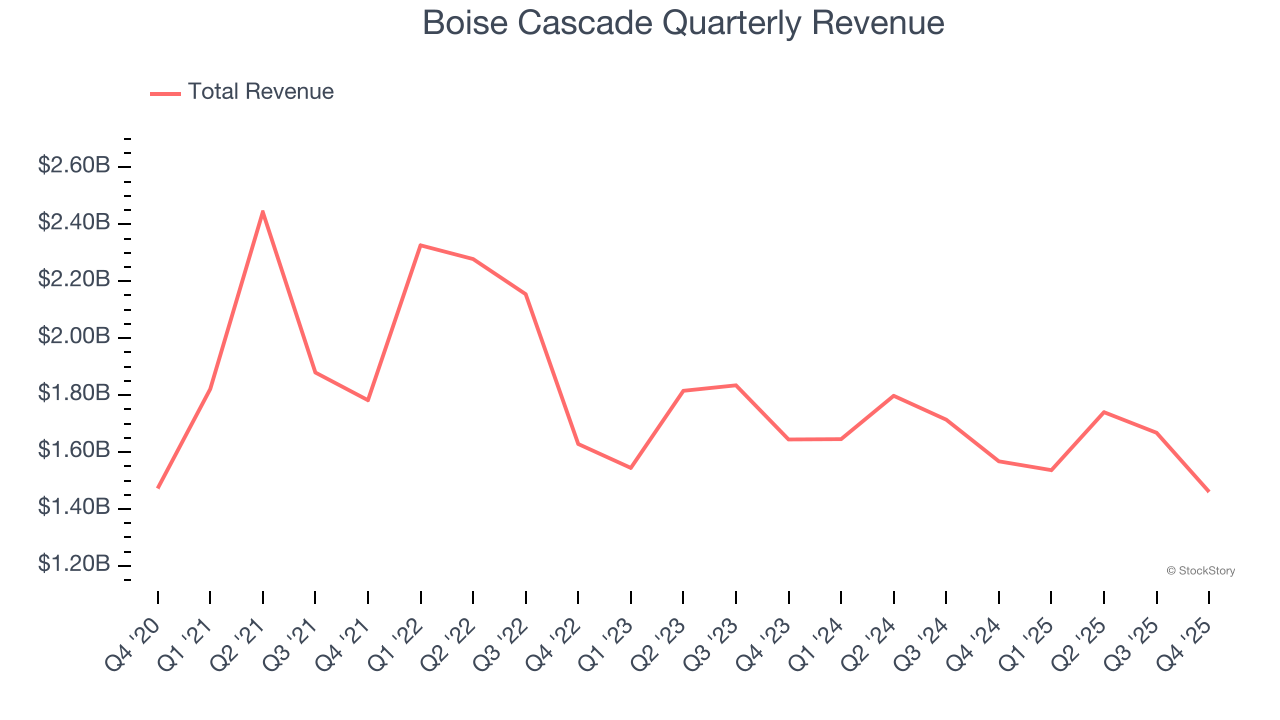
Long-term growth is the most important, but within industrials, a half-decade historical view may miss new industry trends or demand cycles. Boise Cascade’s performance shows it grew in the past but relinquished its gains over the last two years, as its revenue fell by 3.2% annually. 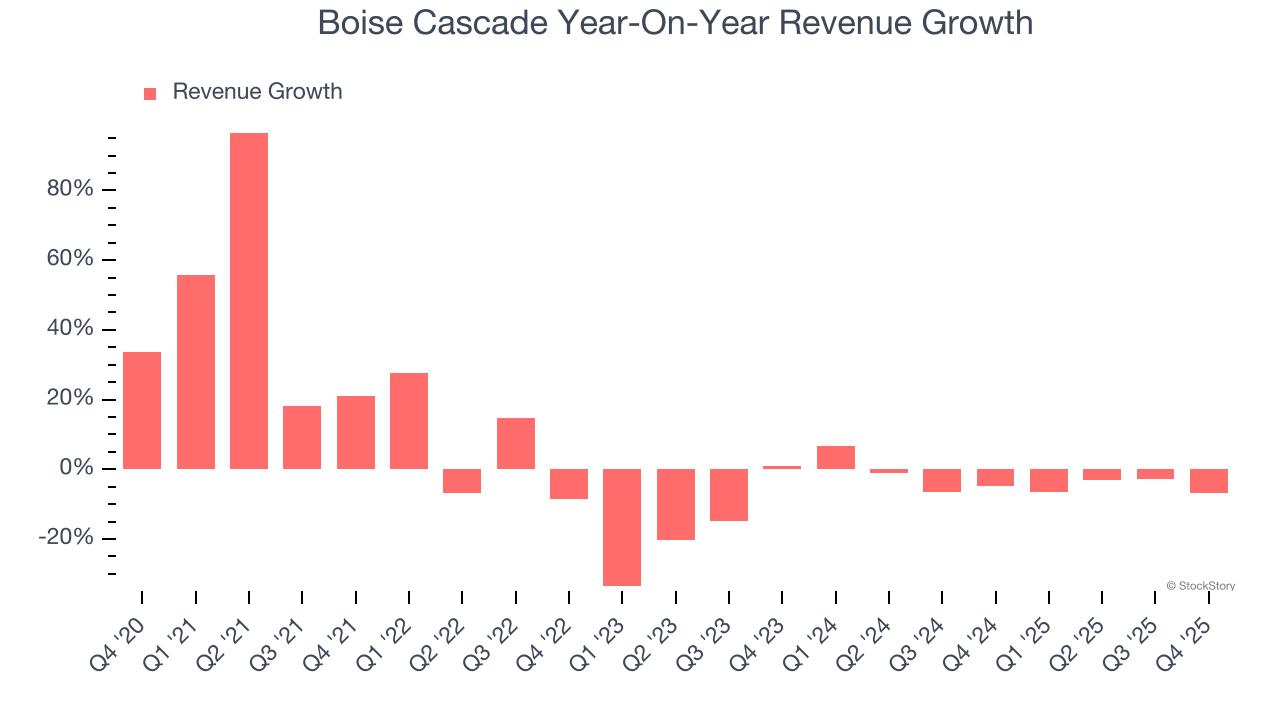
We can dig further into the company’s revenue dynamics by analyzing its most important segments, Building Material Distribution and Wood products, which are 93.4% and 24.2% of revenue. Over the last two years, Boise Cascade’s Building Material Distribution revenue (plywood, siding, insulation) averaged 3.7% year-on-year declines while its Wood products revenue (lumber and beams) averaged 11% declines. 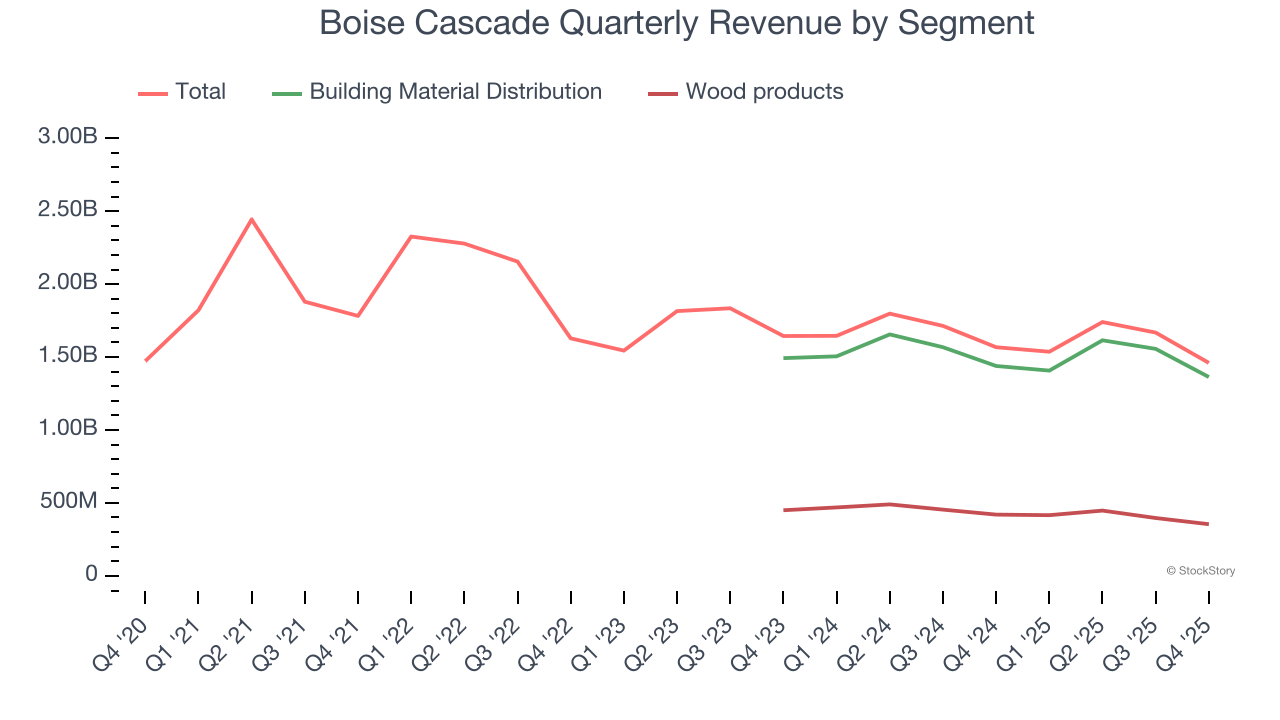
This quarter, Boise Cascade’s revenue fell by 6.8% year on year to $1.46 billion but beat Wall Street’s estimates by 0.6%.
Looking ahead, sell-side analysts expect revenue to grow 3.1% over the next 12 months. Although this projection implies its newer products and services will spur better top-line performance, it is still below the sector average.
While Wall Street chases Nvidia at all-time highs, an under-the-radar semiconductor supplier is dominating a critical AI component these giants can’t build without. Click here to access our free report one of our favorites growth stories.
Operating Margin
Operating margin is a key measure of profitability. Think of it as net income - the bottom line - excluding the impact of taxes and interest on debt, which are less connected to business fundamentals.
Boise Cascade has done a decent job managing its cost base over the last five years. The company has produced an average operating margin of 9.4%, higher than the broader industrials sector.
Analyzing the trend in its profitability, Boise Cascade’s operating margin decreased by 9.4 percentage points over the last five years. This raises questions about the company’s expense base because its revenue growth should have given it leverage on its fixed costs, resulting in better economies of scale and profitability.
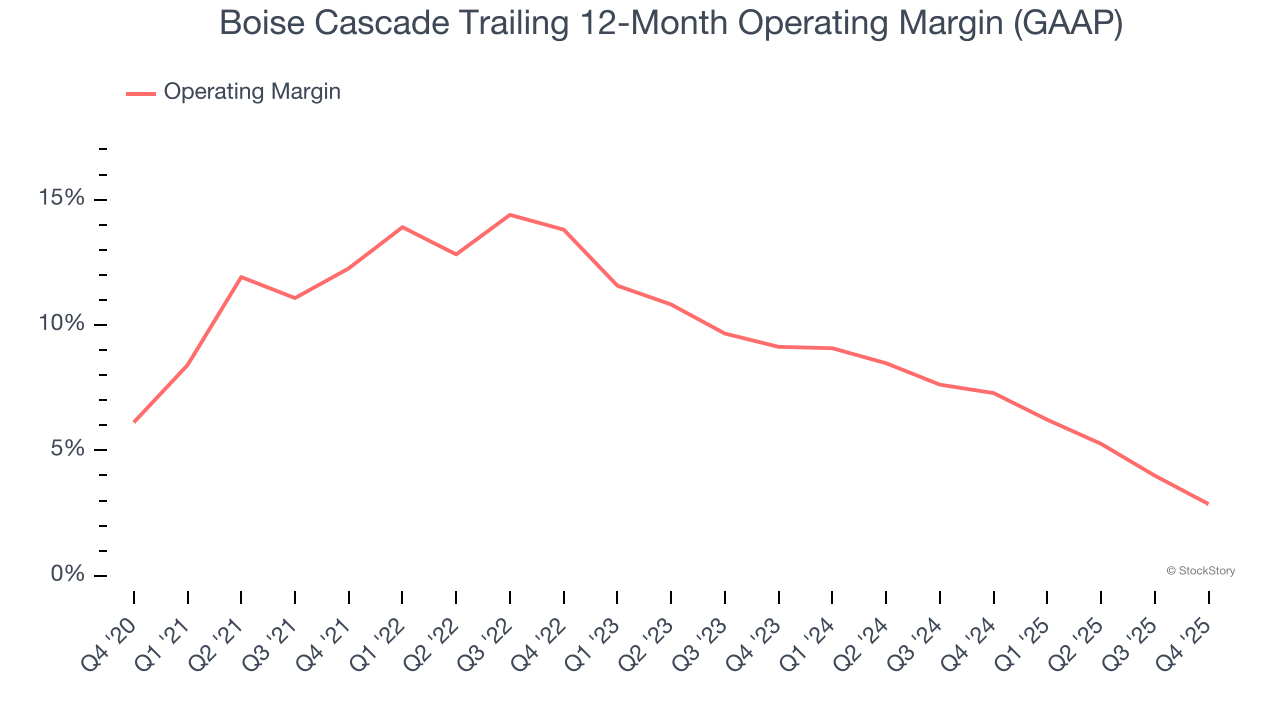
This quarter, Boise Cascade generated an operating margin profit margin of 1.1%, down 4.8 percentage points year on year. Since Boise Cascade’s operating margin decreased more than its gross margin, we can assume it was less efficient because expenses such as marketing, R&D, and administrative overhead increased.
Earnings Per Share
We track the long-term change in earnings per share (EPS) for the same reason as long-term revenue growth. Compared to revenue, however, EPS highlights whether a company’s growth is profitable.
Sadly for Boise Cascade, its EPS declined by 4.5% annually over the last five years while its revenue grew by 3.2%. This tells us the company became less profitable on a per-share basis as it expanded due to non-fundamental factors such as interest expenses and taxes.
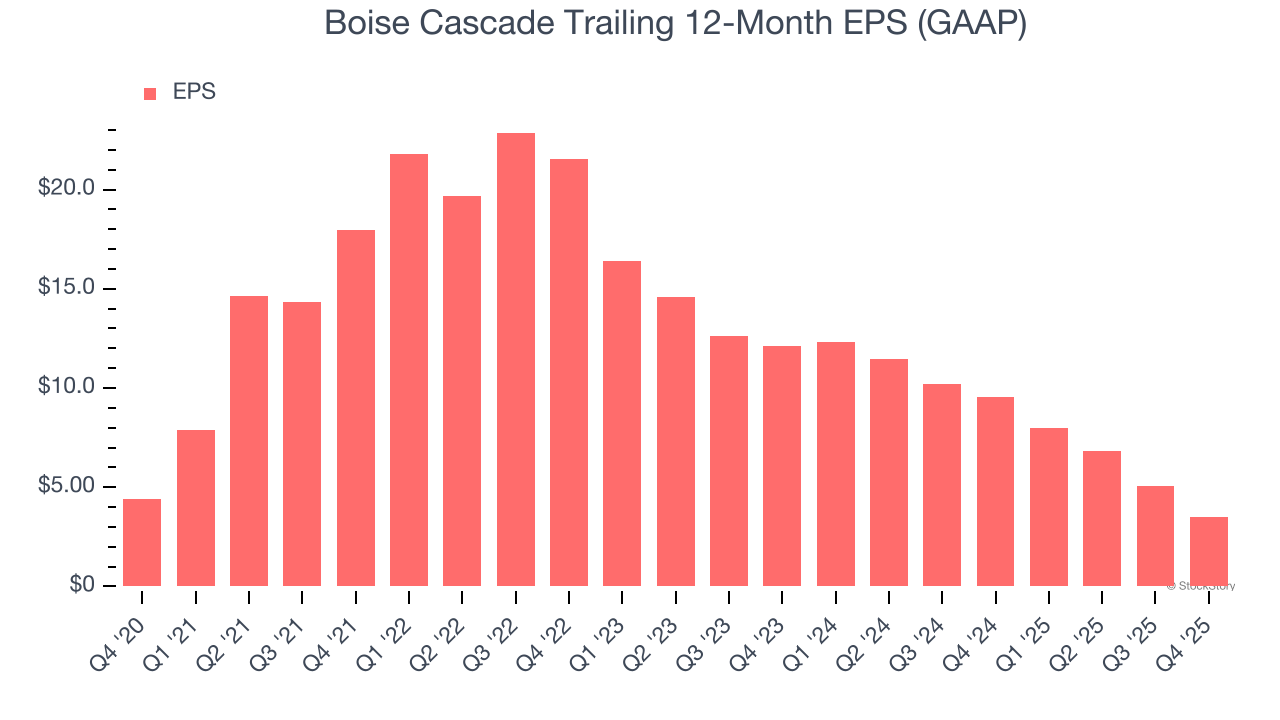
We can take a deeper look into Boise Cascade’s earnings to better understand the drivers of its performance. As we mentioned earlier, Boise Cascade’s operating margin declined by 9.4 percentage points over the last five years. This was the most relevant factor (aside from the revenue impact) behind its lower earnings; interest expenses and taxes can also affect EPS but don’t tell us as much about a company’s fundamentals.
Like with revenue, we analyze EPS over a more recent period because it can provide insight into an emerging theme or development for the business.
For Boise Cascade, its two-year annual EPS declines of 46.1% show it’s continued to underperform. These results were bad no matter how you slice the data.
In Q4, Boise Cascade reported EPS of $0.24, down from $1.78 in the same quarter last year. Despite falling year on year, this print easily cleared analysts’ estimates. Over the next 12 months, Wall Street expects Boise Cascade’s full-year EPS of $3.52 to grow 8.3%.
Key Takeaways from Boise Cascade’s Q4 Results
It was good to see Boise Cascade beat analysts’ EPS expectations this quarter. We were also excited its EBITDA outperformed Wall Street’s estimates by a wide margin. Zooming out, we think this quarter featured some important positives. The stock remained flat at $81.25 immediately after reporting.
Boise Cascade may have had a good quarter, but does that mean you should invest right now? The latest quarter does matter, but not nearly as much as longer-term fundamentals and valuation, when deciding if the stock is a buy. We cover that in our actionable full research report which you can read here (it’s free).