The year 2025 will be remembered in financial history as the moment prediction markets evolved from a niche curiosity into a foundational pillar of the global economy. What was once dismissed as "gambling for nerds" has transformed into a high-stakes "truth machine," providing real-time data that traditional polling and expert analysis have struggled to match. In just twelve months, the industry shed its speculative reputation, proving that when people put money where their mouths are, the resulting data is more accurate than any focus group.
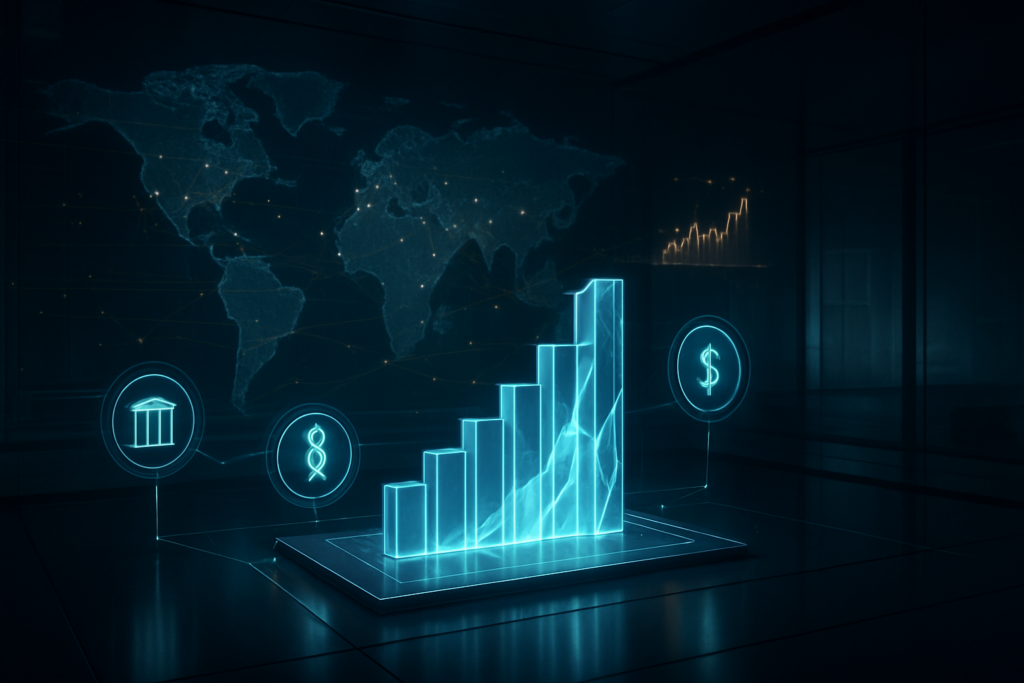
The numbers are staggering. Monthly trading volume across major platforms surged from under $100 million in early 2024 to a consistent baseline of over $13 billion by the end of 2025. During periods of extreme macroeconomic volatility, such as the Federal Reserve’s surprise mid-year pivot, volumes peaked as high as $22 billion. This explosive growth wasn't just driven by a few "whales" or election hobbyists; it was propelled by the deep integration of prediction markets into the daily workflows of retail investors and corporate treasuries alike.
The Market: What's Being Predicted
The transformation of prediction markets in 2025 was defined by the transition from "event betting" to "event hedging." While the 2024 U.S. presidential election provided the initial spark, the market's liquidity migrated toward complex economic and regulatory outcomes throughout 2025. Today, traders are less focused on who will win an award show and more focused on whether the "Digital Asset Market Clarity Act" will pass the Senate, or if a specific judicial ruling will impact the business model of a Fortune 500 company.
The landscape is dominated by two primary titans: Polymarket, the decentralized giant that pioneered high-volume crypto-settled markets, and Kalshi, the first CFTC-regulated prediction market in the United States. Throughout 2025, these platforms transitioned into high-liquidity exchanges where billions of contracts change hands daily. According to market data, daily trading volumes reached a peak of $700 million in early 2026, with liquidity depth in key economic markets (such as CPI prints and Fed rate decisions) now rivaling that of traditional interest rate swaps.
The resolution criteria for these markets have also become more sophisticated. Rather than simple "Yes/No" binary outcomes, 2025 saw the rise of "range markets" and "scalar contracts," allowing participants to bet on the exact percentage of a tax hike or the precise date of a regulatory approval. This level of granularity has turned prediction markets into a "real-time demand curve for uncertainty," according to industry analysts.
Why Traders Are Betting
The primary driver behind this $13 billion monthly volume is accessibility. In 2025, prediction markets became "financial infrastructure" through a series of high-profile integrations. Robinhood Markets, Inc. (NASDAQ: HOOD) launched its "Prediction Markets Hub" in partnership with Kalshi in March 2025, bringing event-based trading to over 24 million active users. This was followed by Coinbase Global, Inc. (NASDAQ: COIN), which integrated prediction market contracts directly into its main application, allowing users to trade on events using USD or USDC. Even the decentralized finance (DeFi) space saw a massive boost when the Phantom wallet integrated prediction markets, enabling millions of Solana users to trade outcomes with a single tap.
This "Great Integration" solved the friction problems that had previously hampered the industry. "Prediction markets… do a very, very good job at distilling information and surfacing truth to people," said Kalshi CEO Tarek Mansour during a late-2025 briefing. Mansour has long argued that the core value of these markets isn't the payout, but the information they generate. "It’s much harder to lie when you have some money on the line… You’re actually much more truthful, and that’s why these markets work so well."
Beyond retail enthusiasm, institutional demand has shifted from speculative to strategic. Quantitative hedge funds and corporate risk officers are now using these markets as a more efficient way to price risks that traditional insurance or derivatives don't cover. If a company's revenue is threatened by a potential government shutdown, they can now purchase a "Yes" contract on that event as a direct hedge, effectively creating a customized insurance policy.
Broader Context and Implications
The success of prediction markets in 2025 has created a new paradigm known as "Information Finance." This shift has profound implications for public sentiment and democratic accountability. In a world of deepfakes and algorithmic echo chambers, prediction markets provide a decentralized, incentivized source of truth. When a news report contradicts a market price, savvy observers have learned to trust the money.
This trend has been bolstered by a series of regulatory victories. After years of legal battles, the CFTC’s acceptance of regulated event markets allowed for the entry of major institutions like AQR Capital Management and Saba Capital Management. These firms now use prediction markets to hedge "tail risks"—rare but catastrophic events that could otherwise devastate a portfolio. The historical accuracy of these markets throughout 2025 was notable, with market odds correctly anticipating several key Supreme Court rulings and interest rate shifts weeks before they occurred.
However, the rise of these markets has also sparked debate. Critics argue that "betting on disaster" could create perverse incentives, though proponents counter that the markets merely reflect existing risks rather than creating them. What is undeniable is that prediction markets have become a vital feedback loop for policymakers, who now monitor the "probability of success" for their own legislation in real-time.
What to Watch Next
As we look further into 2026, the next frontier for prediction markets is their full integration into institutional terminal software. Rumors suggest that major financial data providers are in talks to include Kalshi and Polymarket feeds as standard features alongside stock tickers and bond yields. This would further cement their role as a primary source of market intelligence for global traders.
Another development to monitor is the expansion into local and municipal prediction markets. Several states are exploring "policy markets" to gauge public opinion and the likely impact of new zoning laws or tax initiatives. Furthermore, the arrival of more "AI agents" as market participants is expected to increase liquidity even further, as automated bots trade on sub-second news releases, driving prices toward efficiency faster than humanly possible.
Bottom Line
The story of prediction markets in 2025 is the story of a technology finally finding its "killer app": the truth. By growing from a $100 million niche to a $13 billion-a-month pillar of financial infrastructure, platforms like Kalshi and Polymarket have proven that the wisdom of the crowd is best captured when that crowd has a stake in being right.
For the average investor, the inclusion of prediction markets in platforms like Robinhood Markets, Inc. (NASDAQ: HOOD) and Coinbase Global, Inc. (NASDAQ: COIN) means that "hedging your life" is now as easy as buying a stock. Whether you are a corporation protecting against a regulatory shift or a retail trader looking for an unbiased source of information, prediction markets have become the ultimate tool for navigating an increasingly uncertain world. As Tarek Mansour noted, these markets don't just predict the future—they reveal the truth of the present.
This article is for informational purposes only and does not constitute financial or betting advice. Prediction market participation may be subject to legal restrictions in your jurisdiction.
PredictStreet focuses on covering the latest developments in prediction markets.
Visit the PredictStreet website at https://www.predictstreet.ai/.