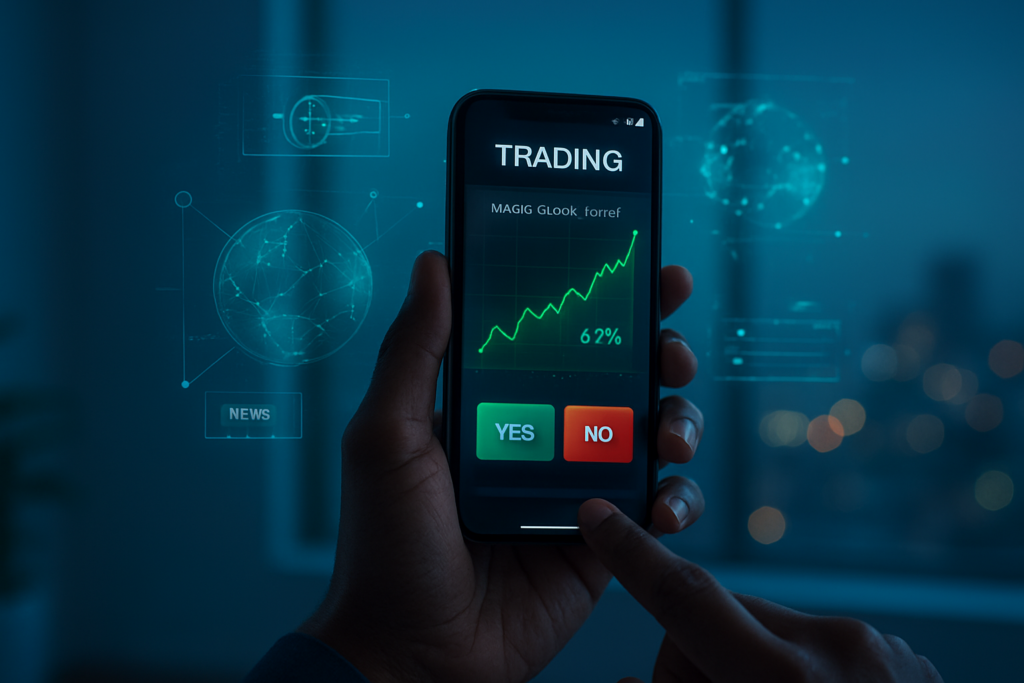
As of late January 2026, the financial landscape has undergone a tectonic shift that few saw coming just two years ago. The integration of prediction markets into the everyday brokerage accounts of millions has transformed "event contracts" from a niche obsession into a multi-billion dollar pillar of mainstream finance. Today, the ability to trade on the outcome of a Federal Reserve meeting or a geopolitical standoff is as accessible as buying a fractional share of an index fund.
Currently, the market is bracing for the January 28 Federal Reserve announcement. While traditional futures markets suggest a modest 16% chance of a rate cut, prediction markets on Robinhood Markets, Inc. (NASDAQ: HOOD) and Kalshi are signaling a 96% "certainty" of a pause. This massive divergence is generating unprecedented interest, with over $1.2 billion in notional value changing hands in the last week alone. Traders are increasingly looking to these markets—not as a form of gambling, but as the most accurate "financial weather vane" available in the digital age.
The Market: What's Being Predicted
The central engine of this revolution is the "Binary Event Contract"—a simple "Yes/No" proposition that settles at $1.00 if an event occurs and $0.00 if it does not. Through strategic partnerships with Kalshi, a CFTC-regulated exchange, and the recent vertical integration of Robinhood Markets, Inc. (NASDAQ: HOOD) into the exchange space, retail traders now have 24/7 access to hundreds of these markets. These contracts are currently trading on Robinhood, Webull, and Interactive Brokers Group, Inc. (NASDAQ: IBKR) through its ForecastX subsidiary.
The sheer volume of these markets is staggering. As of January 27, 2026, Robinhood has surpassed 11 billion event contracts traded since its initial pilot launch in late 2024. While political outcomes—such as the 2026 U.S. Midterm elections—remain the "heavyweights" of the platform, high-frequency "hourly" contracts on S&P 500 movements and Bitcoin price targets have become the bread and butter for retail speculators.
Liquidity has improved dramatically, thanks to the entry of institutional market makers like Susquehanna International Group (SIG). In the past, a $100,000 bet could move a niche prediction market by 10 or 20 points. Today, the "Robinhood effect" ensures that even multi-million dollar positions in major economic contracts experience minimal slippage. This deep liquidity has allowed these platforms to challenge the dominance of offshore, unregulated competitors like Polymarket, which, despite its massive global mindshare, now shares the stage with the U.S.-regulated giants.
Why Traders Are Betting
The primary driver of the current "betting fever" is the search for "Alpha"—information that the traditional market hasn't priced in yet. Traders are using prediction markets to hedge real-world risks. For example, a homebuyer might buy "Yes" contracts on a Fed rate hike to offset the cost of their potential mortgage increase. This "financialization of information" has moved beyond speculation into a form of personal insurance.
Recent "whale" activity has also fueled the fire. In mid-January 2026, a series of high-conviction trades on Venezuelan political stability—dubbed the "Maduro Trade"—saw massive returns for early movers, signaling a major geopolitical shift before traditional news outlets could even confirm the story. This "wisdom of the crowd" often acts as a leading indicator, moving 10 to 15 minutes ahead of the Bloomberg terminal.
Furthermore, the psychology of the retail trader has evolved. The "gamification" of the 2021 meme-stock era has matured into a more sophisticated "skin in the game" philosophy. Notable retail "whales," some generating over $100,000 in monthly profits by specializing in niche categories like box office results or hyper-local weather patterns, have become influencers in their own right. They argue that prediction markets are the only "honest" markets because they reward accuracy over hype.
Broader Context and Implications
The mainstreaming of prediction markets via Robinhood and Webull represents a victory for the "democratization of finance." This shift was largely enabled by the CLARITY Act of 2025, which provided a clear federal regulatory roadmap for event derivatives. However, the road hasn't been entirely smooth. Just this month, regulators in Massachusetts and New York issued cease-and-desist orders against certain sports-related contracts, highlighting a growing tension between federal oversight and state-level gambling concerns.
Historical data from the 2024 U.S. election proved that prediction markets were significantly more accurate than traditional polling, a fact that has emboldened the industry. This accuracy has led to the emergence of "Information Finance," a sector where firms like Intercontinental Exchange, Inc. (NYSE: ICE) are now investing billions. These companies view prediction market data as a valuable commodity, selling real-time probability feeds to hedge funds and government agencies.
Perhaps the most significant move in this space occurred on January 21, 2026, when Robinhood completed its acquisition of a 90% stake in MIAXdx. By owning its own exchange and clearinghouse, Robinhood is signaling that it no longer wants to be just a storefront for Kalshi’s products; it wants to be the primary architect of the world's event-trading infrastructure.
What to Watch Next
The immediate focus for the market is the January 28 FOMC meeting. If the Fed defies the 96% probability and cuts rates, it could trigger one of the largest "liquidation events" in the history of prediction markets, testing the resilience of the clearinghouses. Beyond the Fed, the upcoming Super Bowl LXI in February is expected to be the largest sports-related prediction event in history, with Webull already offering zero-commission trading for the game.
Investors should also monitor the legal battles in Massachusetts. A court victory for Kalshi could open the floodgates for more "exotic" contracts across all 50 states, while a loss could force platforms to geofence their most popular products. The evolution of the "Prediction Hub" on these apps is also expected to include more AI-driven sentiment analysis, helping users synthesize thousands of news points into a single "Yes/No" trade.
Finally, keep an eye on the integration of these markets into retirement accounts. There are already whispers in Washington about a pilot program that would allow 401(k) participants to use event contracts for downside protection against inflation—a move that would truly cement prediction markets as a permanent fixture of the American financial diet.
Bottom Line
The integration of prediction markets into the platforms of Robinhood and Webull has fundamentally changed how the public interacts with news and data. What was once a hobby for mathematicians and political junkies is now a legitimate asset class used by millions to hedge risk and express opinions. The "wisdom of the crowd" is no longer a theoretical concept; it is a tradable, liquid, and highly accurate financial instrument.
This shift tells us that the future of finance is not just about what companies are worth, but about what events are worth. As we look toward the 2026 Midterms and beyond, these markets will likely continue to outperform traditional forecasting methods. While regulatory hurdles remain, the momentum behind "Information Finance" appears unstoppable.
For the retail trader, the message is clear: the era of being a passive observer of world events is over. In the world of 2026, every headline is a trade, and every prediction has a price.
This article is for informational purposes only and does not constitute financial or betting advice. Prediction market participation may be subject to legal restrictions in your jurisdiction.
PredictStreet focuses on covering the latest developments in prediction markets. Visit the PredictStreet website at https://www.predictstreet.ai/.