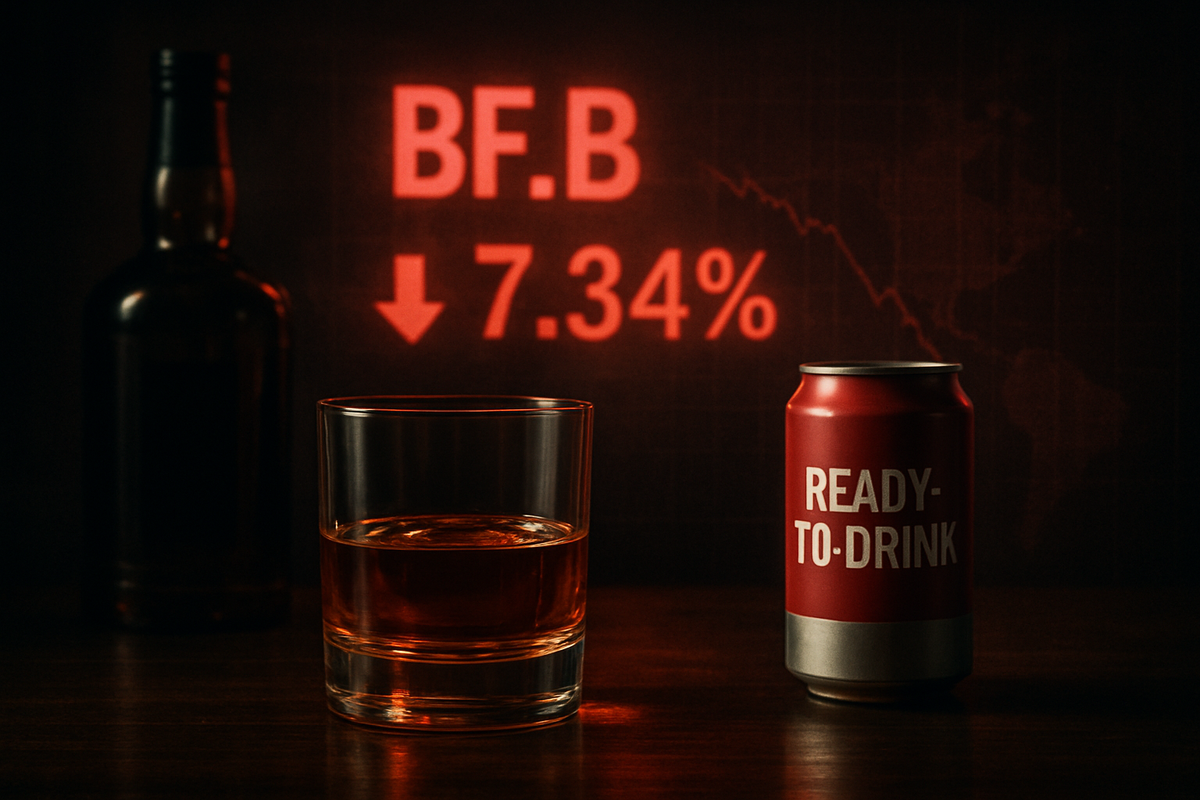
The storied halls of the American spirits industry were shaken today as Brown-Forman (NYSE: BF.B) saw its share price crater by 7.34% following the release of its third-quarter fiscal 2026 earnings report. Despite posting a surprise beat on both the top and bottom lines, investors reacted aggressively to the underlying rot in volume growth and a murky outlook for the remainder of the year. The decline highlights a persistent struggle for the Louisville-based distiller as it grapples with a global consumer base that is increasingly tightening its belt and rethinking its relationship with premium alcohol.
This sharp sell-off reflects more than just a single quarter’s performance; it is a manifestation of the "post-pandemic hangover" that has plagued the industry for nearly two years. While the company reported earnings per share (EPS) of $0.58—well ahead of the $0.47 analyst consensus—the market looked past the profit numbers to focus on a 5.4% decline in reported revenue in several key segments. The immediate implication is clear: the era of easy growth fueled by home-bar stocking is officially over, and the path to recovery for high-end spirits is fraught with economic and geopolitical hurdles.
A Disconnect Between Profits and Prospects
The details of today’s earnings report tell a tale of two realities. On one hand, Brown-Forman (NYSE: BF.B) managed to pull internal levers to boost profitability. Its $1.06 billion in revenue exceeded the $1.0 billion estimate, and aggressive cost-cutting measures allowed the company to deliver a significant EPS beat. However, the volume of spirits actually leaving the warehouses tells a different story. Organic sales growth remained flat or negative across major developed international markets, as the company continues to battle "inventory normalization"—a polite industry term for retailers and distributors having far more Jack Daniel’s on hand than they can sell.
The timeline of this decline traces back to the 2024-2025 period, when the massive surge in pandemic-era demand finally hit a wall. During the lockdowns, consumers spent lavishly on "premiumization," buying expensive bottles of Woodford Reserve and Old Forester to enjoy at home. By the time 2026 rolled around, that trend had inverted. Today’s report confirmed that many consumers are now "trading down" to smaller bottle sizes or cheaper alternatives, while others are simply drinking less frequently.
The reaction from institutional investors was swift. Key stakeholders expressed concern over the "low visibility" cited by CEO Lawson Whiting during the earnings call. While the company has maintained its dividend—marking 42 consecutive years of growth—the 7.34% drop suggests that a reliable dividend is no longer enough to mask the lack of organic volume growth.
Winners and Losers in a Sobering Market
In the wake of Brown-Forman’s (NYSE: BF.B) stumble, the broader spirits sector is being re-evaluated. The clear "losers" in this environment are the traditional premium heavyweights. Diageo (NYSE: DEO), the maker of Johnnie Walker and Smirnoff, saw its stock feel the heat today as well, following its own recent guidance cut and dividend stagnation. Similarly, Pernod Ricard (OTC: PRNDY) continues to struggle with a catastrophic 25% sales slump in China, where the luxury spirits market has essentially evaporated. These companies are all fighting the same uphill battle: a global consumer who is increasingly price-sensitive and health-conscious.
However, there are pockets of resilience. The "Ready-to-Drink" (RTD) category continues to be a rare bright spot. Brown-Forman’s partnership with Coca-Cola (NYSE: KO) for the canned "Jack & Coke" cocktail remains a high-volume success, attracting younger drinkers who prefer convenience over the ritual of mixing a drink. Companies that pivoted early toward these lower-margin but higher-velocity products, such as the Boston Beer Company (NYSE: SAM) with its diverse beyond-beer portfolio, are arguably better positioned to weather the current storm than those strictly tethered to the "super-premium" bottle market.
The End of the Premiumization Era?
The current crisis at Brown-Forman (NYSE: BF.B) fits into a broader industry trend known as the "premiumization plateau." For a decade, the spirits industry operated on the assumption that consumers would always be willing to pay more for "better" alcohol. This trend was supercharged by the pandemic but has now collided with high interest rates and persistent inflation. The result is a shift in consumer behavior toward "selective premiumization"—where people buy one high-end bottle a year instead of one a month.
Furthermore, geopolitical tensions have added a layer of complexity that previous generations of distillers didn't have to face. Flagship American brands like Jack Daniel’s have become pawns in international trade disputes, with "tit-for-tat" tariffs targeting American whiskey. These regulatory headwinds have compressed operating margins at a time when the company needs every cent to reinvest in marketing. This mirrors historical precedents, such as the trade wars of the late 2010s, but with the added weight of a more fragile global economy.
There is also the cultural shift of "zebra striping"—a trend among Gen Z and Millennial consumers where they alternate between alcoholic and non-alcoholic beverages during a night out. This behavior, once a niche health choice, has become mainstream, further dampening the total volume of spirits sold.
Looking Ahead: A Strategic Pivot Required
In the short term, Brown-Forman (NYSE: BF.B) faces a grueling period of inventory management. The company must wait for the "destocking" cycle at the retail level to conclude before it can see a true reflection of consumer demand in its shipment numbers. Strategically, the company is likely to double down on its RTD portfolio and emerging markets. While the U.S. and Europe are saturated and sluggish, markets like Mexico, Brazil, and Turkey have shown double-digit organic growth, offering a potential lifeline.
Long-term, the challenge will be re-engaging a consumer who has learned to live without high-priced spirits. Potential scenarios include a further consolidation of the industry, as smaller, independent craft distillers—once the darlings of the market—go bankrupt or are acquired by the giants at discount prices. For Brown-Forman (NYSE: BF.B), the goal will be to maintain its "brand equity" without sacrificing too much margin to promotional discounts.
Investor Takeaway: Watching the Bottom of the Glass
The 7.34% drop in Brown-Forman (NYSE: BF.B) shares is a wake-up call for the entire consumer staples sector. It serves as a stark reminder that even the most "recession-proof" industries are vulnerable to shifts in consumer sentiment and the long-tail effects of a global pandemic. The key takeaway for investors is that a "beat" on earnings can be hollow if it is driven by cost-cutting rather than actual demand.
Moving forward, the market will be looking for signs of stabilization in the U.S. whiskey category and any relief on the international tariff front. The spirits industry is not going away, but it is undergoing a fundamental transformation. For now, investors should watch the volume figures and the performance of the RTD segment as the primary indicators of a potential turnaround. Until the "post-pandemic hangover" truly clears, the road for Brown-Forman and its peers remains decidedly uphill.
This content is intended for informational purposes only and is not financial advice.