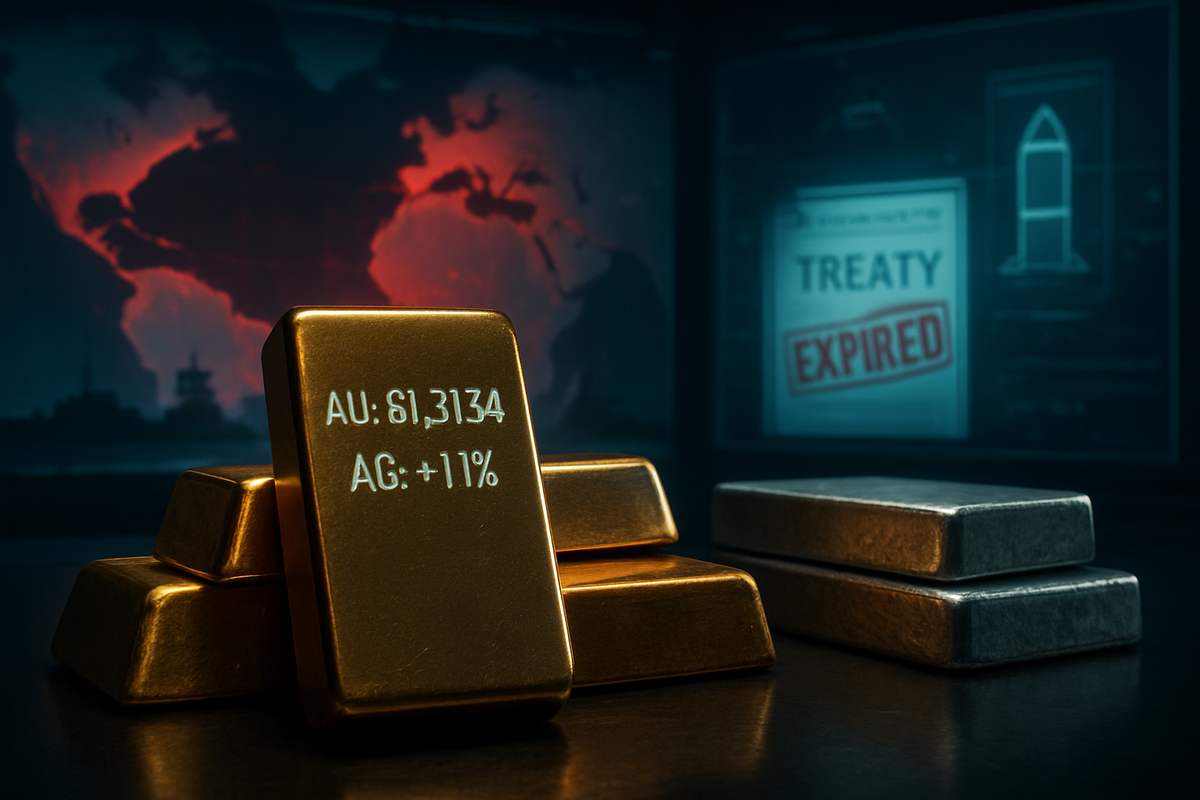
March 4, 2026 — The global financial landscape has been fundamentally altered this week as precious metals prices hit levels once considered the realm of speculative fiction. Gold has stabilized at a staggering $5,133.40 per ounce, while silver prices recorded a violent 11% surge in just five trading days, briefly touching the $90 mark. This historic rally is not merely a market fluctuation; it is a visceral reaction to a world where the guardrails of nuclear diplomacy have effectively vanished, sending investors into a desperate flight toward the ultimate "hard" assets.
The immediate implications are profound: central banks are accelerating their diversification away from sovereign debt, and the "Era of Super-Margins" has arrived for the world’s largest miners. However, this wealth is being built on a foundation of extreme geopolitical fragility. With the Strait of Hormuz currently blocked and the international nuclear order in shambles, the premium on physical safety has replaced traditional valuation metrics like interest rate differentials or inflation hedges.
The Collapse of the Nuclear Guardrails
The catalyst for this unprecedented surge can be traced back to a series of catastrophic diplomatic failures throughout early 2026. On February 5, 2026, the world entered uncharted territory when the New START treaty—the final remaining nuclear arms control agreement between the United States and Russia—officially expired without a successor. This expiration removed the last formal limits on the world’s two largest nuclear arsenals, marking the definitive dawn of what historians are already calling the "Third Nuclear Age."
The tension reached a breaking point on February 28, 2026, when a massive, coordinated military strike was launched by U.S. and Israeli forces against Iran’s nuclear and military infrastructure. The operation resulted in the death of Iran’s Supreme Leader and the immediate closure of the Strait of Hormuz by the Islamic Revolutionary Guard Corps. As roughly 20% of the world’s petroleum and liquefied natural gas (LNG) supplies were cut off overnight, the flight to safety became a stampede. Gold, which had already been hovering near $4,500, gapped up to an all-time high of $5,595 before settling at the current $5,133 level as of this morning.
The Mining Giants: Super-Margins Amidst Operational Rifts
The astronomical rise in metal prices has transformed the balance sheets of major producers, yet the sector faces its own internal turmoil. Newmont Corporation (NYSE: NEM), the world’s largest gold miner, reported a record $7.3 billion in free cash flow for the previous fiscal year and has moved aggressively to return capital to shareholders via a $6 billion buyback program. However, Newmont has signaled a "production trough" for 2026, with guidance lowered to 5.3 million ounces. This supply constraint at a time of record demand has only served to pour gasoline on the fire of rising prices.
Meanwhile, Barrick Gold Corporation (NYSE: GOLD) is undergoing a historic strategic pivot. To capture the current valuation premium, Barrick is reportedly preparing for an IPO of its North American assets, including its cornerstone stake in Nevada Gold Mines (NGM). Despite the high prices, an intensifying legal and operational rift between Barrick and Newmont over the management of the NGM joint venture has emerged as a significant "wild card" risk. While these companies are generating record profits, the friction between the industry's two largest players threatens the stability of the very supply chains the market is relying on.
Other players, such as Agnico Eagle Mines Limited (NYSE: AEM), are emerging as "low-risk" winners. Operating primarily in Tier-1 jurisdictions like Canada and Australia, Agnico Eagle has seen its shares outperform the broader sector as investors seek to avoid the geopolitical exposure inherent in African or Middle Eastern assets. Conversely, junior miners and explorers are struggling to keep up with the rising costs of energy and security, highlighting a widening gap between the "majors" and the rest of the industry.
A Structural Shift in the Global Order
This rally represents a departure from historical norms where gold was primarily a hedge against inflation or a weak dollar. In 2026, the demand is structural. Central banks in the "Global South" have transitioned from occasional buyers to permanent accumulators of gold, viewing it as a defense against the weaponization of the global financial system. The failure of nuclear diplomacy in the Middle East and the expiration of New START have validated the thesis that sovereign risk is no longer a theoretical concern, but an active threat to capital preservation.
Silver’s 11% weekly jump highlights its unique dual-identity in this new era. While it serves as a "poor man's gold" in times of crisis, its role as a critical component in advanced weaponry and autonomous energy systems has created a supply-demand imbalance that is now reaching a critical state. The "silver rally" of 2026 is driven by the realization that in a world of high-intensity conflict, industrial metals are as strategic as the fuel that powers them.
The Road to $6,000: What Comes Next?
In the short term, the market is laser-focused on the Strait of Hormuz. Any sign of a prolonged blockade will likely send gold toward the $6,300 year-end targets set by major investment banks. Analysts are also watching for a potential "proliferative domino effect" in East Asia; if North Korea or other regional powers ramp up their nuclear rhetoric in response to the Iran strikes, the floor for precious metals will likely move even higher.
Investors should also prepare for high-frequency volatility. The recent 11% jump in silver was followed by a series of "flash crashes" as algorithmic traders triggered profit-taking at the $100 psychological level. The market is currently in a state of "extreme greed," and while the fundamental backdrop is bullish, the technical indicators suggest that the path forward will be fraught with violent corrections.
Summary and Investor Outlook
The massive rally in precious metals in March 2026 is a sobering reflection of a world in geopolitical transition. Gold at $5,133 and silver's double-digit weekly gains are the prices the market is paying for the loss of global diplomatic stability. While companies like Newmont (NYSE: NEM) and Barrick Gold (NYSE: GOLD) are reaping the rewards of record margins, they are doing so in an environment where operational risk is at a multi-decade high.
Moving forward, investors must differentiate between "safe-haven" assets and "safe-haven" jurisdictions. The era of assuming that a high gold price lifts all boats is over. In the coming months, the focus will shift toward the resolution of the NGM joint venture rift and the potential for a new global security framework—or the lack thereof. For now, the "Third Nuclear Age" has cemented the status of gold and silver as the only assets that no one else’s promise can devalue.
This content is intended for informational purposes only and is not financial advice.