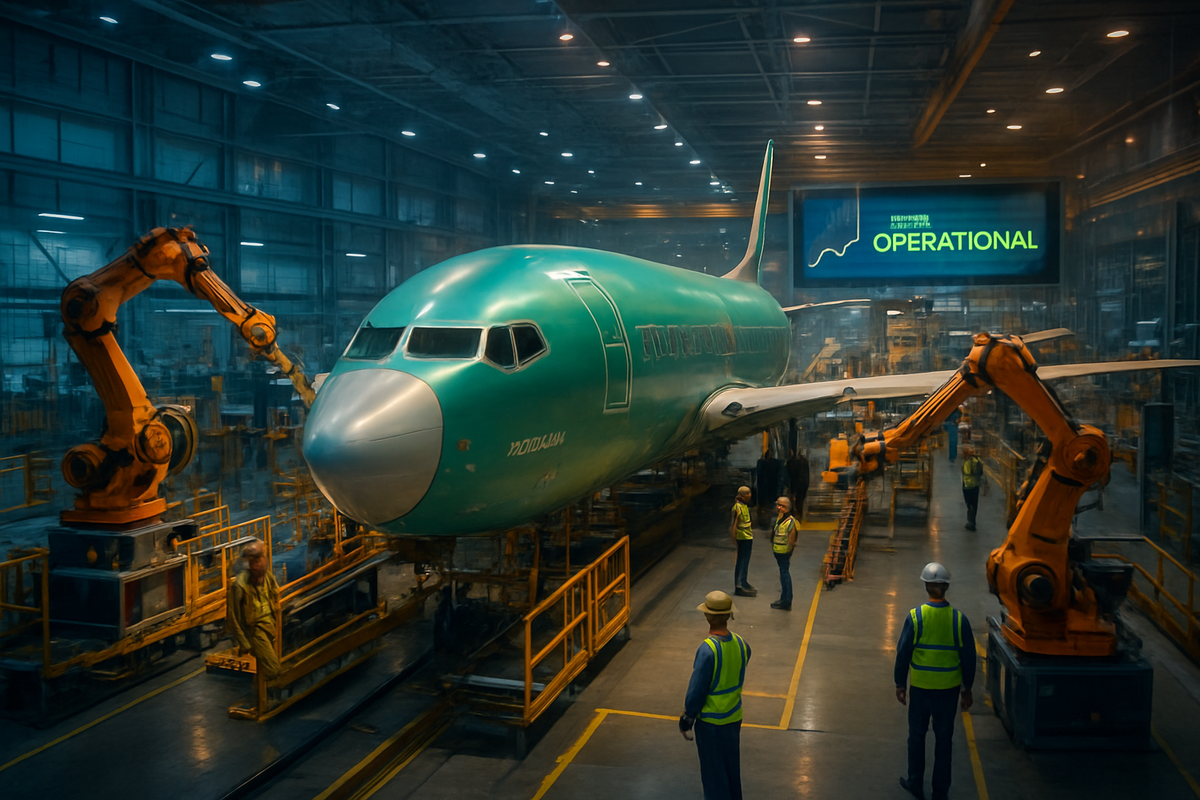
As the first quarter of 2026 nears its end, The Boeing Company (NYSE: BA) finds itself at a critical crossroads in its decades-long history. In a series of high-stakes updates delivered this week, Boeing leadership reinforced its commitment to returning the Commercial Airplanes (BCA) division to profitability within the 2026 calendar year, even as the aerospace giant grapples with the lingering shadows of production caps and a massive debt load. For investors and industry observers, the current fiscal year represents a "moment of truth" for a company that has spent the better part of the last two years attempting to rebuild its reputation for quality and safety from the ground up.
The immediate implications of Boeing's latest financial guidance are a mixture of cautious optimism and sobering reality. While the company has managed to stabilize its production lines and reduce manufacturing defects by 40% over the last year, the financial "lift-off" remains heavy. Management confirmed that the Commercial Airplanes division is currently operating at a loss, with margins expected to remain negative through the first half of 2026. However, the strategic shift toward vertical integration and a "quality-first" manufacturing philosophy is intended to finally flip the script, potentially ending a multi-year streak of multi-billion dollar losses that have defined the post-pandemic era for the Virginia-based manufacturer.
The Long Climb: A Timeline of Crises and New Leadership
The road to 2026 has been marked by a relentless series of operational and regulatory hurdles. The catalyst for Boeing’s current "quality over speed" strategy was the January 2024 Alaska Airlines mid-air door-plug blowout, an event that triggered a total overhaul of the company’s safety culture. This was followed by a 53-day strike by the International Association of Machinists (IAM) in late 2024, which effectively paralyzed production of the 737 MAX and 777X programs. The strike ended in November 2024 with a 38% pay increase for workers, adding nearly $1 billion in labor costs and forcing a methodical, slow restart of assembly lines throughout 2025.
Central to this transformation is CEO Kelly Ortberg, who took the helm in August 2024. In a move that signaled a break from the "financial engineering" era, Ortberg relocated his office to Seattle to be closer to the factory floors. His primary objective has been the elimination of "travelled work"—the practice of finishing assembly tasks out of sequence—which has been identified as a root cause of quality escapes. On March 17, 2026, Boeing CFO Jay Malave provided a critical update, noting that while these quality reforms have temporarily suppressed delivery volumes, they are the "necessary medicine" to achieve a predictable, profitable production rate by the end of this year.
The timeline leading to today’s announcement includes the monumental $4.7 billion acquisition of Spirit AeroSystems (NYSE: SPR), which was finalized in December 2025. By bringing its primary fuselage supplier back in-house, Boeing has attempted to resolve systemic quality issues at the source. However, the integration has been more expensive than initially projected. Early 2026 audits revealed deeper operational challenges within Spirit’s facilities, contributing to a projected operating margin loss of 7.5% to 8% for the Commercial Airplanes division in the current quarter. Market reaction has been tepid, with shares of Boeing trading sideways as investors weigh the promise of future profitability against the reality of a $54 billion debt burden.
Winners, Losers, and the Ripple Effects of Recovery
The primary beneficiary of Boeing’s slow and steady recovery is undoubtedly its workforce and long-term quality standards, but the financial "winners" are less obvious in the short term. General Electric (NYSE: GE), through its GE Aerospace division, stands to benefit as Boeing’s 737 MAX production finally clears the Federal Aviation Administration (FAA) caps. As Boeing moves from its current cap of 42 aircraft per month toward a target of 53 by the end of 2026, engine demand will surge, providing a reliable tailwind for GE’s services and original equipment business.
On the losing side of this equation is Airbus (OTC: EADSY), which has enjoyed a period of unchallenged dominance in the narrowbody market. While Airbus remains the market leader, Boeing’s renewed focus on factory-floor stability means the American manufacturer is finally becoming a reliable competitor again. However, the true "losers" in the immediate term may be the airlines that have had to extend the life of older, less fuel-efficient fleets due to Boeing's delivery delays. Carriers such as Southwest and United have had to pivot their growth strategies as Boeing’s 2026 "pivot year" means some 737 MAX deliveries are being pushed into late 2027.
The supply chain also faces a bifurcated reality. Smaller Tier 2 and Tier 3 suppliers, who were squeezed during the 2024 production halts, are now seeing a steadying of orders. Conversely, the acquisition of Spirit AeroSystems has effectively ended the independence of one of the industry's largest players, leading to a consolidation of the aerospace landscape that may limit competitive pricing for components in the future.
Broad Industry Trends and Regulatory Oversight
Boeing’s struggle to hit its 2026 profitability target is emblematic of a broader trend in global manufacturing: the return of "sovereign" supply chains and the prioritization of resilience over efficiency. The re-acquisition of Spirit AeroSystems marks the end of a 20-year experiment in outsourcing critical aerospace components, a move that other industrial giants are watching closely. This shift back to vertical integration suggests that the industry is moving away from the "Just-in-Time" models that proved so fragile during the pandemic and subsequent safety crises.
Regulatory implications remain the most significant external factor. The FAA’s "strict on-site monitoring presence" continues into 2026, with federal inspectors still required to sign off on every aircraft before it leaves the factory. This level of oversight is unprecedented and has set a new global standard for aerospace regulation. Historical precedents, such as the recovery of the DC-10 or the early teething issues of the 787 Dreamliner, pale in comparison to the structural and cultural overhaul currently mandated by the FAA. This "regulatory shadow" means Boeing’s return to profitability is not just a financial hurdle, but a political and bureaucratic one.
The Path Ahead: Strategic Pivots and the 777X
Looking forward, the remainder of 2026 will be defined by two major factors: the successful integration of Spirit AeroSystems and the certification of the 777X. The 777X program, which faced a $900 million pre-tax charge in 2025, is now the cornerstone of Boeing’s long-term widebody strategy. If the company can achieve certification and begin deliveries by early 2027, it will provide a massive cash flow boost that could finally help the company tackle its mountain of debt.
In the short term, Boeing must prove it can hit its "stretch goal" of 53 737 MAX units per month by December 2026. Achieving this without a resurgence of quality defects is the only way the company will regain the full confidence of the FAA and the flying public. We may see Boeing explore further asset sales in its defense and space sectors to accelerate debt repayment, especially as the Commercial Airplanes division continues to burn cash in the first half of the year. The long-term success of the company depends on whether the "Ortberg Era" can truly replace a culture of quarterly earnings with a culture of engineering excellence.
Wrap-Up and Investor Outlook
Boeing’s announcement of a "pivot year" in 2026 confirms that the path to profitability is longer and steeper than many had hoped in late 2024. The key takeaways for the market are clear: Boeing is prioritizing the long-term integrity of its production system over short-term financial targets. While the deferred goal of $10 billion in free cash flow is a disappointment, the 40% reduction in defects and the stabilization of the supply chain suggest that the underlying "engine" of the company is finally being repaired.
Moving forward, the market will remain volatile as Boeing navigates the final stages of Spirit's integration and FAA oversight. Investors should watch for the mid-2026 production rate updates and any news regarding the 777X flight test program. The lasting impact of this era will likely be a more conservative, quality-focused Boeing that, while less profitable in the immediate term, provides a more stable foundation for the global aviation industry. For now, Boeing is flying through heavy weather, but for the first time in years, the flight path appears to be leveled out.
This content is intended for informational purposes only and is not financial advice.