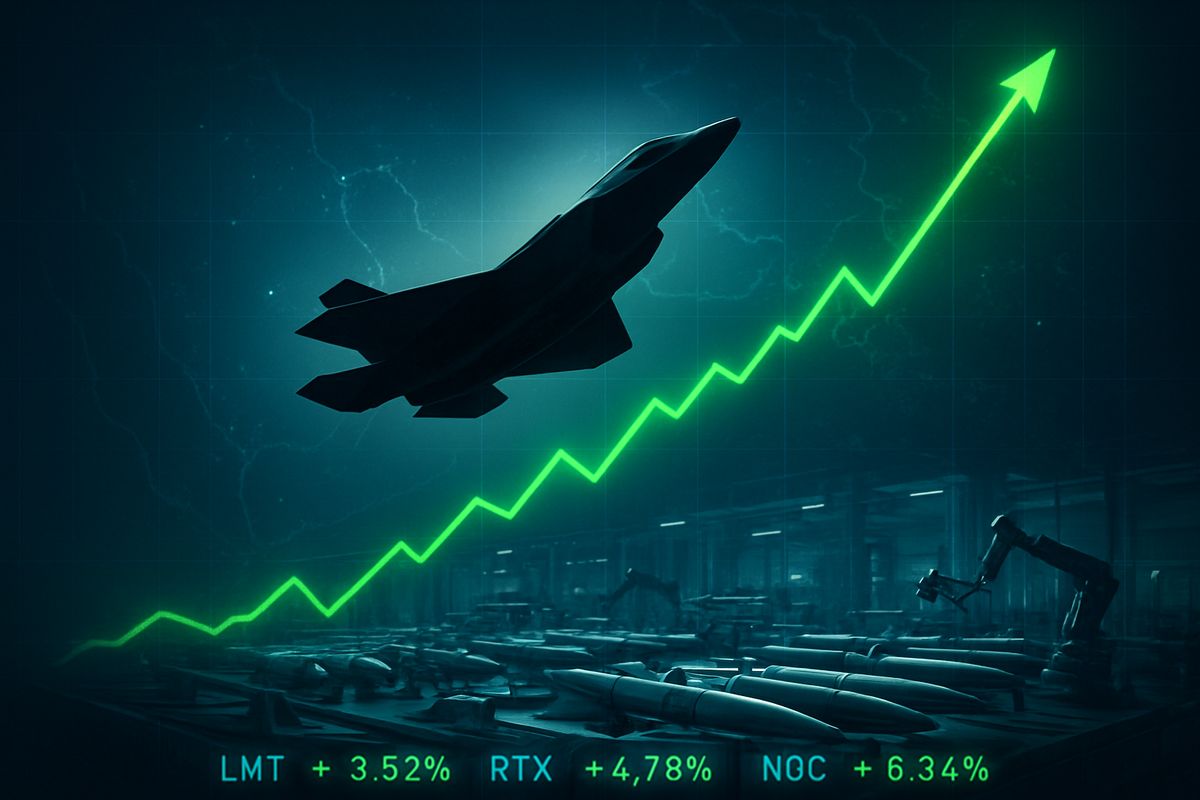
The escalation of a high-intensity regional conflict in the Middle East has sent shockwaves through global financial markets, driving U.S. defense stocks to unprecedented heights. Following the launch of "Operation Epic Fury" on February 28, 2026—a coordinated U.S.-Israeli campaign against Iranian strategic assets—investors have flooded into the aerospace and defense sector, anticipating a prolonged period of record-breaking military expenditures. As of March 16, 2026, the sector has undergone a massive "re-rating," as the sheer scale of munitions consumption in the opening weeks of the war indicates that the Pentagon will require tens of billions of dollars in emergency supplemental funding to replenish depleted stockpiles.
The immediate implications are staggering: major defense contractors are now operating under a de facto wartime production mandate. With the Strait of Hormuz effectively paralyzed and global oil prices surging past $100 per barrel, the market is pricing in not just a short-term tactical intervention, but a structural shift in U.S. defense policy. Analysts suggest that the "burn rate" of precision-guided munitions and interceptors during the first 17 days of the conflict has outpaced even the most aggressive projections, setting the stage for a replenishment super-cycle that could bolster order backlogs for the next decade.
The Fog of War and the Rush for "Exquisite" Munitions
Operation Epic Fury began in late February with a barrage of over 6,000 precision strikes targeting Iranian nuclear facilities, Islamic Revolutionary Guard Corps (IRGC) command centers, and ballistic missile production sites. The conflict reached a fever pitch on March 13, following reports of the death of high-ranking Iranian leadership in Tehran. Iran’s retaliation via drone swarms and ballistic missile attacks against U.S. bases in Iraq, Qatar, and Bahrain has necessitated a massive deployment of air defense systems, highlighting a critical vulnerability: the rapid exhaustion of the U.S. interceptor inventory.
The timeline of events moved with startling speed. By March 2, only days after the initial strikes, the defense sector saw a collective "gap up" in valuation. Initial market reactions were driven by the realization that the U.S. was expending "years" worth of critical munitions in a matter of days. The Pentagon has already submitted an emergency supplemental request for $50 billion under the Middle East Security Emergency Act of 2026, aimed specifically at backfilling the Tomahawk cruise missiles and Patriot interceptors used to blunt Iranian counter-attacks. This request, currently moving through Congress with rare bipartisan speed, represents one of the largest single-event funding injections in modern military history.
Titans of the Arsenal: The Primary Beneficiaries
Lockheed Martin (NYSE: LMT) has emerged as a central pillar of the current market rally. Shares of the defense giant hit an all-time high of $692 on March 2 and have remained buoyant as the F-35 Lightning II continues to lead strike packages over Iranian airspace. The company is currently sitting on a record backlog of $194 billion. Beyond the aircraft, Lockheed’s PAC-3 missile production is now under a presidential mandate to quadruple, moving from an annual output of 600 units to 2,000. On March 9, the company secured a $700.4 million modification for F-35 long-lead materials, signaling that the Pentagon is preparing for a sustained conflict.
RTX Corporation (NYSE: RTX), formerly known as Raytheon, has seen its stock soar to a record $215. The conflict has become a showcase for RTX’s "exquisite" weaponry, including the Tomahawk cruise missile and the Patriot/AMRAAM air defense suites. With a backlog that swelled to $268 billion by mid-March, RTX is the primary beneficiary of the $256.2 million emergency contract awarded to bolster F135 engine production and spare parts. Meanwhile, Northrop Grumman (NYSE: NOC) saw its shares surge 6% at the conflict’s onset, largely due to the operational debut of the B-21 Raider stealth bomber. Analysts have revised price targets for NOC as high as $785, citing the high demand for deep-strike capabilities and the extensive use of the B-2 Spirit fleet for penetrating hardened Iranian bunkers.
A Paradigm Shift in Defense Spending
This event fits into a broader industry trend where "mass" and "precision" are colliding. For years, the defense industry focused on low-rate production of high-tech assets. The Iran escalation has proved that in a peer-to-peer or high-intensity regional conflict, the U.S. requires both high-tech capability and massive inventory depth. This has ripple effects on the entire supply chain, from specialized semiconductor manufacturers to propulsion systems providers. The regulatory landscape is also shifting; the "Middle East Security Emergency Act" includes provisions to bypass traditional multi-year procurement hurdles, allowing the Pentagon to sign multi-year contracts for munitions—a move the industry has lobbied for since the early 2020s.
Historical precedents such as the post-9/11 defense surge or the replenishment cycles seen during the Ukraine-Russia conflict pale in comparison to the daily "burn rate" of Operation Epic Fury. While previous conflicts focused on ground munitions or older-generation missiles, the current war is consuming the most expensive and sophisticated assets in the U.S. arsenal at a rate of $1 billion to $2 billion per day. This transition marks the end of the "peace dividend" era and the beginning of a "war footing" economy, where defense contractors are valued not just on their current revenue, but on their industrial throughput and surge capacity.
The Road Ahead: Strategic Pivots and Scenarios
In the short term, the primary challenge for the "Big Three" defense firms will be labor and supply chain constraints. Quadrupling production for complex systems like the THAAD interceptor or PAC-3 missiles cannot happen overnight. Investors should expect a series of strategic pivots, where these companies move away from non-core segments to focus entirely on high-throughput manufacturing of "attritable" and "exquisite" systems. The emergence of autonomous drone swarms as a primary Iranian tactic may also force Lockheed and RTX to accelerate the deployment of directed-energy (laser) weapons and high-power microwave systems to provide more cost-effective defense than million-dollar interceptors.
Market opportunities will likely emerge in the "Second Tier" of the defense industrial base—the sub-contractors who provide the sensors, chips, and energetic materials required by the primes. However, the risk of a wider regional conflagration involving other major powers remains a significant tail risk. If the conflict remains localized to Iran but lasts through the end of 2026, the defense sector may see a multi-year period of double-digit growth, sustained by the need to not only win the current war but to rebuild a credible deterrent for future theaters.
Investor Outlook: Navigating the Wartime Economy
The rally in defense stocks is more than a knee-jerk reaction to a geopolitical crisis; it is a fundamental re-evaluation of the sector’s role in a fragmented and volatile global order. The key takeaways from the first three weeks of Operation Epic Fury are clear: the U.S. arsenal is significantly more depleted than previously admitted, and the cost of replenishment will be astronomical. As the Pentagon’s $50 billion supplemental request moves toward passage, the market will likely continue to reward those companies with the largest backlogs and the most robust manufacturing pipelines.
Moving forward, the market will be hyper-focused on quarterly "book-to-bill" ratios and any signs of supply chain bottlenecks that could hamper the mandated production ramp-up. Investors should watch for the official passage of the Middle East Security Emergency Act and subsequent contract awards, which will serve as the next major catalysts for the sector. While the human and geopolitical costs of the escalating Iran war are tragic, the financial reality is that the defense industrial base has entered a new, high-growth epoch that will define the market for the remainder of the decade.
This content is intended for informational purposes only and is not financial advice.