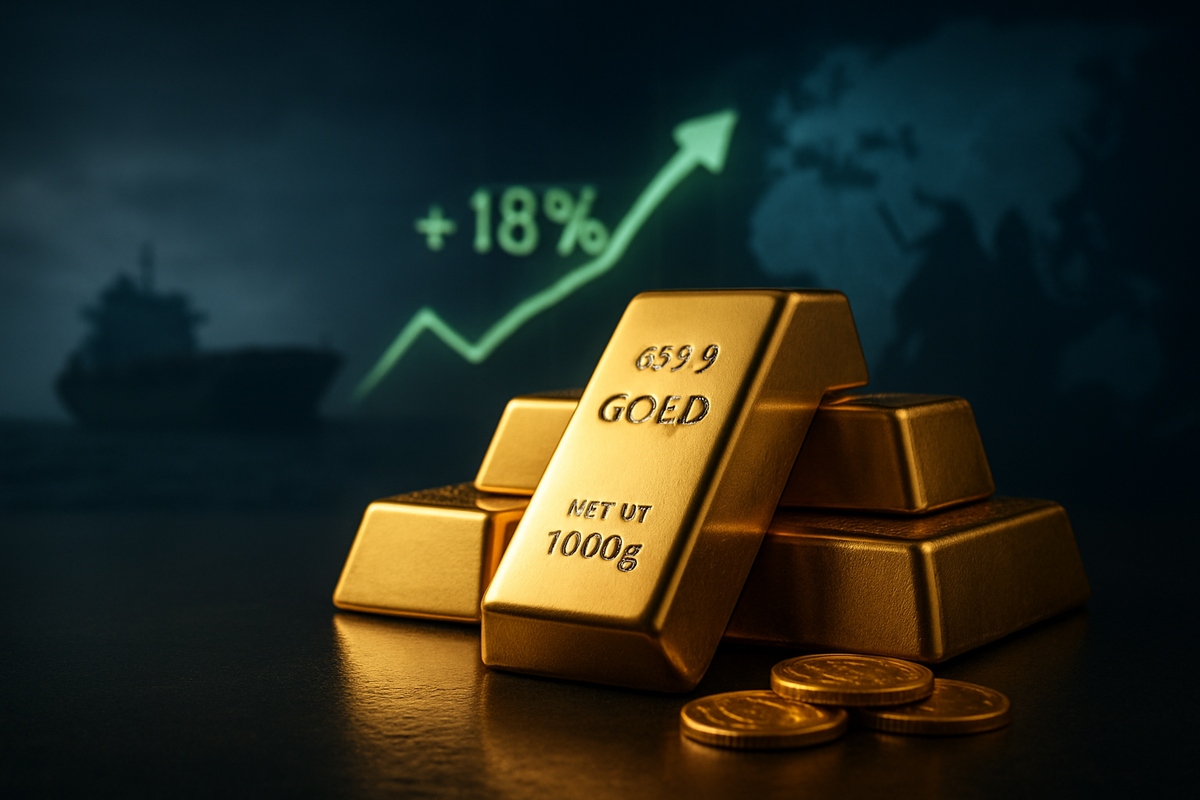
February 24, 2026 — Gold prices surged to a historic high of $5,200 per ounce today, marking a 2% daily spike that has sent shockwaves through global financial markets. This latest rally brings the precious metal’s year-to-date (YTD) gains to a staggering 18%, as investors scramble for safe-haven assets in the face of sudden U.S. tariff policy shifts and an escalating military standoff in the Middle East.
The sudden influx of capital into bullion comes as traditional equity markets face a "risk-off" rotation. With the S&P 500 and Nasdaq cooling from their 2025 highs, the narrative of "digital gold" vs. "physical gold" has swung decisively back toward the latter. Analysts are now pointing to a confluence of policy vacuums and geopolitical flashpoints as the primary engines driving this modern-day gold rush.
A Perfect Storm: Tariffs, Courts, and Conflict
The immediate catalyst for today’s 2% jump was a "policy earthquake" originating in Washington D.C. On February 20, 2026, the U.S. Supreme Court issued a landmark ruling declaring that previous tariffs imposed under the International Emergency Economic Powers Act (IEEPA) were unlawful. This created an overnight regulatory vacuum, throwing global trade into a state of flux. In a swift countermove today, the U.S. administration invoked Section 122 of the Trade Act of 1974, announcing a temporary 15% flat tariff on all global imports. This broad, unilateral move has reignited fears of a "Trade War 2.0," weakening the U.S. dollar and pushing investors toward the stability of gold.
Simultaneously, geopolitical tensions in the Middle East reached a fever pitch this week. A significant military buildup in the region, involving U.S. carrier strike groups and a standoff with Iranian forces near the Strait of Hormuz, has added a hefty risk premium to commodities. Iran’s temporary closure of the Strait for "military drills" in mid-February threatened a vital artery for global trade, further cementing gold's role as the ultimate hedge against systemic instability.
This rally is not merely a short-term reaction; it is the culmination of a trend that began in early January. Following a record-breaking 2025 where gold prices rose nearly 65%, the metal saw a brief correction to $4,850 before this V-shaped recovery. Central banks have been the silent architects of this floor, with the World Gold Council reporting that institutions in Poland, China, and India are on track to purchase up to 800 tonnes of gold in 2026 alone, prioritizing "monetary sovereignty" over dollar-denominated reserves.
The "Golden Age" for Miners and ETFs
The surge to $5,200/oz has transformed the gold mining sector into a bastion of high-margin profitability. Newmont Corporation (NYSE: NEM), the world’s largest gold miner, has seen its stock approach its 52-week high of $134.88. Reporting its Q4 2025 earnings just last week, Newmont posted a significant beat with adjusted earnings per share (EPS) of $2.52. Under the leadership of CEO Natascha Viljoen, the company has prioritized a "margin-first" strategy, achieving record free cash flow as its All-In Sustaining Costs (AISC) remain anchored near $1,680/oz, leaving a massive $3,500 profit margin per ounce.
Similarly, Barrick Gold (NYSE: GOLD) has capitalized on the rally, with its stock up over 85% over the past twelve months. Despite a slight production dip as it sequences its mines, Barrick’s board recently sanctioned a high-profile IPO of its North American gold assets, including its stake in Nevada Gold Mines, to unlock shareholder value. Other major players like Agnico Eagle Mines (NYSE: AEM) and royalty giants like Franco-Nevada (NYSE: FNV) are also reaping the rewards of "super-margins" that resemble high-growth tech firms rather than traditional industrial operations.
Investors are also pouring record amounts into exchange-traded funds. The SPDR Gold Shares (NYSE Arca: GLD) recorded over $276 million in inflows in a single week, while the VanEck Gold Miners ETF (NYSE Arca: GDX) and the VanEck Junior Gold Miners ETF (NYSE Arca: GDXJ) have outperformed the underlying metal as traders seek operational leverage. Conversely, losers in this environment include luxury retailers like Signet Jewelers (NYSE: SIG), who face soaring input costs for their raw materials, and high-growth tech sectors that traditionally see capital outflows during "flight-to-safety" episodes.
Significance: De-Dollarization and the New Macro Reality
This event marks a significant departure from historical market cycles. Traditionally, rising interest rates or a strong dollar would dampen gold's appeal. However, in 2026, gold has decoupled from these traditional headwinds. The aggressive "de-dollarization" sentiment among BRICS+ nations and central banks has created a structural demand that persists regardless of Fed policy. The 15% global tariff surcharge acts as a "double-edged sword"—while it may be intended to protect domestic industry, it creates inflationary pressure that gold is uniquely positioned to hedge.
The current climate draws comparisons to the stagflationary periods of the 1970s, but with the added complexity of modern supply chains and digital trade. The Supreme Court's intervention in trade policy suggests a new era of "regulatory volatility," where executive power is challenged, leading to sudden, sweeping policy shifts. For partners and competitors, this means that "just-in-time" supply chains are being replaced by "just-in-case" asset allocation, with gold serving as the primary insurance policy.
The Road Ahead: Targets and Pivots
In the short term, technical analysts are eyeing the $5,500 level as the next major resistance point for gold. If the 15% flat tariff leads to a protracted trade dispute with the EU or China, gold could easily test the $6,000 mark by the end of Q3 2026. Strategic pivots are already underway in the corporate world; companies are increasingly looking at gold not just as a commodity, but as a reserve asset for their corporate balance sheets, following the lead of tech pioneers from years past.
The primary challenge for the market will be the "cost creep" in the mining sector. While automation and on-site renewable energy have kept costs down for giants like Newmont and Barrick so far, sustained high inflation could eventually eat into those 70% margins. Investors should watch for the upcoming "Trade War 2.0" negotiations in Geneva; any sign of a de-escalation in Middle Eastern tensions or a rollback of the 15% tariff could trigger a sharp, albeit likely temporary, correction in bullion prices.
A New Frontier for the Safe Haven
Today’s 2% spike is more than a daily fluctuation; it is a signal of a deepening shift in the global financial order. As gold settles at $5,200, the narrative has moved from "inflation hedge" to "geopolitical necessity." The 18% YTD gain reflects a world that is increasingly fragmented, where trust in fiat currencies and international trade agreements is being tested by both judicial rulings and military drills.
Moving forward, the market remains in a "buy-the-dip" regime. The combination of central bank accumulation and massive margin expansion for miners provides a robust foundation for the metal. For investors, the months ahead will require a keen eye on the Strait of Hormuz and the halls of Washington. In a world of 15% global tariffs and naval standoffs, gold’s ancient luster has never looked more modern.
This content is intended for informational purposes only and is not financial advice.