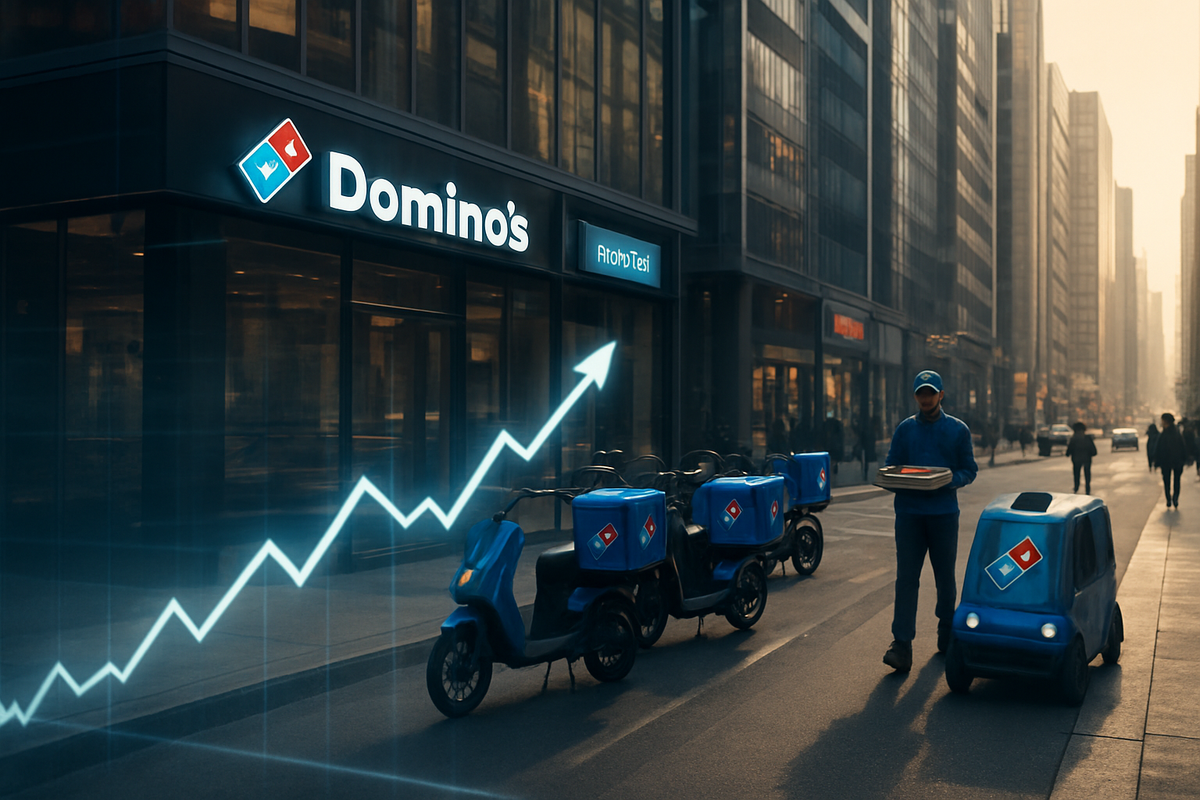
The global pizza industry has reached a definitive turning point in early 2026, and one player is emerging as the undisputed victor. Domino’s Pizza (NYSE: DPZ) has spent the last two years executing its aggressive "Hungry for MORE" strategy, a move that has not only fortified its balance sheet but has fundamentally reshaped the competitive landscape of the Quick Service Restaurant (QSR) sector. Following a blockbuster earnings report released on February 23, 2026, the company has proven that its pivot toward transaction-led growth and third-party delivery integration is paying off in dividends—literally and figuratively.
The immediate implications for the market are clear: Domino’s is no longer just a delivery company; it is a high-efficiency logistics and technology powerhouse that is successfully squeezing its primary rivals. With a forward price-to-earnings (P/E) ratio now dipping below 20x, institutional investors are beginning to view the stock as a rare value play in a growth-oriented sector. As consumer spending remains cautious amid lingering economic uncertainty, Domino's ability to offer "renowned value" while maintaining premium margins has established a formidable moat that competitors are struggling to breach.
The surge in Domino’s dominance reached a fever pitch this week following the announcement of its Q4 2025 and full-year financial results. The company reported a 6.4% year-over-year increase in revenue, totaling $1.54 billion for the quarter, with U.S. same-store sales climbing 3.7%. This performance was spearheaded by the "Hungry for MORE" initiative, which focused on four key pillars: Most delicious food, Operational excellence, Renowned value, and Enhanced digital. A standout success was the 2025 integration with DoorDash, which followed a highly successful 2024 rollout on Uber Eats, collectively contributing to over 5% of total U.S. sales by the start of 2026.
The timeline leading to this moment began in late 2023 when CEO Russell Weiner shifted the company’s focus away from price hikes and toward increasing order volume. By "fortressing" its markets—opening more stores in closer proximity to customers—Domino’s slashed delivery times and lowered costs. The strategy was met with initial skepticism by some analysts who feared it would cannibalize existing store sales. However, the 2025 data proved the opposite: the increased density allowed Domino’s to dominate the carryout market, which now accounts for a significant portion of its growth. Industry reaction to the latest earnings has been overwhelmingly positive, with the Board of Directors approving a 15% dividend hike to $1.99 per share, signaling immense confidence in the company’s cash flow stability.
The primary "losers" in this shifting landscape are legacy competitors who have failed to match Domino's technological and logistical scale. Yum! Brands (NYSE: YUM), the parent company of Pizza Hut, has seen its pizza division struggle with sales stagnation and store closures throughout 2025. While Yum! Brands remains a diversified giant, Pizza Hut has lost significant ground to Domino’s in the value-conscious demographic. Similarly, Papa John’s International (NASDAQ: PZZA) has faced what analysts describe as a "concerning erosion" of its market share. Papa John’s historical reliance on a "premium" ingredient positioning has faltered as Domino's successfully bridged the quality gap with innovations like its Parmesan Stuffed Crust, all while maintaining a more attractive price point.
Conversely, the "winners" extend beyond Domino’s shareholders. Third-party delivery platforms like Uber Technologies (NYSE: UBER) and DoorDash (NASDAQ: DASH) have benefited from the massive volume generated by the pizza leader. By ending its long-standing holdout against aggregators, Domino’s has tapped into a younger, app-native customer base that previously opted for local independent pizzerias. For investors, the most compelling takeaway is the valuation gap; while many tech-enabled retail stocks trade at 30x earnings or higher, DPZ is currently trading at a forward P/E of approximately 19.3x. This makes it an outlier in the QSR space, offering high-tech growth at a traditional value multiple.
This event fits into a broader industry trend of "digital consolidation," where companies with the largest data sets and most efficient loyalty programs are able to outmaneuver smaller players. The Domino’s Rewards program reached 37.3 million active users by the end of 2025, providing the company with a direct marketing channel that bypasses traditional advertising costs. This level of vertical integration is reminiscent of how Amazon revolutionized retail; Domino’s is effectively using its proprietary tech stack to control the entire customer journey, from the first click on an app to the final delivery at the doorstep.
Historically, the pizza industry was fragmented among thousands of local "mom and pop" shops and a few national chains. However, the 2026 landscape shows a move toward a "winner-takes-most" scenario. Domino’s has publicly stated a goal to capture 50% of the U.S. QSR pizza market, up from its current 23.3%. This mirrors the consolidation seen in other sectors, like the coffee industry’s dominance by a few major brands. Regulatory-wise, the focus remains on labor costs and the gig economy, but Domino’s "fortressing" strategy mitigates some of these risks by utilizing its own e-bike fleets and corporate-controlled delivery networks, reducing reliance on the volatile third-party driver pool.
Looking ahead, the next 12 to 24 months will be defined by how Domino’s manages its international expansion and its debt obligations. The company faces a $1.3 billion debt refinancing hurdle in mid-2027, which remains a point of caution for some conservative analysts. However, if the current trajectory of free cash flow continues—having reached over $671 million in 2025—the company is well-positioned to handle these obligations without stalling its growth engines. Short-term, the focus will be on the full-year rollout of its partnership with DoorDash in more rural U.S. markets, where Pizza Hut traditionally held a geographic advantage.
Strategic pivots may include further automation within the kitchen. With labor costs continuing to rise, rumors of "Project Dough-Bot"—an automated pizza assembly line—have begun to circulate in industry circles. If Domino’s can successfully automate even 20% of its in-store production by late 2026, the margin expansion could be unprecedented. For investors, the primary challenge will be monitoring whether the aggregator partnerships (Uber/DoorDash) begin to squeeze margins or if they continue to provide the incremental, high-margin volume that defined 2025.
In summary, Domino’s Pizza enters the second quarter of 2026 as a leaner, faster, and more dominant version of its former self. By leaning into its "Hungry for MORE" strategy, the company has successfully navigated a period of economic volatility that has left rivals like Pizza Hut and Papa John’s reeling. The combination of a massive loyalty base, strategic aggregator partnerships, and a focus on "fortressing" has created a compounding growth loop that is difficult to replicate.
For the market, the most significant takeaway is the current entry point. At under 20 times forward earnings, DPZ offers a compelling narrative for those looking for a "tech-company-disguised-as-pizza" with a 14-year history of dividend growth. Investors should watch for the Q1 2026 results to see if the DoorDash integration continues to drive the same incremental gains seen in the Uber Eats partnership. As the "Pizza Wars" of the mid-2020s continue, Domino's is not just winning; it's rewriting the rules of the game.
This content is intended for informational purposes only and is not financial advice.