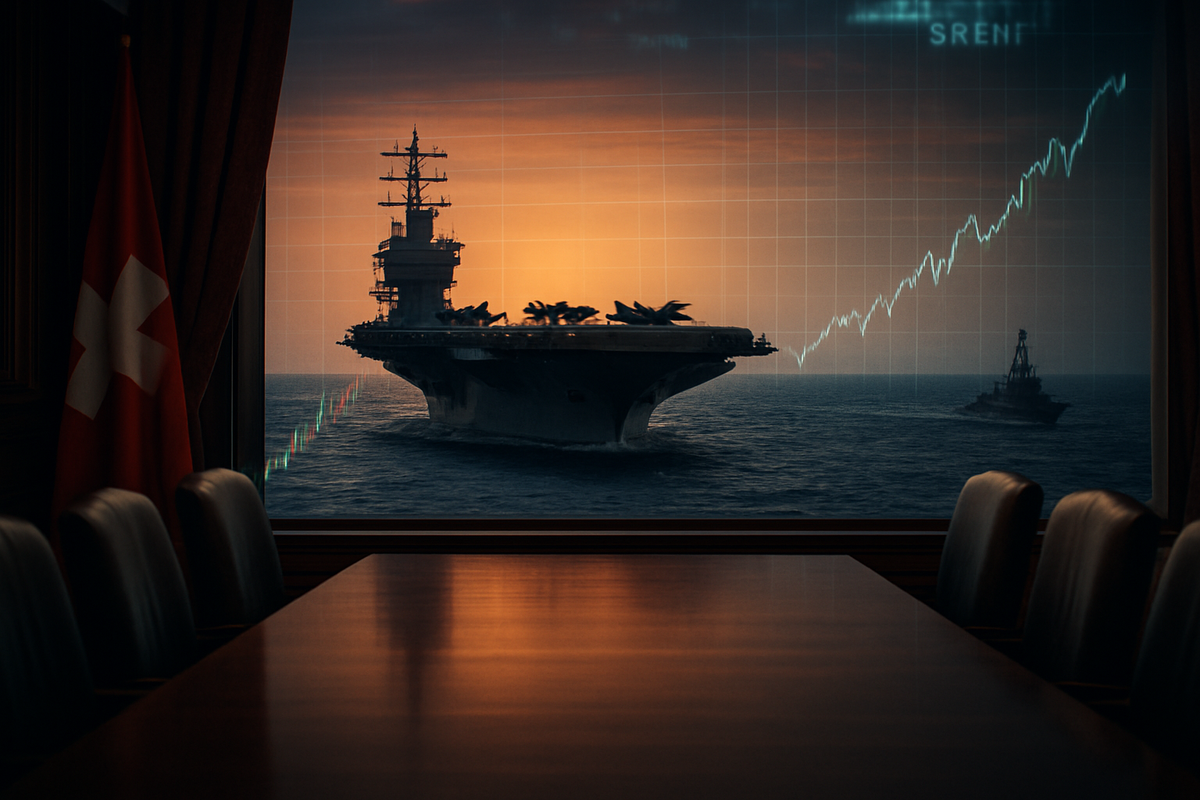
As the global financial community turns its eyes toward Geneva, Switzerland, a palpable sense of trepidation has seized the markets. Scheduled for this Thursday, February 26, 2026, the high-stakes diplomatic talks between the United States and Iran represent a critical crossroads for Middle Eastern stability and global energy security. With a massive U.S. naval armada currently positioned in the Arabian Sea and Mediterranean, the "coercive diplomacy" strategy of the current administration has pushed the geopolitical risk premium to levels not seen in over two years.
The immediate implications are stark: a breakthrough could lead to a rapid deflation of oil prices and a surge in global risk appetite, while a breakdown in negotiations could trigger a direct military confrontation. Investors are currently pricing in a "war premium" of approximately $10 to $15 per barrel, with Brent crude hovering near $72 as of Tuesday morning. The presence of two U.S. carrier strike groups within striking distance of Iranian assets underscores the "maximum pressure" backdrop against which these diplomatic maneuvers are taking place.
A Tense Buildup to the Geneva Summit
The road to this Thursday’s summit has been paved with escalating military skirmishes and a tightening economic noose. Over the past six months, the U.S. has revitalized its "Maximum Pressure 2.0" campaign, aiming to reduce Iranian oil exports to near-zero levels. This strategy has coincided with significant domestic unrest within Iran, where anti-regime protests have weakened Tehran’s negotiating hand. The timeline reached a boiling point on February 3, 2026, when an F-35 wing from the USS Abraham Lincoln (CVN-72) intercepted and destroyed an Iranian Shahed-139 drone over the Strait of Hormuz, marking the most direct military engagement between the two nations this decade.
The "armada" in question is formidable. The USS Abraham Lincoln is currently stationed in the Arabian Sea, supported by a phalanx of destroyers including the USS McFaul and USS Mitscher. Meanwhile, the world’s largest aircraft carrier, the USS Gerald R. Ford (CVN-78), is currently transiting the Mediterranean to provide a dual-carrier strike capability. On the diplomatic front, the talks are expected to feature U.S. Special Envoy Steve Witkoff and Iranian Foreign Minister Abbas Araghchi, with back-channel coordination reportedly managed by senior advisor Jared Kushner. The primary agenda item is a "detailed Iranian proposal" involving the dilution of 60% enriched uranium in exchange for immediate sanctions relief—a deal the U.S. has so far met with skepticism, demanding a total dismantling of enrichment facilities at Fordow.
Winners and Losers: The Market’s Response
The energy sector has emerged as the primary beneficiary of the heightened tensions. ExxonMobil (NYSE: XOM) and Chevron (NYSE: CVX) have seen their share prices climb to multi-year highs as they serve as natural hedges against Middle Eastern instability. Chevron, in particular, is reportedly eyeing strategic expansions in the region, including potential acquisitions in Iraq, to solidify its footprint while production elsewhere remains vulnerable to price volatility. Conversely, if a deal is reached on Thursday, these stocks could see a sharp "sell-the-news" correction as the geopolitical premium evaporates.
The defense industry is also on a war footing, with Lockheed Martin (NYSE: LMT) and Northrop Grumman (NYSE: NOC) trading at significant premiums. The deployment of F-35s and F-22s to bases in Jordan and Israel has increased the demand for high-end sustainment contracts and integrated missile defense systems like THAAD. On the losing side, consumer discretionary sectors and major airlines are feeling the pinch of elevated fuel costs. A failure in Geneva would likely lead to a broader market "risk-off" event, hurting growth-oriented tech stocks while bolstering safe-haven assets like gold and the U.S. Dollar.
The Wider Significance of the "Maximum Pressure" Era
This event marks a departure from the historical precedents of the 2015 JCPOA. Unlike the Obama-era focus on containment through multilateralism, the current 2026 approach is a stark exercise in unilateral leverage. The U.S. is not merely seeking a return to the status quo but is demanding a fundamental shift in Iran's regional influence and nuclear capabilities. This strategy has ripple effects across the globe, forcing allies in the European Union and partners in the Middle East to choose between U.S. financial alignment and regional energy stability.
The regulatory implications are also profound. A breakdown in talks could lead to even more stringent secondary sanctions, affecting global shipping firms and insurance providers that operate in the Persian Gulf. Historically, when two U.S. carriers are deployed simultaneously in this manner, it has preceded either a major conflict or a significant diplomatic pivot. The market is currently betting on the latter, but the margin for error is razor-thin. If the "armada" is forced into action, the disruption to the Strait of Hormuz—through which 20% of the world's oil flows—would dwarf previous energy crises.
What Comes Next: Scenarios for Friday and Beyond
In the short term, the market will react instantaneously to any joint statement released late Thursday. A "freeze-for-freeze" interim agreement, where Iran stops enrichment in exchange for a partial lifting of oil sanctions, would likely be the most bullish scenario for the broader S&P 500, as it would signal a de-escalation without a full military exit. However, if the talks end without a scheduled follow-up, the likelihood of a surgical strike on Iranian nuclear facilities increases exponentially, potentially sending WTI crude toward $90 or $100 per barrel.
Longer-term, the strategic pivot required by global energy companies will depend on whether this "maximum pressure" successfully forces Iran into a permanent non-proliferation stance. If successful, we could see a massive influx of Iranian light crude back into the global market by late 2026, which would fundamentally alter the OPEC+ production calculus and potentially lead to a sustained period of lower energy prices. For defense contractors, the outcome in Geneva will determine the pace of procurement for "loitering munitions" and AI-driven drone defense systems that are currently being battle-tested in the Gulf.
Investors’ Wrap-Up: Watch the Strait and the Swiss
The upcoming Geneva talks represent the most significant geopolitical catalyst of 2026 thus far. The key takeaways for investors are centered on the binary nature of the potential outcomes: a diplomatic breakthrough would revitalize global risk appetite, while a stalemate could trigger a military escalation that would reorder the global energy map. Moving forward, the market will be hypersensitive to any news regarding the movement of the USS Gerald R. Ford and any comments from the Iranian Foreign Ministry.
Investors should closely monitor the "war premium" in oil prices and the performance of defense majors as indicators of the perceived likelihood of conflict. While the presence of the U.S. armada is designed to deter, it also creates a volatile environment where a single miscalculation could have lasting impacts on the global economy. As Thursday approaches, the mantra for the markets remains "hope for diplomacy, but prepare for the armada."
This content is intended for informational purposes only and is not financial advice