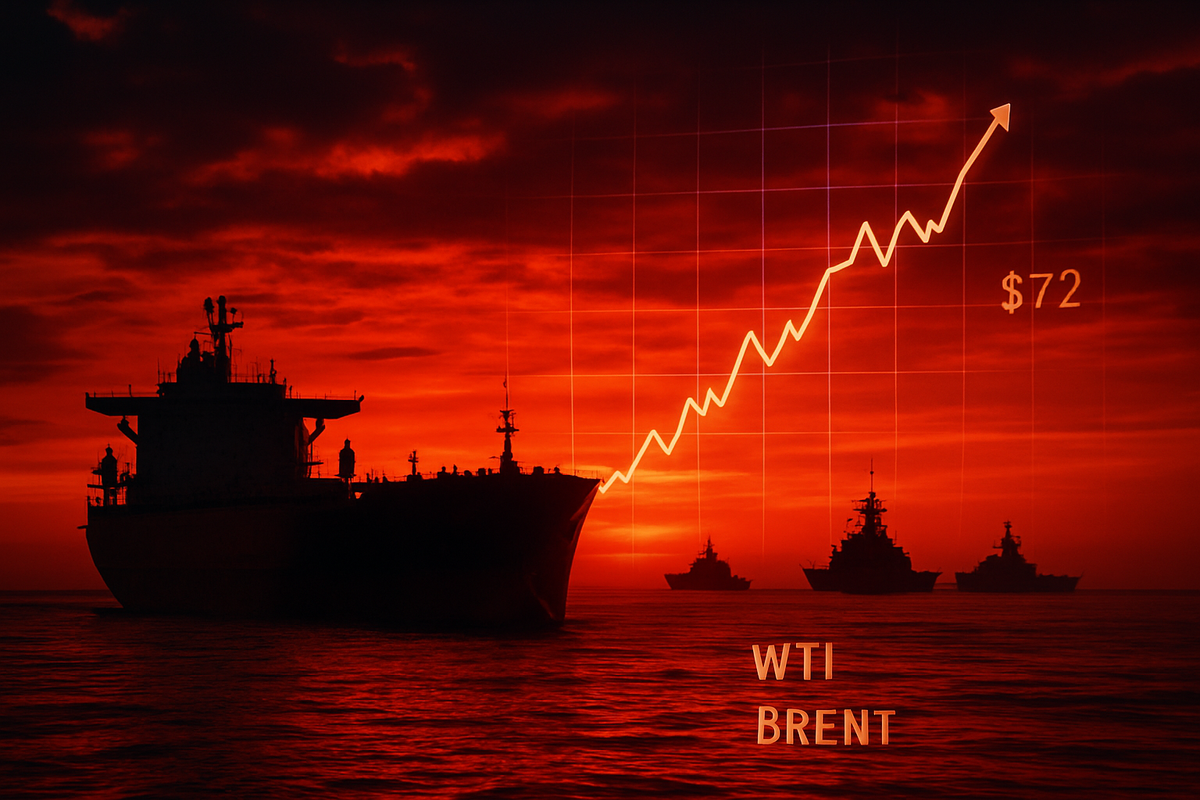
Crude oil prices have climbed to their highest levels since August 2025, with West Texas Intermediate (WTI) trading near $66.50 and Brent crude hovering around $72.00 per barrel. This sharp upward trajectory follows a series of escalations in the Persian Gulf and a hardening of rhetoric from the Trump-Vance administration regarding Iran’s nuclear program. Market participants are increasingly pricing in a "fear premium" as the geopolitical standoff enters a critical phase, threatening the stability of global energy flows.
The immediate implications are being felt across global equity and commodity markets. As of February 23, 2026, energy stocks are outperforming the broader market, while transportation and consumer discretionary sectors face renewed inflationary pressure. Analysts suggest that the current price levels reflect not just a supply-demand imbalance, but a systemic shift toward regional instability that could see Brent crude test the $80 mark if diplomatic channels remain closed.
The Ultimatum and the Strait of Hormuz
The current price surge is the direct result of a 10-to-15-day nuclear ultimatum issued by the U.S. government in mid-February. Vice President J.D. Vance, a leading voice in the administration’s "maximum pressure 2.0" strategy, has explicitly stated that the U.S. will no longer tolerate anything less than "zero enrichment" from Tehran. During a high-stakes press briefing on February 18, Vance warned that the "diplomatic window is closing" and that all options—including surgical military strikes—remain on the table if Iran fails to comply with international inspectors.
This political tension has translated into physical threats in the maritime domain. Earlier this month, on February 3, 2026, Islamic Revolutionary Guard Corps (IRGC) gunboats reportedly attempted to intercept a U.S.-flagged tanker near the Strait of Hormuz. In response, the Pentagon has ordered the deployment of the USS Gerald R. Ford and USS Abraham Lincoln carrier strike groups to the Arabian Sea. The IRGC countered this move by launching the "Smart Control" naval exercise, which involved temporary closures of parts of the Strait for live-fire drills, further spooking the global shipping industry.
The timeline of this escalation dates back to the "Twelve-Day War" in June 2025, a brief but intense conflict between Israel and Iran that severely damaged several Iranian enrichment facilities. Since then, the region has been in a state of "frozen conflict" that has now thawed into active hostility. The market reaction has been swift, with oil futures seeing their highest trading volumes in years as hedge funds and institutional investors move to cover short positions and hedge against a potential total blockade of the Strait.
Market Winners and Losers
In the wake of rising crude prices, American energy giants such as ExxonMobil (NYSE: XOM) and Chevron (NYSE: CVX) have emerged as primary beneficiaries. These companies are viewed by investors as "safe havens" due to their significant production footprints in the Permian Basin and the Atlantic Basin, particularly in Guyana. Because their primary assets are geographically shielded from Middle Eastern volatility, their stock prices have climbed 2.8% and 1.5% respectively over the past week, as they capture higher margins without the immediate risk of asset seizure or regional destruction.
Conversely, European majors like BP (NYSE: BP) and Shell (NYSE: SHEL) have seen more muted gains. While they benefit from higher commodity prices, their extensive international operations and historical reliance on Middle Eastern transit routes make them more vulnerable to rising insurance premiums and shipping disruptions. Investors are currently favoring domestic U.S. producers who are less exposed to the logistical nightmare currently unfolding in the Persian Gulf.
The "losers" in this scenario extend beyond the oil patch to the aviation and logistics sectors. Companies like Delta Air Lines (NYSE: DAL) and United Airlines (NASDAQ: UAL) are facing the prospect of surging jet fuel costs just as the spring travel season approaches. If oil remains at these levels, these carriers may be forced to reintroduce fuel surcharges, potentially dampening consumer demand. Additionally, defense contractors such as Lockheed Martin (NYSE: LMT) and Northrop Grumman (NYSE: NOC) have seen increased interest as the U.S. ramps up its military presence in the Middle East, signaling a broader market shift toward defense and energy security.
Geopolitical Shifts and Policy Implications
This event fits into a broader global trend of energy fragmentation, where the "globalized" energy market is being replaced by regionalized blocs. The Trump-Vance administration's focus on "maximum pressure" is not just about nuclear non-proliferation; it is also a strategic move to decouple Western energy markets from hostile regimes. This shift has significant policy implications, as it reinforces the U.S. as a dominant energy exporter while forcing European and Asian allies to reconsider their dependence on the Strait of Hormuz.
The historical precedent for this situation is the 2018-2019 "tanker war" phase, but the 2026 iteration is vastly more dangerous due to the advanced drone and missile capabilities now possessed by regional actors. Furthermore, the 2025 "Twelve-Day War" has left the Iranian leadership in a more precarious domestic position, making them more likely to use "asymmetric" tactics, such as cyberattacks on global energy infrastructure or mining the Strait, to exert leverage over the West.
Regulatory and policy ripple effects are also emerging. The administration has signaled it may increase sanctions on Chinese entities that continue to purchase Iranian crude, a move that could ignite a broader trade war. This environment of heightened regulation and sanctions is forcing global banks and commodity traders to undergo rigorous compliance checks, slowing the pace of global trade and adding another layer of cost to every barrel of oil moved across the ocean.
What Comes Next: Diplomacy or Conflict?
In the short term, the market is laser-focused on the expiration of the U.S. ultimatum, expected within the next seven days. If Iran makes even a minor diplomatic concession, we could see a rapid $5 to $7 "relief" drop in prices. However, a defiant stance from Tehran could lead to a localized military engagement, potentially sending Brent crude toward the $100 mark almost overnight. Strategic pivots are already occurring; many traders are shifting their focus to the North Sea and West African benchmarks, seeking to avoid the volatility of Middle Eastern grades.
Long-term, this crisis may accelerate the transition to alternative energy sources in Europe and Asia, not necessarily for environmental reasons, but for national security. However, for the next 12 to 24 months, the world remains tethered to hydrocarbons, and the current instability highlights the fragility of that connection. Market opportunities may emerge in the tanker sector, specifically for companies with modern fleets that can navigate high-risk zones, but the risks of "black swan" events remain extraordinarily high.
Summary and Investor Outlook
The surge in oil prices to six-month highs is a stark reminder that geopolitical risk remains the most potent driver in the energy markets. With WTI at $66 and Brent at $72, the global economy is at a crossroads. The combination of Vice President Vance’s hardline nuclear stance and the looming threat to the Strait of Hormuz has created a volatile environment that rewards domestic production while penalizing globalized logistics.
Moving forward, the market will likely remain in a state of high-alert. Investors should keep a close eye on naval movements in the Persian Gulf and the specific language used by the White House as the 10-day deadline approaches. The lasting impact of this standoff may be a permanent "geopolitical premium" baked into oil prices, reflecting a world where energy security is no longer guaranteed by global cooperation but by military deterrence.
This content is intended for informational purposes only and is not financial advice