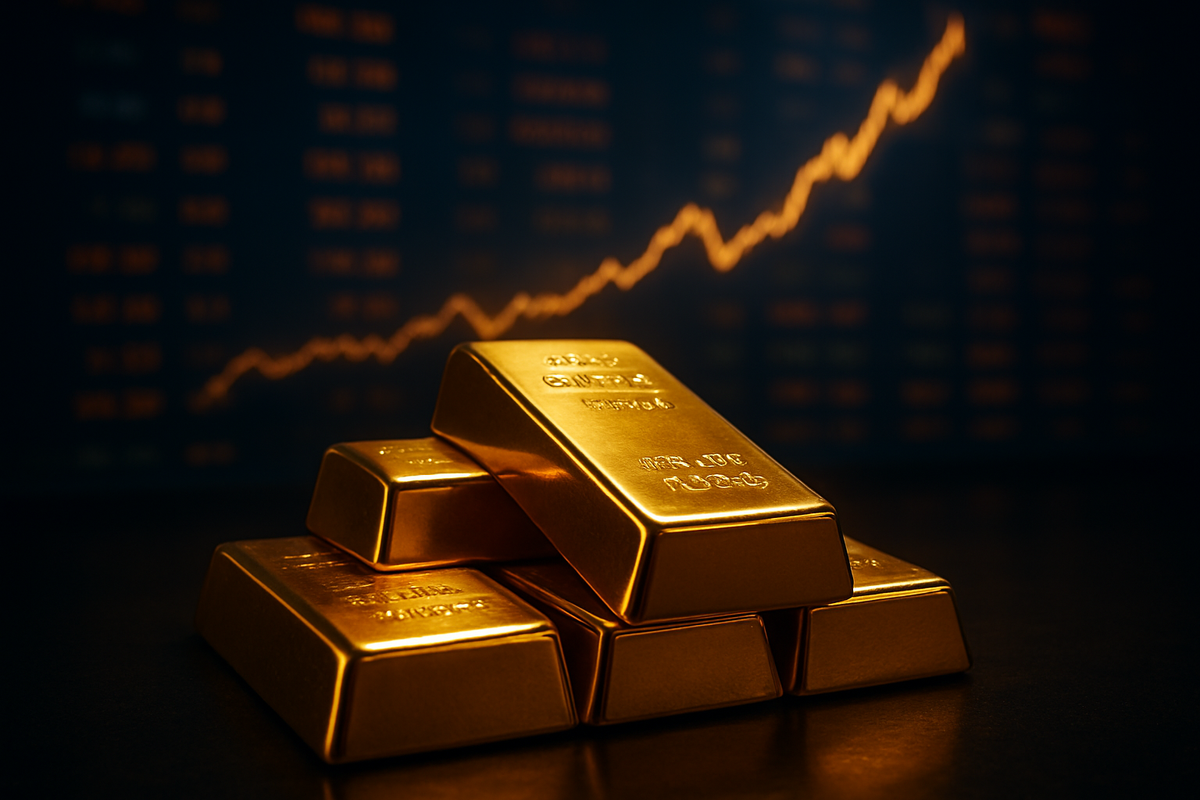
The first trading week of 2026 has opened with a seismic shift in global markets, as gold prices surged to near-record highs following a weekend of unprecedented geopolitical volatility. Spot gold (XAU/USD) climbed over 2.5% on Monday, January 5, 2026, trading near $4,445 per ounce. This latest spike comes on the heels of a historic "Hard Asset Super-Cycle" in 2025, which saw the precious metal gain a staggering 65% over the year. For investors, the message is clear: in an era of fiscal instability and sudden military interventions, gold remains the ultimate insurance policy.
The immediate catalyst for this morning's rally was a dramatic military operation in South America, where U.S. forces reportedly captured Venezuelan President Nicolás Maduro over the weekend. This "black swan" event has sent shockwaves through energy and commodity markets, reigniting fears of regional instability and unpredictable American foreign policy. As equity markets brace for a volatile week, the "safe-haven" trade has returned with a vengeance, driving massive inflows into bullion and propelling major gold mining stocks to levels not seen in decades.
The Road to $4,500: A Timeline of Turmoil
The current surge in gold prices is not merely a reaction to recent headlines but the culmination of a two-year structural shift in the global financial system. The rally began in earnest throughout 2024 as central banks, led by Poland, Turkey, and China, accelerated their diversification away from the U.S. dollar. By the end of 2024, gold had already breached the $2,600 mark, but it was the events of 2025 that transformed a steady climb into a parabolic breakout.
In October 2025, the United States entered its longest-ever government shutdown, a 42-day paralysis that froze federal economic data and shook confidence in the U.S. Treasury market. During this period of "information darkness," institutional investors flocked to gold as a hedge against fiscal mismanagement. Simultaneously, a new "reciprocal tariff framework" introduced by the Trump administration in early 2025 intensified global trade wars, fueling fears of currency debasement. By December 26, 2025, gold hit an all-time intraday high of $4,549.71, marking a generational shift in how the market values "hard money" versus fiat currency.
Perhaps the most significant milestone occurred in late 2025, when total central bank gold reserves officially overtook holdings of U.S. Treasury securities for the first time since 1996. This "Great Rotation" has provided a structural floor for prices, as emerging market central banks continue to purchase gold at a pace of over 200 tonnes per quarter. The current "Venezuela Premium" is simply the latest layer on a foundation built of fiscal deficits and geopolitical realignment.
Mining Giants Reap the Rewards of Record Margins
The surge in bullion prices has breathed new life into the gold mining sector, which struggled with inflationary cost pressures just two years ago. Today, companies like Newmont (NYSE: NEM), Barrick Gold (NYSE: GOLD), and Agnico Eagle Mines (NYSE: AEM) are operating with the widest profit margins in their history. Despite rising All-In Sustaining Costs (AISC), which have climbed to an average of $1,500–$1,600 per ounce due to labor and energy inflation, the $4,400+ gold price environment has created a windfall of free cash flow.
Newmont (NYSE: NEM), the world's largest gold producer, saw its stock price soar approximately 170% in 2025, ending the year near $105 per share. The company has pivoted from a growth-at-all-costs model to an aggressive capital return strategy, recently announcing a $3.0 billion share buyback program. Similarly, Barrick Gold (NYSE: GOLD) has emerged as a top performer, with its shares surging 184% over the past twelve months. Under a revised leadership structure, Barrick hiked its base dividend by 25% in late 2025, signaling to investors that the "golden era" of mining profitability has arrived.
Agnico Eagle Mines (NYSE: AEM) remains the "market darling" for many analysts due to its low-cost operations in stable jurisdictions like Canada and Finland. With an AISC near $1,300 per ounce—significantly lower than its peers—Agnico is capturing nearly $3,100 in profit for every ounce produced. This massive margin has allowed the company to rapidly deleverage its balance sheet while maintaining a steady dividend, making it a preferred vehicle for institutional investors looking for leveraged exposure to the gold price without the geopolitical risks associated with emerging market mines.
A Structural Shift in the Global Order
The wider significance of gold’s ascent cannot be overstated. We are witnessing a historic "de-dollarization" trend that has moved from the fringes of economic theory to the center of central bank policy. The U.S. federal deficit, which reached a staggering $1.78 trillion in 2025, has forced a re-evaluation of the "risk-free" status of U.S. Treasuries. When the world's reserve currency issuer faces persistent fiscal gridlock and rising debt-to-GDP ratios, gold naturally re-emerges as the primary global reserve asset.
This event mirrors the gold rushes of 1979 and 2011 but with a distinct difference: the current rally is driven by institutional and sovereign demand rather than retail speculation. The "Hard Asset Super-Cycle" is also creating ripple effects across the commodity complex. Silver and platinum have followed gold’s lead, and even digital assets like Bitcoin have benefited from the "flight-from-fiat" sentiment. However, gold’s unique lack of counterparty risk has kept it at the forefront of the safe-haven trade during the recent military escalations in South America and Eastern Europe.
Furthermore, the regulatory environment is beginning to adapt. Several U.S. states have recently passed legislation to recognize gold and silver as legal tender, a move aimed at protecting citizens from currency volatility. These policy shifts, combined with the "information gaps" caused by government shutdowns, have fundamentally altered the market's psychological landscape, making $4,000 gold the "new normal" rather than a temporary spike.
Technical Levels and the Path to $5,000
As of January 5, 2026, technical analysts are watching the $4,445 level closely. This area, which served as support during the December rally, has now become a critical pivot point. The 14-day Relative Strength Index (RSI) currently sits at 66.23, suggesting that while gold is approaching "overbought" territory, there is still significant momentum for a push toward the $4,550 record high. If the geopolitical situation in South America escalates further, a breakout above $4,560 could open the door for a psychological run toward $5,000 by the end of Q2 2026.
On the downside, the $4,400 level remains a formidable psychological floor. Should prices dip, institutional "buy-the-dip" orders are expected to cluster around the $4,350–$4,360 range, which is reinforced by the 50-day moving average. For mining companies, these elevated price floors ensure that even a moderate correction would leave them with exceptionally healthy balance sheets. The strategic pivot for 2026 will likely involve further consolidation in the industry as majors use their record cash piles to acquire junior explorers and secure future reserves.
The market opportunities emerging from this rally are not limited to bullion. The "royalty and streaming" companies are also seeing a resurgence as they benefit from higher prices without the direct operational risks of mining. Investors should watch for potential scenarios where a sudden de-escalation of tensions leads to a sharp "Monday Correction," similar to the one seen on December 29, 2025. However, with structural demand from central banks remaining high, any significant pullback is likely to be viewed as a buying opportunity.
A New Era for the Safe-Haven Asset
In summary, the rally of January 2026 marks a new chapter for gold. No longer just a "barbarous relic," it has reclaimed its throne as the essential component of a diversified portfolio in a fragmented world. The combination of aggressive central bank buying, U.S. fiscal uncertainty, and sudden geopolitical shocks has created a perfect storm for the precious metal. For the mining sector, the challenge will be to manage these windfall profits responsibly while navigating an increasingly complex global operating environment.
Moving forward, investors should keep a close eye on the Federal Reserve’s reaction to this commodity surge and whether the "de-dollarization" trend continues to gain momentum in the G20. The coming months will likely be defined by high volatility, but the underlying fundamentals for gold have rarely been stronger. As we navigate the uncertainties of 2026, the allure of the yellow metal as a "war hedge" and "fiscal insurance" is set to remain a dominant theme in the global markets.
This content is intended for informational purposes only and is not financial advice.