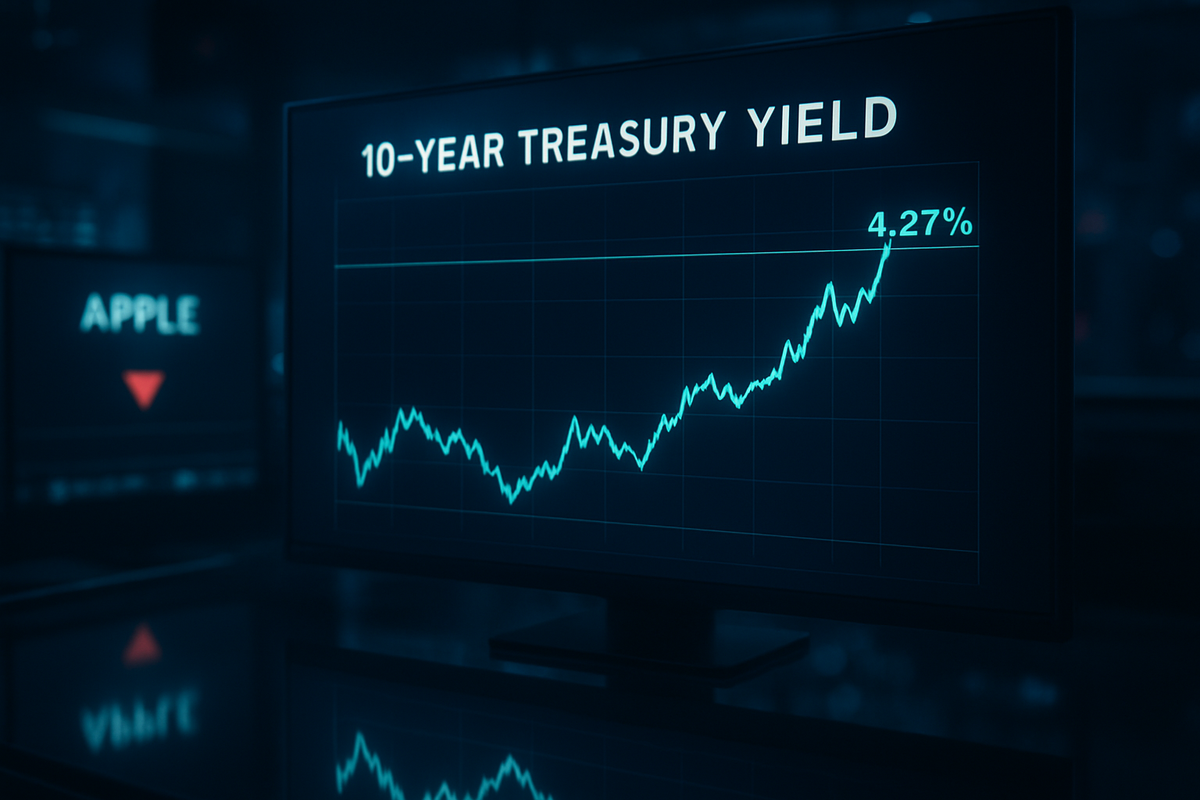
The U.S. bond market sent a shudder through equity desks on Friday as the 10-year Treasury yield surged past the critical 4.27% threshold, hitting its highest level in 18 months. This sharp ascent, driven by a combination of hawkish shifts in Federal Reserve leadership and robust economic growth data, has reignited fears of a "higher-for-longer" interest rate environment. The immediate fallout was most visible in the technology sector, where the tech-heavy NASDAQ Composite dropped 0.7%, erasing earlier weekly gains and putting pressure on the market’s AI-driven momentum.
The move marks a pivotal moment for investors who had, until recently, anticipated a more aggressive easing cycle from the central bank. With the 10-year yield breaking out from its recent range, the "risk-free" rate of return is now high enough to challenge the rich valuations of mega-cap technology stocks. As borrowing costs climb and the discount rate applied to future earnings rises, the high-flying innovators of the S&P 500 are finding themselves on the defensive against a backdrop of fiscal uncertainty and persistent inflationary pressures.
Hawkish Fed Nominations and "Soft Landing" Data Fuel the Surge
The breach of the 4.27% mark on January 30, 2026, was catalyzed by a "perfect storm" of economic and political catalysts. The primary spark was the news that the White House would nominate former Federal Reserve Governor Kevin Warsh to succeed Jerome Powell as Chair. Warsh, a known "inflation hawk" and frequent critic of the Fed’s massive balance sheet, is widely expected to slow or even halt the pace of rate cuts that the market had previously baked into its 2026 forecasts. The news sent immediate shockwaves through the Treasury pits, pushing the 10-year yield up five basis points in a single session.
This leadership shift coincided with a series of "hot" economic data points that suggest the U.S. economy is far from cooling. Late December reports confirmed that third-quarter GDP expanded at a blistering 4.4% annual rate, while the most recent employment data showed a fall in the unemployment rate to 4.4% alongside a 3.8% year-over-year increase in wages. While these figures represent a successful "soft landing" for the economy, they also eliminate any urgent need for the Fed to provide further stimulus, effectively cementing the yield's upward trajectory.
The market reaction was swift and unforgiving for growth-oriented assets. Microsoft Corp. (NASDAQ: MSFT) saw its shares tumble nearly 7% following its latest earnings report, which highlighted slowing growth in its Azure cloud division and a staggering $60 billion capital expenditure plan—much of it tied to its partnership with OpenAI. Meanwhile, Nvidia Corp. (NASDAQ: NVDA), which recently touched a historic $5 trillion market capitalization, struggled to maintain its footing as investors questioned whether the massive ROI on AI infrastructure could withstand a 4.27% risk-free rate. Apple Inc. (NASDAQ: AAPL) also saw its post-earnings gains vanish, as the stock faded from its all-time highs despite a solid showing in its AI-integrated iPhone cycle.
Winners and Losers: Financial Carry vs. The Refinancing Wall
While the surge in yields has battered high-multiple tech stocks, it has created a lucrative environment for "carry-heavy" financial institutions. JPMorgan Chase & Co. (NYSE: JPM) remains a primary beneficiary, with the bank guiding for a record $103 billion in Net Interest Income (NII) for 2026. Although rising deposit costs have caused some margin compression, the bank’s core lending engine continues to thrive in a high-yield environment. Similarly, insurance giants like MetLife Inc. (NYSE: MET) are using the 4.27% yield to lock in higher returns on their vast fixed-income portfolios, aggressively reinvesting maturing bonds into new, higher-yielding securities that bolster their book value.
In a departure from historical norms, some traditional "bond proxies" are showing resilience due to their ties to the AI boom. NextEra Energy Inc. (NYSE: NEE) reaffirmed its 2026 earnings guidance, largely because its renewable energy and grid infrastructure are in high demand from power-hungry data centers. By utilizing a $1.16 billion rate-stabilization mechanism, NextEra has managed to decouple from the broader utilities sector, which typically suffers when yields rise.
Conversely, the real estate sector is facing a severe "maturity wall." Companies like American Tower Corp. (NYSE: AMT) are grappling with the cost of refinancing billions in debt that was originally issued at sub-3% rates. American Tower recently refinanced $1 billion in debt at rates exceeding 5%, a move that directly squeezes its Adjusted Funds From Operations (AFFO). This refinancing pressure is being felt across the REIT landscape, where many firms are trading at a 15% discount to their Net Asset Value as the high cost of capital stalls multiple expansion and deal-making.
The Broader Context: Fiscal Deficits and Geopolitical Friction
The rise in yields is not occurring in a vacuum; it reflects deep-seated concerns over the U.S. fiscal trajectory and shifting geopolitical dynamics. With the federal deficit currently hovering around 6% of GDP, the sheer volume of Treasury issuance required to fund government operations is placing natural upward pressure on yields. Investors are demanding a higher "term premium" to hold long-term government debt, especially as the "Trump 2.0" administration explores expansive fiscal policies and potential tariffs.
Geopolitical tensions have also added a risk premium to the bond market. Recent diplomatic friction regarding trade frameworks with European allies and the lingering threat of 10–25% tariffs on imported goods have stoked fears of "cost-push" inflation. This environment is reminiscent of the late 1970s, where persistent fiscal expansion met with a hawkish central bank shift, leading to prolonged periods of market volatility. The current "AI angst"—where investors fear an infrastructure bubble—only exacerbates the sensitivity of the market to these macroeconomic shifts.
Looking Ahead: The 2026 "Debt Wall" and Fed Transitions
As we move deeper into 2026, the primary challenge for the market will be navigating the $1.8 trillion "debt wall" of maturing corporate bonds. Companies that relied on the "easy money" era to fuel share buybacks and expansion must now face a reality where their interest expenses could double upon refinancing. This will likely lead to a "survival of the fittest" scenario, where companies with strong free cash flow thrive, while "zombie" firms that require frequent debt markets access face significant distress.
In the short term, all eyes will be on the Kevin Warsh confirmation hearings and the Fed’s subsequent policy meetings. If the new leadership signals a permanent halt to the easing cycle, the 10-year yield could easily test the 4.5% level, further pressuring tech valuations. Investors should watch for potential strategic pivots from mega-cap tech companies, which may be forced to scale back their aggressive capital expenditure in favor of preserving margins and returning cash to shareholders through dividends rather than buybacks.
Conclusion: A New Era for Valuations
The breach of the 4.27% yield level marks a definitive end to the hope that interest rates would quickly return to pre-pandemic norms. For the tech-driven bull market, this represents a fundamental change in the "rules of the game." The days of "growth at any cost" are being replaced by a rigorous focus on profitability and capital efficiency. While the U.S. economy remains resilient, the cost of that resilience is a bond market that no longer provides a tailwind for stock multiples.
Moving forward, investors must be more selective, favoring sectors with strong pricing power and low refinancing needs. The 2026 market is likely to be defined by a widening gap between those who can leverage high rates—like major banks and insurers—and those who are crushed by them. As the Federal Reserve undergoes a leadership transition and the fiscal deficit remains a looming shadow, the 4.27% yield is more than just a number; it is a signal that the era of "cheap money" is officially in the rearview mirror.
This content is intended for informational purposes only and is not financial advice