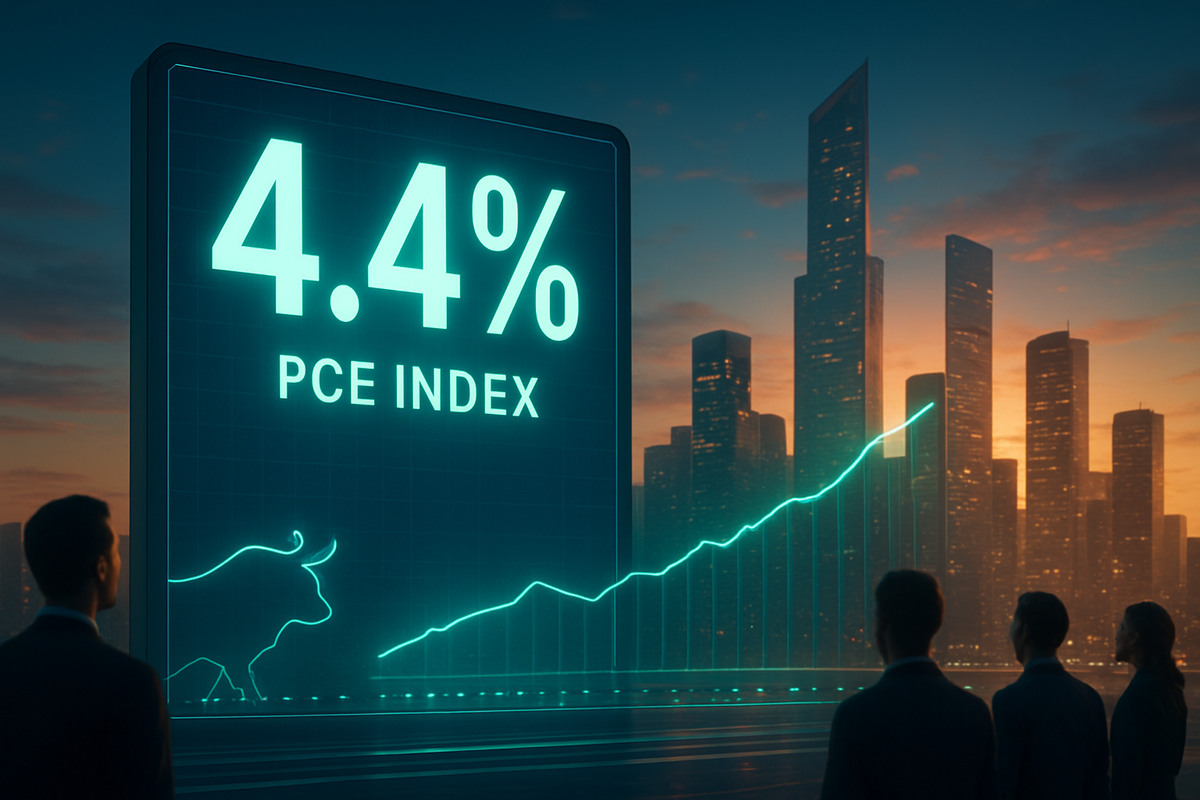
The United States economy has defied the skeptics once again, reporting a robust 4.4% annualized growth rate for the third quarter of 2025. This significant beat, revealed in delayed data released this week, has sent a wave of optimism through Wall Street. By pairing high-octane growth with Personal Consumption Expenditures (PCE) figures that only slightly exceeded targets, the data suggests the Federal Reserve has successfully navigated the narrow path of a "soft landing"—an economic state where growth remains strong while inflation stabilizes.
The immediate implications for the market are profound. Investor sentiment has shifted from "recession watch" to "expansion acceleration," as the figures provide a fundamental floor for the record-breaking equity prices seen in early 2026. With the VIX volatility index retreating and consumer spending remaining the primary engine of the domestic economy, the Q3 data serves as a definitive signal that the structural shocks of the previous years have been largely absorbed, clearing the runway for a sustained bull market.
Resilience in the Face of Friction: A 4.4% Surprise
The Bureau of Economic Analysis (BEA) released the revised Q3 2025 figures on January 22, 2026, following a tense 43-day federal government shutdown that had previously clouded the economic outlook. The headline 4.4% GDP growth rate was an upward revision from initial internal estimates of 4.3% and a substantial leap from the 3.8% recorded in the second quarter. This growth was fueled by a 3.5% surge in consumer spending and a surprising 9.6% rebound in exports, suggesting that American goods and services remain in high demand globally despite geopolitical tensions.
Simultaneously, the PCE price index—the Federal Reserve’s preferred inflation gauge—registered at 2.8%, with the Core PCE (excluding food and energy) holding at 2.9%. While these numbers were technically "misses" compared to the Fed's 2% ideal target, the market viewed them as manageable. The slight upward pressure on prices was seen not as a sign of runaway inflation, but as a byproduct of a high-functioning, high-employment economy. This "Goldilocks" scenario—not too hot to trigger aggressive rate hikes, but not cold enough to signal a recession—immediately calmed a nervous market.
Key stakeholders, including institutional analysts and policy advisors, had been bracing for a much bleaker report. Prior to the release, analysts at S&P Global Ratings had forecasted growth closer to 1.6% for the upcoming year, fearing that government cost-cutting and tariff uncertainties would stifle momentum. The 4.4% print acted as a massive relief valve, triggering a 0.6% jump in the S&P 500 and a 0.9% rally in the Nasdaq on the day of the announcement.
Winners and Losers in the Post-Shutdown Surge
The technology sector emerged as the primary beneficiary of the positive data, with large-cap firms leading the charge. Meta Platforms Inc. (NASDAQ: META) saw its shares rise by over 4% as the high GDP growth signaled continued strength in digital advertising budgets. Similarly, semiconductor giants like Advanced Micro Devices, Inc. (NASDAQ: AMD) and NVIDIA Corp. (NASDAQ: NVDA) surged, supported by the narrative that the "One Big Beautiful Bill Act" (OBBBA) passed in mid-2025 is successfully incentivizing long-term corporate capital expenditure in AI and high-performance computing. Microsoft Corp. (NASDAQ: MSFT) also benefited as productivity gains across the economy fueled higher software demand.
In the consumer space, the 3.5% consumption rate provided a massive boost to retail leaders. Costco Wholesale Corp. (NASDAQ: COST) and Walmart Inc. (NYSE: WMT) saw increased traffic as consumers felt emboldened by high employment and wealth effects from rising home values. The TJX Companies, Inc. (NYSE: TJX) also reported strong momentum, capturing the "deep value" segment that remains robust even in a growing economy. Netflix, Inc. (NASDAQ: NFLX) shared in the rally, as discretionary spending on digital services showed no signs of tapering off.
However, the news was not universally positive for all players. While large financial institutions like Morgan Stanley (NYSE: MS) and BlackRock, Inc. (NYSE: BLK) thrived on increased trading volume and rising Assets Under Management (AUM), smaller regional lenders faced a more complex reality. The combination of high GDP growth and persistent 2.9% Core PCE has kept interest rates "higher for longer" than some regional banks had anticipated. Furthermore, a new 10% credit card interest rate cap proposal currently moving through the legislature has rattled smaller lenders who rely more heavily on consumer debt margins, creating a divergent landscape in the financial sector.
Broader Significance and Historical Precedents
The Q3 GDP beat is more than just a data point; it represents a successful decoupling of the US economy from the "geopolitical dominoes" that many feared would trigger a downturn in 2025. Historically, the US has rarely achieved 4.4% growth this deep into a tightening cycle. The current scenario draws comparisons to the late 1990s, where productivity gains—then driven by the internet, now by artificial intelligence—allowed the economy to expand rapidly without sparking the hyperinflationary spirals of the 1970s.
Furthermore, this event highlights the effectiveness of recent industrial policies. The impact of the OBBBA, signed into law in July 2025, is now clearly visible in the data through increased productivity and corporate investment. This shift toward a productivity-led expansion rather than a debt-led one provides a more stable foundation for the "soft-landing" scenario. It also mitigates the risks associated with the recent "Greenland Pivot" and other trade negotiations, as the domestic economy shows it can maintain momentum even amid shifting international alliances.
From a regulatory standpoint, the PCE "miss" actually provides the Federal Reserve with a convenient excuse to maintain a restrictive yet stable monetary policy. By not cutting rates too early, the Fed is building a "policy buffer" that could be used in the future if growth eventually slows. This strategic patience is a hallmark of the current administration’s economic team and has been a key factor in keeping market volatility low as we enter 2026.
The Road Ahead: 2026 and Beyond
Looking forward, the focus shifts to whether this 4.4% momentum can be sustained through the final quarter of 2025 and into the first half of 2026. While some analysts, such as Michael Pearce of Oxford Economics, suggest a slight cooling is inevitable as the "catch-up" growth from the government shutdown wanes, the overall outlook remains bullish. Federated Hermes has already upgraded its 2026 GDP forecast to 3.3%, a significant jump from the previous consensus of 2.1%.
Investors should prepare for a strategic pivot toward companies that can capitalize on high productivity. As the labor market remains tight, the premium on automation and AI-driven efficiency will only increase. We may also see a wave of mergers and acquisitions in the retail and financial sectors as larger, well-capitalized firms look to acquire smaller competitors who are struggling with the "higher for longer" interest rate environment.
The primary risk on the horizon remains the potential for a "re-acceleration" of inflation if consumer spending turns from robust to overheated. If the PCE numbers continue to miss on the upside in the coming months, the Fed may be forced to consider one final rate hike, which would test the market's current resilience. However, for the moment, the "soft landing" appears to be the most likely path, with the US economy operating as the world’s most reliable engine of growth.
Final Assessment for Investors
The Q3 2025 GDP report is a watershed moment for the post-pandemic era. It confirms that the US economy is not merely surviving high interest rates but is actively thriving under a new regime of productivity and investment. The "soft landing" is no longer a theoretical hope; it is the current reality, backed by hard data and a resilient consumer base.
Moving forward, investors should keep a close eye on the monthly PCE updates to ensure that the "misses" remain within the manageable 2.8% to 3.1% range. Any spike beyond those levels could reignite hawkish Fed rhetoric. Additionally, the performance of the tech and retail sectors will serve as a barometer for whether the 4.4% growth was a one-time surge or the beginning of a new, sustained expansion phase.
In summary, the US economy has demonstrated an extraordinary ability to "separate the signal from the noise." Despite shutdowns, geopolitical shifts, and fiscal tightening, the fundamental strength of the American consumer and the accelerating impact of AI-driven productivity have created a "Goldilocks" environment that, for now, remains the envy of the global market.
This content is intended for informational purposes only and is not financial advice