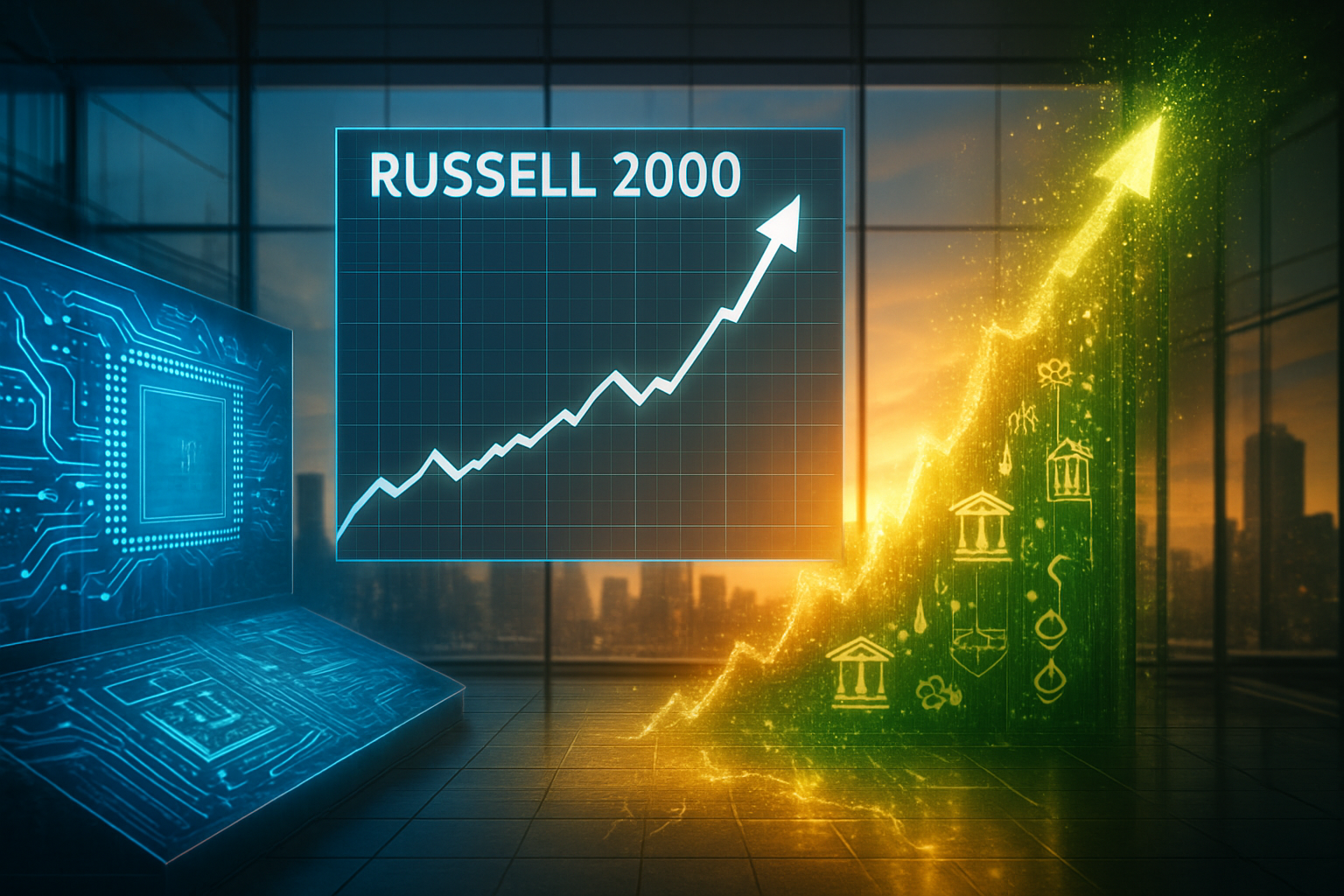
As of January 22, 2026, the financial landscape is witnessing a historic shift. After nearly two years of mega-cap technology dominance driven by the artificial intelligence boom, the "Great Rotation" has finally arrived. Capital is flowing out of the overcrowded Silicon Valley giants and into the domestic-focused engines of the American economy. The Russell 2000 Index (INDEXRUSSELL:RUT), the benchmark for small-cap stocks, has surged nearly 8% in the first three weeks of the year alone, signaling what many analysts believe is the start of a multi-year breakout.
The implications for the broader market are profound. This shift suggests that the extreme valuation gap between the "Magnificent Seven" and the rest of the market—which reached historic highs in 2025—is finally snapping back. With the Federal Reserve signaling a transition to a lower-interest-rate environment and domestic earnings growth accelerating, the small-cap sector is positioned to lead the market in 2026.
The Convergence of Lower Rates and Earnings Growth
The recent breakout of the iShares Russell 2000 ETF (NYSEARCA:IWM) is not merely a technical bounce; it is backed by a shift in fundamental drivers. Leading analysts from Jefferies (NYSE: JEF) and Lazard (NYSE: LAZ) have highlighted 2026 as the year the "earnings gap" finally flips in favor of smaller companies. Steven DeSanctis, equity strategist at Jefferies, recently set a year-end target for the Russell 2000 at 2,825, projecting a 14% gain. This optimism is fueled by a forecast of 19% earnings growth for small caps in 2026, significantly outpacing the 12% growth projected for large-cap peers.
This momentum follows a volatile 2025, where high borrowing costs weighed heavily on small-cap balance sheets. However, as of January 2026, the Federal Reserve has pivoted, with markets pricing in at least two more rate cuts this year. Because small-cap companies traditionally carry more floating-rate debt than their cash-rich mega-cap counterparts, these falling borrowing costs provide an immediate boost to their bottom lines. At Lazard Asset Management, portfolio manager Oren Shiran noted that the "tangible return of earnings growth" to the small-cap space is the defining characteristic of this new market cycle.
Winners and Losers in the Rotation
The rotation is creating clear winners in sectors that were previously sidelined. In the financials sector, regional lenders like CNB Financial Corp (NASDAQ: CCNE) and Bank of the James Financial Group (NASDAQ: BOTJ) are seeing renewed interest as a steepening yield curve and a resurgence in middle-market M&A activity boost their outlook. Similarly, HCI Group, Inc. (NYSE: HCI) has become a standout in the insurance space, with analysts pointing to its high operating leverage and domestic focus as key advantages in a resurgent U.S. economy.
Industrials are also emerging as primary beneficiaries of the "One Big Beautiful Act" (OBBBA), a 2025 legislative package that reintroduced tax incentives for domestic manufacturing. Companies like Willdan Group, Inc. (NASDAQ: WLDN) and Limbach Holdings, Inc. (NASDAQ: LMB) are thriving as they provide the essential infrastructure and energy services required for the ongoing reshoring of American industry. Conversely, the "losers" in this environment are the mega-cap tech stocks that formed the backbone of the Invesco QQQ Trust (NASDAQ: QQQ). While companies like NVIDIA (NASDAQ: NVDA) remain profitable, they are facing "AI gravity"—a term coined by Lazard’s Ronald Temple—as massive capital expenditures and high valuations make them less attractive compared to the "Growth at a Reasonable Price" (GARP) found in the Russell 2000.
Breadth and the Maturity of the AI Rally
This rotation signifies a healthy broadening of market breadth, which had been dangerously narrow throughout much of late 2024 and 2025. In the first half of January 2026, the Russell 2000 outperformed the Nasdaq for ten consecutive sessions, the longest such streak in over three decades. This suggests that the AI rally has entered a more "mature" phase. Instead of investors simply buying the companies building the AI infrastructure, they are now looking for the companies using AI to drive productivity and margin expansion.
The shift toward active investing is also accelerating. In a market dominated by a few tech titans, passive index funds like the SPDR S&P 500 ETF Trust (NYSEARCA:SPY) were easy winners. However, in the current environment, the dispersion between winners and losers within the small-cap universe is much wider. This favor’s stock-pickers who can identify specialized players like GeneDx Holdings Corp. (NASDAQ: WGS) in healthcare or Northwest Pipe Company (NASDAQ: NWPX) in infrastructure, both of which are seeing significant capital inflows as they capture niche markets that mega-caps cannot reach.
Strategic Pivots for the Year Ahead
Looking ahead into the remainder of 2026, the primary challenge for investors will be navigating this transition from a momentum-driven market to a value-and-growth-driven one. Small-cap management teams are already pivoting their strategies; many are using the recent surge in their stock prices to conduct secondary offerings or engage in strategic acquisitions to consolidate fragmented markets. For instance, Thermon Group Holdings, Inc. (NYSE: THR) recently raised its 2026 guidance, citing a strategic shift toward electrification and decarbonization projects that are now being funded by the lower cost of capital.
In the short term, the market may experience some volatility as "hot money" exits the tech sector, potentially leading to sharp, temporary pullbacks in the major indices. However, the long-term outlook for the Russell 2000 remains robust. If the Federal Reserve continues its path toward a neutral rate and domestic manufacturing data stays strong, the small-cap rotation could evolve from a seasonal trend into a decade-defining shift in market leadership.
The Road to 2,825: A Final Outlook
The resurgence of the Russell 2000 marks a turning point for the 2026 market. The combination of easing monetary policy, domestic fiscal tailwinds, and a significant earnings recovery has created a "perfect storm" for small-cap outperformance. For the first time in years, the "old economy" sectors—financials, industrials, and healthcare—are providing the growth that investors used to find only in high-flying tech.
Investors should closely watch the upcoming Q1 earnings season for confirmation that the projected 19% earnings growth for small caps is materializing. While the AI rally isn't over, its nature has changed, favoring companies that can deliver tangible results over speculative promises. As the "Great Rotation" continues, the message from Wall Street is clear: the small-cap breakout is no longer a forecast—it is the reality of 2026.
This content is intended for informational purposes only and is not financial advice.