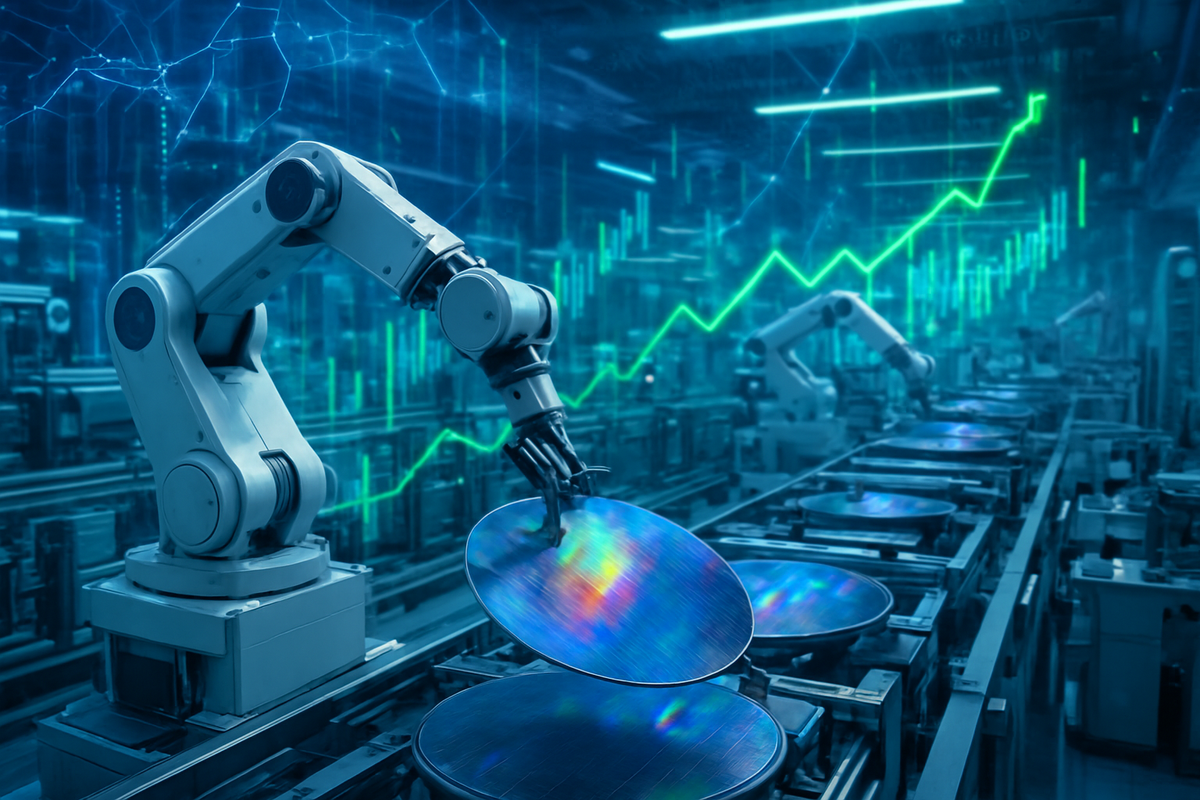
The global semiconductor market experienced a seismic shift on January 15, 2026, as Taiwan Semiconductor Manufacturing Company (NYSE: TSM) released a fourth-quarter earnings report that shattered even the most optimistic analyst projections. The results, characterized by record-breaking revenue and a massive upward revision in capital spending, sent an unmistakable signal to the financial world: the artificial intelligence "giga-cycle" is not only real but accelerating. In early trading, the news sparked a widespread rally across the sector, adding hundreds of billions of dollars in collective market capitalization to industry titans like NVIDIA (NASDAQ: NVDA) and AMD (NASDAQ: AMD).
The immediate implications of the report have calmed long-standing investor jitters regarding a potential "AI bubble." By projecting a nearly 30% revenue growth for the coming year and announcing a staggering 2026 capital expenditure (CapEx) budget of up to $56 billion, TSMC has effectively underwritten the growth narratives of the world’s largest technology firms. As the sole foundry capable of producing the ultra-advanced chips required for generative AI at scale, TSMC’s performance acts as the definitive barometer for the health of the entire digital economy.
For the quarter ending December 31, 2025, TSMC reported revenue of $33.73 billion, a 25.5% increase year-over-year, comfortably beating its own guidance and Wall Street estimates. Net profit surged 35% to $16 billion, driven by a gross margin of 62.3% that exceeded expectations. The financial community was particularly struck by the revenue breakdown, which revealed that High-Performance Computing (HPC)—the segment housing AI accelerators—now accounts for 58% of the company's total sales, officially dethroning smartphones as the primary engine of the business.
The timeline leading to this moment has been defined by a relentless race for "leading-edge" supremacy. Throughout 2025, the industry watched as TSMC raced to bring its 2nm (N2) process technology to mass production. During the earnings call, CEO C.C. Wei confirmed that mass production of 2nm chips officially commenced in late 2025, with the technology already being "overwhelmed" by demand from anchor customers. This milestone comes as the company manages a delicate geopolitical balancing act, expanding its manufacturing footprint into Arizona and Japan while keeping its most advanced capabilities centered in Taiwan.
Market reaction was swift and decisive. As the opening bell rang in New York, shares of semiconductor firms surged in tandem with TSMC’s ADRs. The primary catalyst was not just the historical profit, but the forward-looking CapEx guidance of $52 billion to $56 billion for 2026. This massive investment in new equipment and facilities suggests that TSMC’s largest customers, including the "Hyperscalers" like Microsoft and Google, have provided the foundry with multi-year commitments that necessitate a rapid expansion of production capacity.
The biggest winner of the day remains NVIDIA (NASDAQ: NVDA), whose stock jumped 5% in early trading. Analysts noted that TSMC’s record-high capital spending is essentially a roadmap for NVIDIA’s upcoming "Rubin" and "Blackwell Ultra" GPU architectures. For the first time in history, analysts suggest that NVIDIA may have surpassed Apple as TSMC’s largest single source of revenue, contributing roughly 20% to the foundry’s top line. This shift marks a fundamental change in the hierarchy of the tech sector, where data center demand now dictates the pace of global innovation.
AMD (NASDAQ: AMD) also enjoyed a significant boost, with shares rising over 6%. AMD has successfully positioned its Instinct series of AI accelerators as the primary alternative to NVIDIA’s ecosystem, and TSMC’s capacity expansion for 3nm and 2nm nodes ensures that AMD will have the "silicon runway" needed to satisfy its growing order book. Similarly, ASML (NASDAQ: ASML) hit an all-time high, as TSMC’s aggressive 2026 roadmap implies a massive influx of orders for ASML’s high-aperture Extreme Ultraviolet (EUV) lithography machines, which are critical for printing the microscopic circuits on 2nm wafers.
However, the "rising tide" did not lift all boats equally. While Intel (NASDAQ: INTC) is making strides with its own 18A (1.8nm) process and recently secured a strategic packaging deal with NVIDIA, it continues to face the daunting task of competing with TSMC’s proven yield rates and massive scale. Samsung Electronics (KRX:005930), despite being an early pioneer of Gate-All-Around (GAA) transistor technology, continues to struggle with yield consistency at the 2nm level compared to TSMC. For these competitors, TSMC’s blockbuster results highlight a widening gap in execution that may take years to bridge.
Beyond the balance sheets, this event signifies a historical pivot in the global semiconductor landscape. We are currently witnessing the maturation of the AI "giga-cycle," where the focus is shifting from experimental models to the massive deployment of physical infrastructure. This trend mirrors the build-out of the internet in the late 1990s, but with significantly higher capital requirements and more concentrated power among a few key players. TSMC’s dominance has reached a point where it is no longer just a supplier; it is the physical foundation upon which the future of artificial intelligence is built.
The ripple effects extend into the geopolitical sphere. During the earnings call, TSMC leadership addressed the "Silicon Shield"—the idea that Taiwan's dominance in chips protects it from regional conflict. As TSMC moves more production to the United States and Europe, some analysts worry about the long-term strategic implications for Taiwan. Simultaneously, the U.S. government has recently adjusted its export controls, moving toward a "case-by-case" review for high-end AI chips heading to certain regions, while implementing new surcharges that could add complexity to TSMC’s global logistics.
Furthermore, the surge in 2nm demand indicates that the "Law of Diminishing Returns" has yet to hit the semiconductor industry. Historically, as transistors shrink, the cost of manufacturing increases exponentially. Yet, the premium that companies are willing to pay for AI performance has overridden these cost concerns. The transition to 2nm and the upcoming A16 (1.6nm) node scheduled for late 2026 represent a monumental engineering feat that keeps Moore's Law—or at least its spirit—alive for another generation.
As we look toward the remainder of 2026, the primary challenge for the industry will be managing the transition to the A16 node and the integration of "backside power delivery" technology. This innovation, which separates a chip's power lines from its data lines, is expected to provide a massive leap in energy efficiency—a critical requirement for power-hungry AI data centers. TSMC has signaled that it will begin ramping this technology in the second half of 2026, setting the stage for yet another upgrade cycle in 2027.
Short-term risks remain, particularly regarding "Sovereign AI." More nations are seeking to build their own localized AI infrastructure to ensure data privacy and national security. This could lead to a fragmented market where demand for "standard" chips is replaced by highly customized, region-specific silicon. TSMC and its partners will need to adapt their business models to handle a higher volume of custom "ASIC" (Application-Specific Integrated Circuit) designs from companies like Broadcom (NASDAQ: AVGO) and Marvell (NASDAQ: MRVL), who are helping non-chip companies design their own AI hardware.
TSMC’s January 15 earnings report has effectively silenced the skeptics of the AI boom. By delivering record profits and a bold $56 billion investment plan, the company has confirmed that the world’s appetite for compute power is nowhere near its limit. The subsequent rally in US semiconductor stocks, led by NVIDIA and AMD, reflects a market that is once again comfortable with the high-growth, high-CapEx reality of the 2020s.
For investors, the key takeaways are clear: the AI trade has shifted from a story of potential to a story of industrial-scale execution. While geopolitical risks and the high cost of overseas manufacturing remain persistent headwinds, the fundamental demand for advanced silicon is robust. In the coming months, the market will be watching two things: the yield rates of TSMC’s 2nm production line and the quarterly capital spending reports of the Big Tech "hyperscalers." As long as these two metrics remain high, the semiconductor sector appears poised to remain the primary engine of the global stock market.
This content is intended for informational purposes only and is not financial advice.