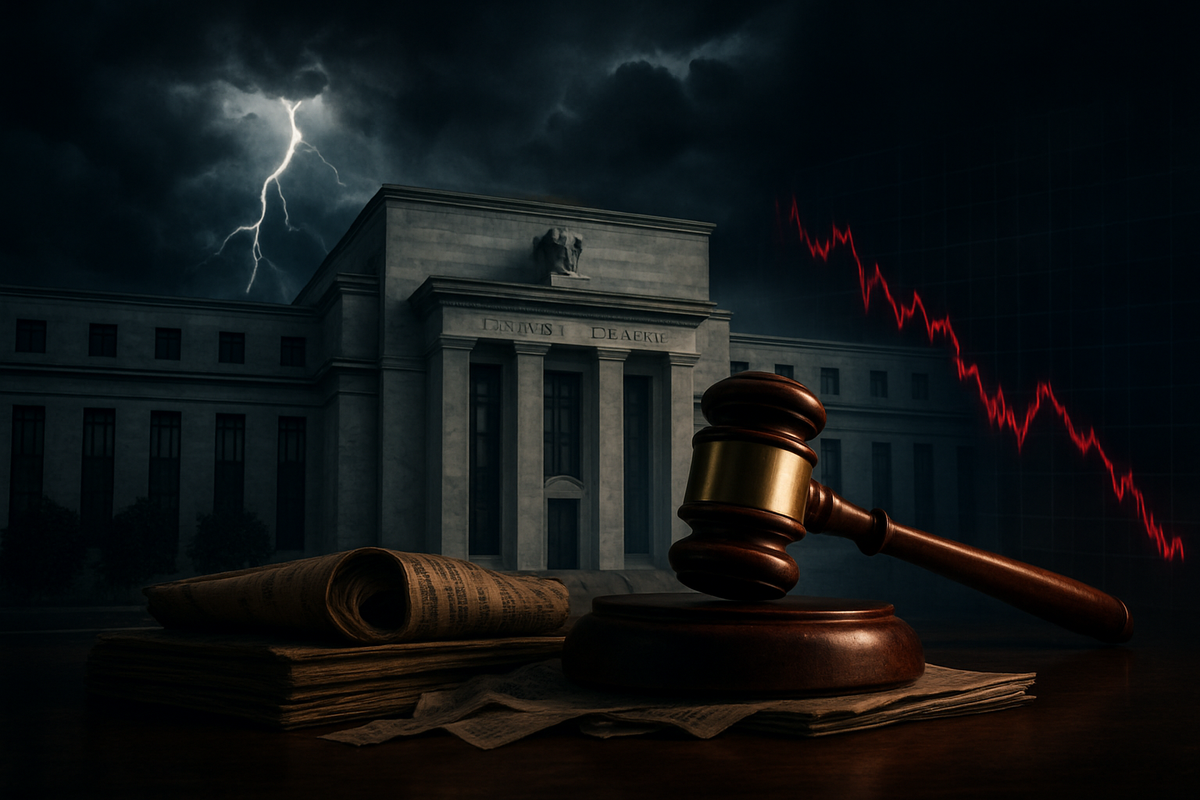
The global financial landscape was rocked this week as the U.S. Department of Justice (DOJ) launched an unprecedented criminal investigation into Federal Reserve Chair Jerome Powell. The move, which involves grand jury subpoenas regarding a multi-billion dollar renovation project, has triggered a sharp decline in major market indices and raised urgent questions about the independence of the world’s most powerful financial institution. On Tuesday, January 13, 2026, the ripple effects were felt across Wall Street as investors grappled with the prospect of a politicized central bank.
The immediate implications are severe: the S&P 500 and the Dow Jones Industrial Average saw significant intraday volatility, while the U.S. Dollar weakened against major global currencies. Analysts warn that the "Fed independence premium"—the market's trust that monetary policy is shielded from political interference—is evaporating. As safe-haven assets like gold surge to record highs, the escalating tension between the executive branch and the Federal Reserve has created an environment of institutional instability not seen in decades.
The Subpoena and the Siege: A Timeline of the Escalation
The crisis became public on January 11, 2026, when Chair Powell revealed that the DOJ, under the direction of U.S. Attorney for the District of Columbia Jeanine Pirro, had served the Federal Reserve with grand jury subpoenas. The investigation officially centers on Powell’s June 2025 testimony to the Senate Banking Committee concerning the $2.5 billion renovation of the Federal Reserve’s headquarters in Washington, D.C. Prosecutors are alleging that Powell misled Congress regarding a $600 million cost overrun that plagued the massive infrastructure project.
However, the timeline of events suggests a deeper, more partisan conflict. Throughout late 2025, the White House repeatedly criticized the Federal Reserve’s "go-slow" approach to interest rate cuts, with President Trump publicly demanding more aggressive easing to stimulate the economy. Powell, in a defiant video message released shortly after the subpoenas were made public, labeled the investigation a "pretext" and "unprecedented action" intended to punish the Fed for its refusal to buckle to political pressure. "The threat of criminal charges is a consequence of the Federal Reserve setting interest rates based on our best assessment of the economy, rather than following the preferences of the president," Powell stated.
The reaction from the global banking community was swift and unified. During a fourth-quarter earnings call today, Jamie Dimon, the CEO of JPMorgan Chase (NYSE: JPM), delivered a scathing critique of the administration's tactics. Dimon warned that "anything that chips away" at Fed independence is a "terrible idea" that will ultimately lead to higher inflation expectations and increased borrowing costs for all Americans. Dimon’s sentiments were echoed by a rare joint statement from 11 global central bank heads, including those from the European Central Bank and the Bank of England, who declared their "full solidarity" with Powell.
Legislative friction has added further fuel to the fire. Key members of the Senate Banking Committee, including Senator Thom Tillis, have threatened to block all future Federal Reserve nominees until the DOJ investigation is resolved. This standoff threatens to leave the Board of Governors understaffed and potentially paralyzed during a period of high market volatility, further eroding the confidence of global investors in U.S. institutional stability.
Winners and Losers: Market Dynamics in a Time of Uncertainty
The primary victims of this institutional clash have been the banking and financial services sectors. Major institutions like JPMorgan Chase (NYSE: JPM), Bank of America (NYSE: BAC), and Goldman Sachs (NYSE: GS) have seen their stock prices swing wildly as the market tries to price in the risk of a "politicized" interest rate environment. Banks are particularly sensitive to shifts in the "term premium"—the extra yield investors demand for holding long-term debt—which has spiked as the political risk associated with U.S. Treasuries becomes a concrete reality.
The real estate and utilities sectors have also emerged as significant losers in the short term. These interest-rate-sensitive industries rely on long-term capital stability to fund massive projects. With the Fed's future leadership in question, the uncertainty regarding future rate paths has caused a sell-off in these sectors. Similarly, consumer credit giants like Visa (NYSE: V) and Mastercard (NYSE: MA) are facing secondary pressure. Not only are they dealing with the broader market downturn, but they are also navigating simultaneous calls from the administration for credit card interest rate caps—a move many see as part of a broader populist agenda that now includes the pressure on the Fed.
Conversely, "safe haven" assets have emerged as the clear winners. Gold and other precious metals have reached all-time highs as investors flee from the dollar-denominated uncertainty. Additionally, some international markets may see a capital inflow as global fund managers seek to diversify away from U.S. institutional risk. Commodities and assets that historically perform well during periods of high inflation expectations are also seeing increased interest, as the market begins to hedge against the possibility of a Fed that is eventually forced to cut rates for political, rather than economic, reasons.
Fixed-income investors are facing a complex landscape. While U.S. Treasuries are traditionally the safest asset in the world, the 10-year yield has risen significantly this week. This is not due to expectations of growth, but rather a "risk premium" being attached to the U.S. government’s ability to manage its own monetary policy without interference. This rise in yields is essentially a tax on the U.S. economy, born directly from the current political conflict.
A Dangerous Precedent: The Erosion of Institutional Norms
The DOJ investigation into Jerome Powell is not just a legal matter; it is a watershed moment for modern central banking. Historically, the Federal Reserve has maintained its independence to ensure that short-term political goals do not lead to long-term economic disasters like hyperinflation. By using the DOJ to investigate a sitting Chair over administrative costs, many experts argue that the executive branch has crossed a "rubicon" that transforms technocratic policy-making into a tool of political leverage.
This event fits into a broader global trend of "institutional erosion," where long-standing norms are being challenged by populist movements. Similar events have occurred in emerging markets, where central bank heads are often replaced when they refuse to print money to fund government spending. Seeing such a tactic employed in the United States—the home of the world’s reserve currency—has sent a shockwave through the international community. The potential ripple effects on competitors and partners are vast, as a weaker, less predictable Fed could undermine the U.S. Dollar’s status as a global anchor.
Regulatory and policy implications are also looming. If the investigation leads to Powell’s resignation or removal before his term ends in May 2026, the administration would have the opportunity to appoint a successor who might be more "aligned" with the executive's vision. This would fundamentally change the internal culture of the Federal Reserve and could lead to a permanent shift in how monetary policy is conducted in the U.S. The historical comparison often cited is the 1970s, where political pressure on the Fed led to the "Great Inflation," a period of economic stagnation that took years of painful interest rate hikes to correct.
The Path Ahead: Strategic Pivots and Potential Scenarios
In the short term, the Federal Reserve is expected to maintain its current interest rate path to avoid the appearance of bowing to the DOJ's pressure. Analysts at JPMorgan suggest that the Fed may now remain "on hold" throughout much of 2026, ironically achieving the opposite of the administration’s desired rate cuts. This "freeze" in policy could lead to a stagnation in the housing market and a slowdown in business investment as the market waits for the legal storm to pass.
The long-term outlook depends heavily on whether an indictment is actually handed down. If the DOJ proceeds with charges, the resulting legal battle could last years, effectively paralyzing the Fed's leadership. Financial institutions may need to engage in significant "strategic pivots," focusing on capital preservation and hedging against volatility rather than growth. Market opportunities may emerge in distressed debt or in foreign markets that offer more stable regulatory environments, but for most domestic investors, the coming months will be defined by a "wait-and-see" approach.
Potential scenarios range from a negotiated settlement—where Powell serves out his term in exchange for the investigation being dropped—to a full-blown constitutional crisis where the President attempts to fire Powell for "cause" related to the DOJ findings. Each scenario carries different risks for the market, but all of them involve a level of uncertainty that has already prompted institutional investors to recalibrate their portfolios toward defensive postures.
Conclusion: A New Era of Risk for the American Investor
The DOJ investigation into Jerome Powell represents a fundamental shift in the risk profile of U.S. assets. The key takeaway for investors is that institutional independence is no longer a given; it is now a variable that must be priced into every trade. The market's reaction over the past 48 hours is a clear signal that the financial community views this as a systemic risk rather than a simple legal inquiry.
Moving forward, the market is likely to remain in a state of heightened sensitivity. Investors should watch closely for any further statements from the DOJ, as well as the Federal Reserve’s upcoming policy meetings. The central question remains: can the Fed maintain its credibility while under the shadow of a criminal probe? If the answer is no, the "risk premium" on U.S. assets could become a permanent fixture of the investment landscape.
In the coming months, the focus will shift from economic data—like CPI and jobs reports—to legal filings and political rhetoric. For the first time in recent memory, the primary driver of the U.S. market may not be the economy itself, but the battle for control over the institutions that manage it.
This content is intended for informational purposes only and is not financial advice