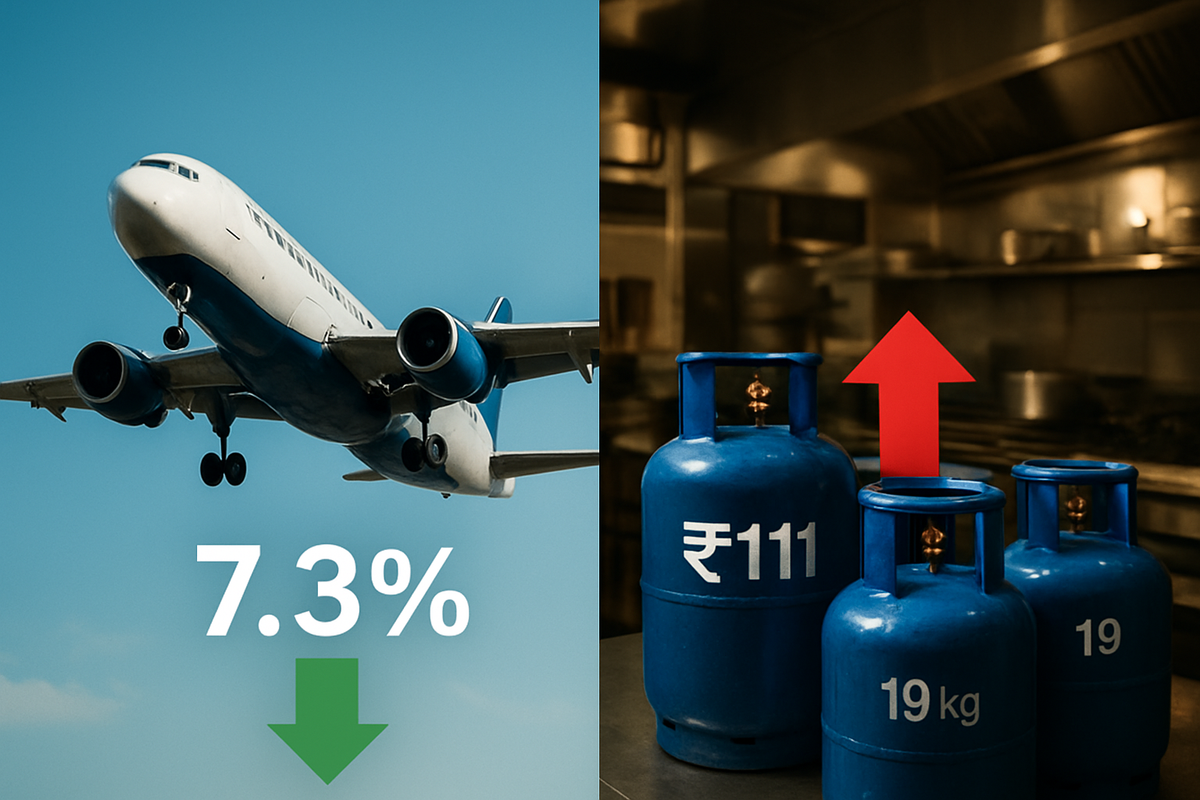
As the clock struck midnight on January 1, 2026, the Indian energy landscape presented a tale of two trajectories. In a major New Year’s Day revision, state-owned oil marketing companies (OMCs) announced a significant 7.3% reduction in Aviation Turbine Fuel (ATF) prices, providing a massive sigh of relief to the domestic aviation industry. Simultaneously, however, the commercial sector was dealt a blow with a sharp ₹111 hike in the price of 19-kg commercial Liquefied Petroleum Gas (LPG) cylinders, threatening to squeeze margins for restaurants and the hospitality sector.
This divergence underscores the complex dynamics of global energy markets. While ATF prices followed the downward trend of international crude oil benchmarks observed in December 2025, LPG prices remained tethered to the surging demand for winter heating in the Northern Hemisphere. The result is a split economic impact: a potential cooling of airfares for travelers and a likely heating up of menu prices at local eateries.
A Tale of Two Revisions: The January 1 Pricing Shift
The price revisions, effective immediately from the first day of 2026, represent one of the most significant monthly adjustments in recent years. For the aviation sector, the 7.3% cut—amounting to approximately ₹7,353.75 per kilolitre—effectively reverses nearly two-thirds of the price hikes accumulated during the final quarter of 2025. In the capital city of Delhi, ATF is now priced at ₹92,323.02 per kl, while in Mumbai, the price has dropped to ₹86,352.19 per kl. This move was facilitated by a moderation in global crude oil prices, which had softened as supply concerns eased toward the end of the year.
Conversely, the commercial LPG market saw a starkly different outcome. The price of a 19-kg cylinder, used primarily by hotels, restaurants, and catering businesses, was hiked by ₹111. In Delhi, the price jumped from ₹1,580.50 to ₹1,691.50, while Mumbai saw a similar rise to ₹1,642.50. This hike is largely attributed to the "winter heating demand" cycle. As colder temperatures persist across Europe and North America, the global cost of propane and butane—the primary components of LPG—typically spikes due to increased consumption for heating, forcing Indian OMCs to adjust rates based on import parity pricing.
The decision was spearheaded by the "Big Three" state-run OMCs: Indian Oil Corporation Limited (NSE: IOC), Bharat Petroleum Corporation Limited (NSE: BPCL), and Hindustan Petroleum Corporation Limited (NSE: HPCL). While these entities operate under a deregulated pricing regime for ATF and commercial LPG, their monthly revisions are closely watched as indicators of broader inflationary pressures and global commodity trends.
Winners and Losers: Navigating the New Pricing Reality
The primary beneficiary of this New Year revision is undoubtedly the aviation sector. Fuel typically accounts for nearly 40% of the operating expenses for Indian carriers. A 7.3% reduction in this overhead is expected to significantly bolster the bottom lines of major players like InterGlobe Aviation Ltd (NSE: INDIGO), the operator of IndiGo, and SpiceJet Ltd (NSE: SPICEJET). Analysts anticipate that this cost saving could allow airlines to offer more competitive pricing during the post-holiday travel season, potentially leading to a 5–7% reduction in ticket prices for consumers. For IndiGo, which commands the largest market share in India, the price cut could translate into hundreds of crores in quarterly savings.
On the losing side of the ledger are the hospitality and commercial catering industries. The ₹111 hike in commercial LPG cylinders comes at a time when the sector is already grappling with high food inflation. Industry bodies, including the Federation of Hotel & Restaurant Associations of India (FHRAI), have warned that such a steep increase in input costs will inevitably be passed on to the consumer. Small and medium-sized restaurants, which operate on thin margins, may be forced to hike menu prices by 3–5% to absorb the additional fuel expense.
The OMCs themselves—IOC, BPCL, and HPCL—face a mixed bag. While the price adjustments help them maintain marketing margins in line with international benchmarks, the divergence highlights the volatility they must manage. Investors in these stocks will be watching to see if the increased volume in aviation fuel sales can offset any potential cooling in commercial LPG demand as businesses look for alternative energy sources or more efficient cooking technologies.
Broader Significance and Global Energy Interplay
This divergence in pricing is not merely a local phenomenon but a reflection of how India’s energy policy is increasingly sensitive to global seasonal trends. The ATF cut aligns with the broader industry trend of stabilizing crude prices as global production meets demand. However, the LPG hike serves as a reminder of India’s heavy reliance on energy imports. Because India imports a significant portion of its LPG requirements, domestic prices are at the mercy of the Saudi Contract Price (CP), which typically peaks during the Northern Hemisphere’s winter months.
Historically, such divergences have led to regulatory scrutiny. While the government has kept domestic LPG (14.2-kg cylinders) prices stable at ₹853 in Delhi to protect households from inflation, the commercial sector remains a "free market" that absorbs the brunt of global volatility. This tiered pricing structure often leads to concerns regarding the illegal diversion of domestic cylinders for commercial use, a challenge that the Ministry of Petroleum and Natural Gas continues to combat through digital tracking and direct benefit transfers.
Furthermore, the ATF price cut may influence the ongoing discussions regarding the inclusion of jet fuel under the Goods and Services Tax (GST) regime. Currently, ATF is subject to varying value-added taxes (VAT) across different states, leading to the price discrepancies seen between Delhi and Mumbai. A lower base price might provide the government with a window to rationalize these taxes without causing an immediate spike in consumer costs, a move long advocated by the Ministry of Civil Aviation.
Looking Ahead: Market Opportunities and Strategic Pivots
In the short term, the aviation industry is likely to witness a period of aggressive marketing and fare wars as airlines look to capitalize on lower fuel costs to fill seats during the typically slower months of February and March. For InterGlobe Aviation Ltd (NSE: INDIGO), this could be an opportunity to further solidify its market dominance. However, if global crude prices rebound due to geopolitical tensions in early 2026, these gains could be short-lived, requiring airlines to remain nimble with their fuel hedging strategies.
For the commercial sector, the hike in LPG prices may accelerate a strategic pivot toward electric cooking and energy-efficient kitchen infrastructure. Large hotel chains and commercial kitchens are increasingly exploring induction-based systems and solar-thermal solutions to reduce their dependence on volatile fossil fuel prices. This shift presents a growing market opportunity for manufacturers of industrial electrical appliances and renewable energy providers.
The market will also be watching for the next round of revisions on February 1. If winter demand in the West persists, commercial LPG could see another hike, further straining the hospitality sector. Conversely, if global oil production increases, further cuts in ATF could sustain the rally in aviation stocks well into the second quarter of the year.
Summary and Investor Outlook
The January 1, 2026, energy price revisions have created a starkly divided economic landscape in India. While the 7.3% cut in ATF provides a much-needed tailwind for the aviation sector, the ₹111 hike in commercial LPG poses a significant headwind for the hospitality industry. These moves highlight the dual challenge of managing domestic inflation while remaining integrated with volatile global commodity markets.
For investors, the key takeaways are clear: the aviation sector, led by IndiGo and SpiceJet, stands to gain significantly in the immediate term, potentially seeing improved margins and higher passenger loads. However, the hospitality sector remains under pressure, and the OMCs will continue to navigate the tightrope of import parity pricing. Moving forward, market participants should keep a close eye on global crude benchmarks and the duration of the Northern Hemisphere winter, as these will be the primary drivers of the next pricing cycle.
This content is intended for informational purposes only and is not financial advice.