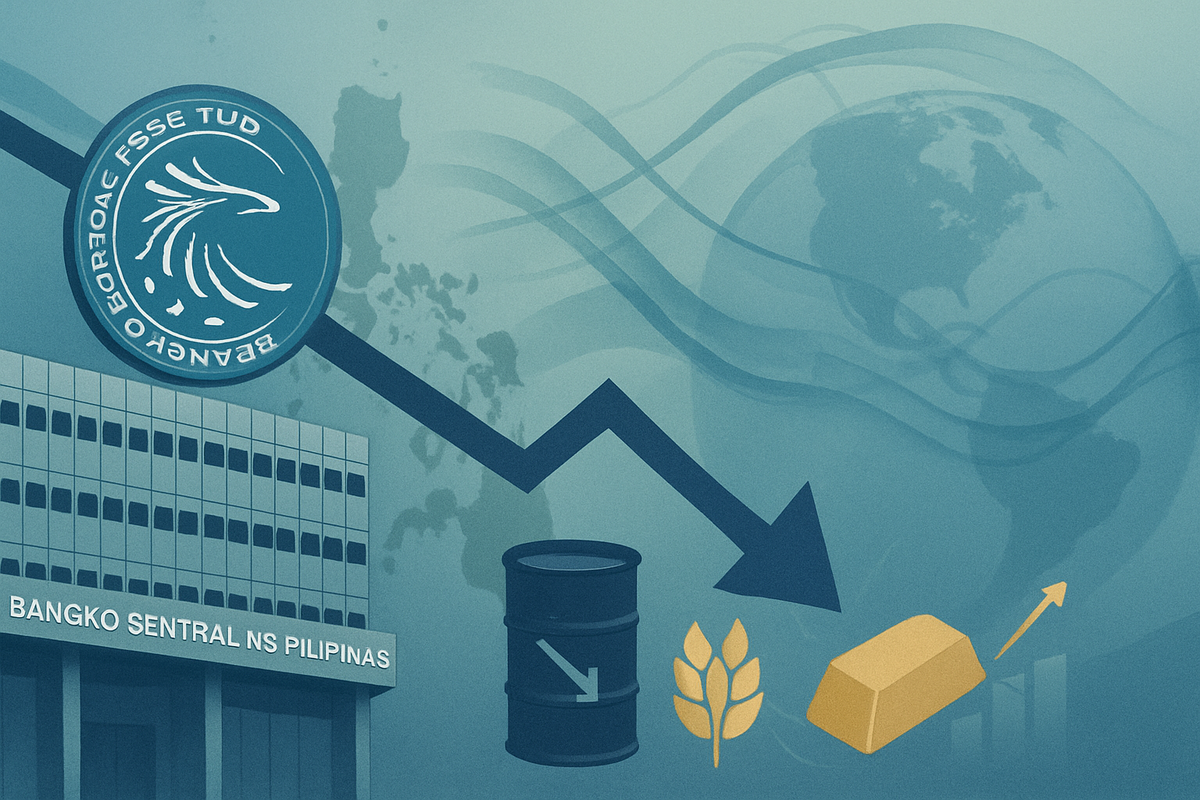
Maybank Research has issued a compelling forecast, predicting that the Bangko Sentral ng Pilipinas (BSP) is far from concluding its cycle of interest rate reductions. This projection, which anticipates a continued easing of monetary policy into late 2025 and 2026, stems from a confluence of factors including a subdued domestic economic growth outlook and a persistently benign inflation environment in the Philippines. The immediate implications of such an easing path, while primarily domestic, ripple through global financial markets by influencing investor sentiment, capital flows, and to a lesser extent, commodity price dynamics.
The central bank's anticipated dovish stance aims to inject much-needed stimulus into the Philippine economy, which has recently shown signs of decelerating growth. While individual BSP rate cuts may not dramatically shift global liquidity or commodity prices on their own, the cumulative effect, alongside similar actions by other emerging market central banks and the anticipated easing by major global players like the US Federal Reserve, contributes to a broader environment of increased global liquidity. This interconnectedness means that while the BSP acts locally, its decisions resonate within a larger global financial tapestry, influencing the cost of capital and investment flows across borders.
BSP's Easing Path: A Response to Economic Headwinds
Maybank's analysis, notably articulated by economists such as Azril Rosli and Suhaimi Ilias, underscores a strategic shift by the Bangko Sentral ng Pilipinas towards a more accommodative monetary policy. This pivot is largely a response to the Philippine economy's weaker-than-expected performance and a consistent undershooting of the central bank's inflation target. As of November 2025, consumer price growth had slowed to a remarkable 1.5 percent, falling below the BSP's 2.0-4.0 percent target range, with the full-year inflation for 2025 projected to average 1.7 percent. This benign inflation environment provides the BSP with ample room to maneuver.
The timeline leading to Maybank's prediction highlights a deliberate easing trajectory. The BSP initiated its easing cycle in August 2024, progressively cutting benchmark borrowing costs, bringing the policy rate to 4.75% by October 2025. This was an unexpected move for many analysts at the time. By early December 2025, BSP Governor Eli M. Remolona Jr. publicly acknowledged the likelihood of slower growth in 2025 (within the 4-5 percent range), further solidifying expectations for a rate cut at the upcoming December 11, 2025, policy meeting. A BusinessWorld poll conducted just prior to this meeting indicated that 17 out of 18 analysts anticipated a 25 basis point (bps) cut. This economic slowdown has been exacerbated by constraints on government spending, partly due to an ongoing corruption scandal, which has softened the overall economic outlook and dampened business sentiment.
Key players involved in this monetary policy discourse extend beyond Maybank and the BSP. Other influential financial institutions and economists, including DBS Bank Ltd., ANZ Bank Ltd., Bank of the Philippine Islands (BPI) (PSE: BPI), Rizal Commercial Banking Corp. (PSE: RCB), Security Bank (PSE: SECB), Metrobank (PSE: MBT), Goldman Sachs Economics Research, United Overseas Bank (UOB), and Oversea-Chinese Banking Corp. Ltd. (OCBC), have also weighed in, largely echoing the sentiment for continued easing. The decisions of the US Federal Reserve (Fed) also play a crucial role, as their monetary policy can influence global capital flows and the stability of the Philippine Peso. Initial market reactions to the BSP's unexpected October 2025 cut saw the Philippine Stock Exchange Index (PSEi) experience a decline. However, as expectations for further cuts solidified in December 2025, the PSEi rebounded, fueled by the favorable inflation data, though overall market volatility persisted due to broader economic concerns.
Corporate Fortunes: Winners and Losers in a Lower Rate Environment
The anticipated continuation of BSP rate cuts, coupled with shifts in global liquidity and commodity prices, presents a mixed bag of opportunities and challenges for public companies in the Philippines and across global markets. Sectors will react differently, with some poised for growth and others facing potential headwinds.
In the banking sector, the impact is likely to be mixed. While lower interest rates generally stimulate lending by making credit more affordable for consumers and businesses, they can also squeeze banks' net interest margins (NIMs). Larger, more diversified banks with strong consumer lending portfolios are better positioned to navigate this environment. For instance, BDO Unibank (PSE: BDO), as the largest bank in the Philippines, is well-placed to capitalize on increased lending activity and boasts a robust balance sheet. Bank of the Philippine Islands (PSE: BPI), known for its high return on equity, could also mitigate margin pressure through its growing consumer loan segment. Metropolitan Bank & Trust Co. (PSE: MBT) is another bank highlighted for its attractive dividend yield and earnings growth.
The manufacturing sector in the Philippines stands to benefit from cheaper borrowing costs, which can reduce operational expenses and facilitate expansion. Furthermore, a projected decline in global commodity prices, particularly for energy and raw materials, would significantly lower input costs, thereby improving profitability for many manufacturers. However, the sector still faces external challenges from slower global economic growth and potential protectionist trade policies.
Commodity-related industries will see a varied impact. Producers of most commodities are likely to be losers in a declining price environment. For example, major global energy companies like ExxonMobil (NYSE: XOM), Chevron (NYSE: CVX), and Shell (LSE: SHEL) could see their profitability pressured by lower crude prices. Mining companies focused on industrial metals might experience reduced demand due to weak global activity. However, there are exceptions; gold miners such as Philippine-listed Apex Mining (PSE: APX) and Manila Mining (PSE: MA) have performed well, with gold surging as a safe-haven asset. Certain base metals like copper and aluminum are also projected to show resilience due to demand from the energy transition. Conversely, industries that are significant consumers of commodities, such as transportation, utilities, and certain manufacturers, will benefit from lower input costs, leading to improved operational efficiency and profitability.
The real estate sector in the Philippines is a clear potential winner. Lower BSP policy rates are expected to translate into reduced mortgage rates, making property acquisition more affordable and stimulating demand. Companies like SM Prime Holdings (PSE: SMPH) and Ayala Land (PSE: ALI) are direct beneficiaries of these anticipated interest rate reductions. Similarly, the utilities/power sector, often considered defensive, will also benefit from lower financing costs for infrastructure projects. Meralco (PSE: MER), a major power company, is highlighted for its defensive nature and growth outlook.
Broader Implications: Navigating Regional and Global Currents
The BSP's rate cutting cycle is not an isolated event but rather a reflection of and contributor to broader industry trends in emerging markets and global monetary policy. The Philippines' accommodative stance aligns with a regional trend, as several central banks in Southeast Asia, including Indonesia and Malaysia, have either begun or are expected to continue easing their policies in 2025 and 2026. This synchronized easing is largely driven by moderating inflation risks and a collective need to support economic growth amidst a complex global economic environment.
A significant global factor influencing these trends is the anticipated rate cuts by the US Federal Reserve in 2025. Historically, lower US interest rates tend to weaken the US dollar, making emerging market assets more attractive and boosting capital inflows. This dynamic often provides emerging market central banks with more leeway to ease their own policies without triggering excessive currency depreciation or capital flight. However, the actual timing and magnitude of Fed cuts remain a critical point of observation, as any deviation could influence global liquidity and the stability of currencies like the Philippine Peso.
The ripple effects of the BSP's policy, particularly within Southeast Asia, are multifaceted. Lower interest rates in the Philippines could enhance its attractiveness for foreign direct investment (FDI) and portfolio investments, especially if coupled with a stable or strengthening peso (perhaps due to benign inflation and strong infrastructure development). This could benefit sectors like banking, financials, and infrastructure. From a trade competitiveness perspective, while rate cuts can lead to currency depreciation, making exports cheaper, a synchronized regional easing might mitigate significant competitive advantages or disadvantages among neighboring economies. However, ongoing global trade tensions, such as US tariffs, could still impact export-dependent economies in the region, leading to divergent policy responses. The Philippines, with its more domestically focused economy, is considered less exposed to direct tariff impacts compared to some of its regional peers.
Regulatory and policy implications are also significant. The current economic slowdown, partly linked to a corruption scandal impacting public infrastructure spending and business confidence, has amplified the role of monetary policy as a tool to stimulate growth. The BSP has emphasized a "measured approach" to its easing cycle, balancing price stability with sustainable economic growth. Beyond interest rates, the BSP has also considered other tools, such as reducing the reserve requirement ratio (RRR) for banks, though its impact on stimulating growth is seen as limited given existing liquidity. Historically, emerging markets have shown a strong correlation with US monetary policy, with lower US rates generally boosting EM assets. However, the "taper tantrum" of 2013 serves as a stark reminder of how global monetary shifts can impact these economies, especially those with weaker fundamentals. The current environment, with a combination of monetary easing, a potentially weaker US dollar, and recovering commodity prices, is seen as one of the most favorable for emerging market bonds in two decades, suggesting that the BSP's actions are part of a larger, more positive global trend for emerging economies.
What Comes Next: Navigating the Evolving Landscape
The coming months and years will be shaped by the interplay of the BSP's monetary policy, global liquidity trends, and commodity price movements. Maybank's prediction of continued BSP rate cuts sets the stage for a dynamic period, requiring strategic pivots from businesses and investors alike.
In the short-term (late 2025 - early 2026), the BSP is highly likely to deliver another 25 bps rate cut at its December 11, 2025 meeting, bringing the policy rate to 4.5%. This will further reduce borrowing costs, aiming to stimulate domestic demand and investment. Global liquidity is expected to remain relatively benign, possibly approaching a cyclical peak by mid-2026, with central bank actions, including the Fed ending quantitative tightening and potentially engaging in "QE-lite," providing support. Commodity prices are projected to continue their overall decline, reaching six-year lows by 2026, primarily due to weak global economic growth and an oil surplus. However, gold and silver are expected to remain strong as safe havens, and industrial metals like copper and aluminum could see price increases due to energy transition demand.
Looking into the long-term (mid-2026 - 2027), the BSP is expected to maintain an accommodative stance, with further modest rate cuts in early 2026, aiming to support an economic recovery projected to strengthen by 2027. Inflation is forecast to remain within target. Global liquidity, while potentially dipping, could see renewed easing from central banks, prolonging relatively easy financial conditions. Commodity prices, while above pre-pandemic levels, are expected to see a recovery in crude oil prices by Q2 2026, and continued strength in copper, aluminum, gold, and silver.
Businesses in the Philippines should leverage lower borrowing costs for expansion and refinancing, focusing on domestic demand opportunities, especially in consumer-facing sectors and tourism. Adapting to digital transformation and AI integration will be crucial for efficiency and new revenue streams. Investors may find opportunities in Philippine equities, particularly in consumer and banking sectors, and in real estate due to reduced mortgage rates. Globally, precious metals like gold and silver, and industrial metals tied to the energy transition (copper, aluminum), present attractive prospects. Fixed-income markets could rally in early 2026, while US equities, especially in AI-driven tech, are expected to continue strong earnings growth, though with increased volatility.
Potential market opportunities include growth in AI and technology, increased demand for energy transition metals, and a boost to Philippine tourism and infrastructure. Challenges include slower global economic growth, persistent policy uncertainty, and geopolitical risks. Scenarios range from a moderate global soft landing with sustained Philippine growth, leading to a favorable environment for recovery, to a persistent global slowdown with more aggressive BSP easing, or even a resurgence of inflationary pressures forcing the BSP to reverse course. Businesses and investors must remain agile, continuously monitoring economic data and policy shifts to adapt their strategies effectively.
Wrap-Up: A Cautious Optimism for the Philippine Market
Maybank's prediction of ongoing rate cuts by the Bangko Sentral ng Pilipinas forms a cornerstone of the current financial outlook for the Philippines. The central bank's proactive stance, driven by a desire to stimulate a slowing economy and capitalize on benign inflation, signals a period of strategic monetary easing that is expected to extend into 2026. This commitment to supporting economic growth, even as inflation approaches the target range, underscores the BSP's focus on fostering a robust domestic recovery.
Moving forward, the market is poised for a nuanced trajectory. Philippine equities are anticipated to benefit from strong domestic demand and the tailwinds of lower borrowing costs, with Maybank projecting attractive corporate earnings growth and a PSEi target of 8,200 points. The property market is also expected to find renewed vigor. However, the Philippine Peso is likely to face depreciation pressures, a common consequence of rate cuts, which investors will need to factor into their international investment strategies.
The lasting impact of the BSP's dovish policy could be a gradual but steady economic recovery, with GDP growth accelerating into 2026 and 2027, provided that government reforms and spending initiatives gain traction and the global economic environment remains supportive. This pro-growth approach is significant for restoring business and consumer confidence, which are vital for sustained economic activity.
Investors should watch several key indicators in the coming months. Foremost are the BSP's actions, particularly the outcome of the December 11, 2025, Monetary Board meeting and any subsequent guidance on the pace and extent of future easing. Any consideration of trimming the reserve requirement ratio (RRR) would also be a significant signal of further liquidity injection. The inflation trajectory will be crucial, as unexpected upward pressures from electricity rates or rice tariffs could prompt the BSP to pause or reverse its easing cycle.
Beyond domestic factors, global liquidity will remain a key determinant. The US Federal Reserve's pivot towards liquidity support and the easing cycles of other major central banks will influence global capital flows and risk appetite. Finally, commodity prices warrant close attention. While an overall decline in energy and food prices is anticipated, specific increases in certain industrial metals (copper, aluminum) and the continued strength of precious metals (gold, silver) will present targeted investment opportunities and could impact input costs for various industries. The interplay of these interconnected factors will ultimately determine the market's trajectory in the Philippines and beyond.
This content is intended for informational purposes only and is not financial advice