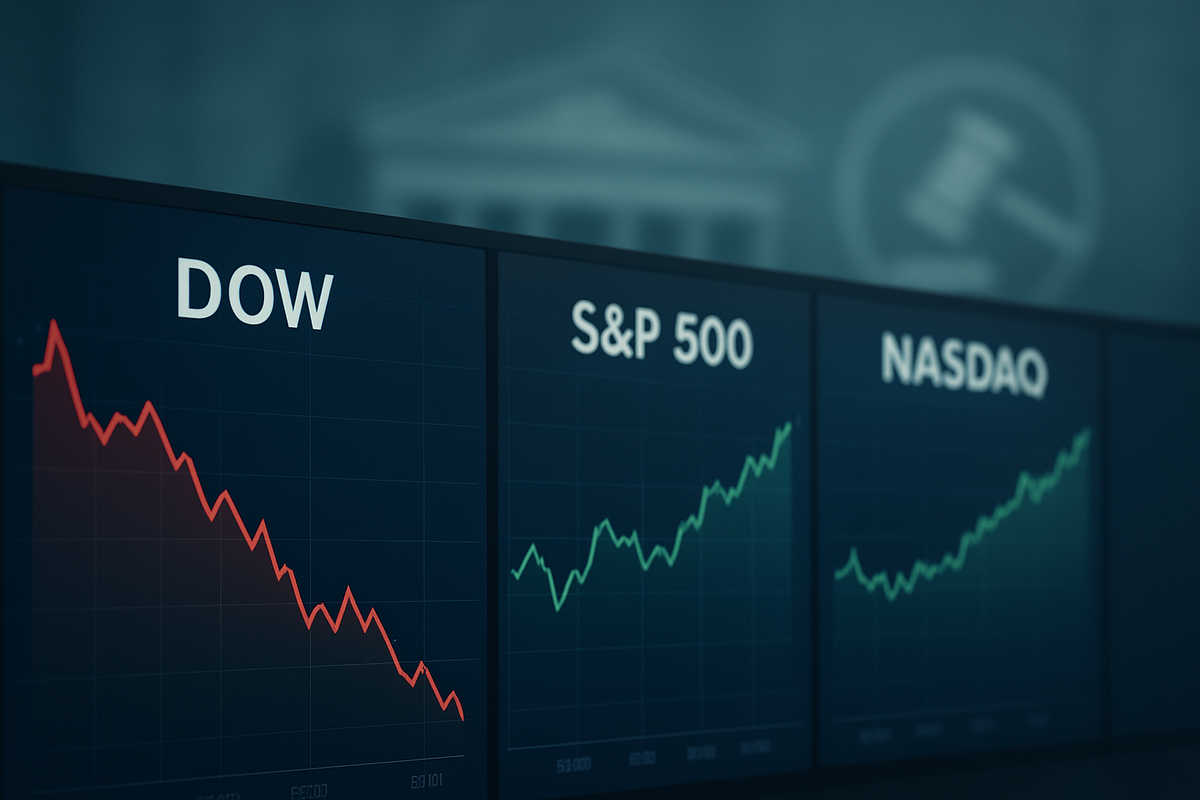
The U.S. stock market commenced the week of December 8, 2025, with a distinctly mixed and cautious tone, as investors grappled with anticipation ahead of a pivotal Federal Reserve interest rate decision. While the Dow Jones Industrial Average experienced a slight dip, reflecting broader market hesitancy, the tech-heavy Nasdaq 100 managed to eke out modest gains, signaling a divergence in sectoral performance. The S&P 500, often seen as a barometer for the broader market, remained largely flat, edging slightly lower or virtually unchanged, underscoring the prevailing wait-and-see approach among market participants.
This nuanced opening highlights a market caught between the immediate implications of corporate specific news and the overarching shadow of monetary policy uncertainty. The initial movements suggest that while certain sectors, particularly technology, are finding pockets of strength driven by individual company catalysts, the broader market remains tethered to macroeconomic indicators and the Fed's impending guidance on interest rates. Investors are keenly watching for clues on the future trajectory of borrowing costs, which will undoubtedly shape corporate earnings, consumer spending, and overall economic growth in the coming months.
Market Opens with a Whimper and a Whisper of Hope
The trading day on December 8, 2025, unfolded with a palpable sense of caution dominating the trading floors. The Dow Jones Industrial Average (DJIA) was an early casualty, slipping by approximately 0.1% to 0.3% within the first hour of trading. This decline was largely attributed to a broad-based hesitancy as investors squared positions and braced for potential volatility later in the week. The S&P 500, rather than mirroring the gains seen in some tech segments, also edged slightly lower, down about 0.1% to 0.2%, or remained virtually unchanged, hovering within half a percent of its October record closing high. The Nasdaq Composite, encompassing a wider array of technology and growth stocks, also opened largely flat, reflecting the overall muted sentiment.
However, the picture wasn't uniformly bleak. The Nasdaq 100, which tracks the 100 largest non-financial companies listed on the Nasdaq, showed a modest gain of around 0.3%. This resilience in a segment of the technology sector was a notable counterpoint to the broader market's cautious stance. The primary driver behind this specific strength appeared to be a combination of ongoing investor interest in technology and significant corporate deal news that provided targeted boosts to certain stocks.
The timeline leading up to this mixed open was characterized by a period of intense speculation surrounding the Federal Reserve. With a nearly 90% probability priced in for a 25-basis-point rate cut later in the week, market participants were dissecting every piece of economic data and every public statement from Fed officials. Debates among policymakers regarding "labor-market softness and sticky inflation" further fueled this uncertainty, creating an environment where investors were reluctant to make aggressive moves. Adding to the cautious global outlook were mixed performances in Asian markets, which contributed to the relatively flat opening in the U.S. as investors awaited clearer signals. Key players involved in shaping this sentiment included the Federal Reserve, global central banks, and major institutional investors whose positioning reflected the prevailing cautious mood.
Key Movers in a Divergent Market: Tesla, Rivian, Lucid, Confluent, and Carvana
In a market defined by its mixed signals, several individual companies stood out for their notable movements, reflecting both broader industry trends and specific corporate developments. The electric vehicle (EV) sector, often a bellwether for growth stock sentiment, saw significant attention. Tesla (NASDAQ: TSLA), the EV giant, experienced a slight dip in early trading, aligning with the broader cautious sentiment impacting high-growth stocks. This movement could be attributed to general market apprehension, coupled with ongoing concerns about EV demand sustainability and increasing competition, despite its dominant market position.
Meanwhile, newer EV players like Rivian (NASDAQ: RIVN) and Lucid (NASDAQ: LCID) also faced headwinds, with their shares generally reflecting the broader market's cautious stance on growth stocks. These companies, still in their nascent stages of scaling production and achieving profitability, are particularly sensitive to shifts in investor confidence and the availability of capital, both of which are influenced by interest rate expectations. Any signs of a tightening monetary policy or economic slowdown tend to disproportionately affect their valuations, as future growth prospects are discounted more heavily.
On the other hand, the technology sector presented a more varied picture. Confluent (NASDAQ: CFLT), a data streaming platform, notably saw a positive movement. This surge was primarily driven by news of IBM's announced acquisition of Confluent, a significant corporate development that immediately boosted investor confidence in the company's valuation and future. Such acquisition news often provides a strong upside catalyst, insulating the stock from broader market jitters. Another notable mover was Carvana (NYSE: CVNA), the online used car retailer, which experienced a premarket rally. This positive momentum was fueled by the anticipation of its inclusion in the S&P 500 index later in the month, a development that typically leads to increased institutional buying as index funds adjust their portfolios. These examples highlight how company-specific news and strategic developments can override general market sentiment, leading to divergent performances even within a cautious opening.
Broader Implications and Industry Ripples
The mixed market open on December 8, 2025, is more than just a daily fluctuation; it’s a snapshot of a market in transition, grappling with the interplay of monetary policy, technological advancements, and evolving consumer behavior. This event fits squarely into broader industry trends characterized by a growing divergence between established, value-oriented companies and high-growth, often unprofitable, technology firms. The cautious stance on the Dow, populated by many mature industrial giants, contrasted with the modest gains in the Nasdaq 100, home to tech innovators, underscores this trend. Investors are increasingly discerning, favoring companies with strong fundamentals or clear growth catalysts (like M&A or index inclusion) in an environment of anticipated higher-for-longer interest rates.
The potential ripple effects of this cautious sentiment are significant. For competitors and partners, particularly within the electric vehicle and technology sectors, the market's reaction to companies like Tesla, Rivian, and Lucid could signal a tightening investment landscape. Companies with less robust balance sheets or unclear paths to profitability might find it harder to secure funding or attract investor interest if the broader market remains risk-averse. Conversely, the M&A activity exemplified by IBM's interest in Confluent suggests that larger, cash-rich companies may see opportunities to acquire innovative firms at attractive valuations, potentially leading to further industry consolidation.
Regulatory and policy implications are also at play. The Federal Reserve's impending decision on interest rates is the most immediate policy driver, but broader regulatory scrutiny on big tech, antitrust concerns, and evolving environmental policies (which heavily impact the EV sector) continue to shape the landscape. Historical precedents suggest that periods of monetary policy tightening or uncertainty often lead to increased market volatility and a flight to quality, where investors prioritize stable, profitable companies over speculative growth. Comparisons to similar events, such as previous cycles of Fed rate hikes or periods of economic uncertainty, indicate that such mixed market opens can be a precursor to sustained sectoral rotations and a re-evaluation of valuation multiples across the board.
What Comes Next: Navigating Uncertainty and Opportunity
Looking ahead, the short-term trajectory of the market will undoubtedly be heavily influenced by the Federal Reserve's interest rate decision later in the week. A widely expected 25-basis-point rate cut, if delivered, could provide a temporary boost to market sentiment, particularly for growth stocks that are sensitive to borrowing costs. However, the accompanying commentary from the Fed regarding future policy and economic outlook will be equally, if not more, critical. Any hawkish signals or indications of continued vigilance against inflation could quickly dampen enthusiasm and reinforce the cautious mood. In the long term, companies will need to adapt to a potentially higher interest rate environment, which necessitates a stronger focus on profitability, efficient capital allocation, and sustainable growth rather than relying solely on top-line expansion.
Potential strategic pivots or adaptations required for companies in this environment include a renewed emphasis on cost control and operational efficiency. For EV manufacturers like Rivian and Lucid, this might mean refining production processes, optimizing supply chains, and accelerating their path to profitability to reduce reliance on external funding. For established tech firms, it could involve strategic acquisitions to bolster capabilities or divesting non-core assets to streamline operations. Market opportunities may emerge for companies that can demonstrate resilience, innovate effectively, and capture market share in a more competitive and cost-conscious environment. Conversely, challenges will persist for those with heavy debt loads, unsustainable burn rates, or products/services that are discretionary in a slowing economy.
Potential scenarios and outcomes range from a "soft landing" where the Fed successfully engineers a mild economic slowdown without triggering a recession, allowing for a gradual market recovery, to a more challenging "hard landing" scenario. In the latter, aggressive monetary policy could lead to a more significant economic downturn, impacting corporate earnings and leading to further market corrections. A "stagflationary" scenario, where inflation remains sticky despite slowing growth, also presents a risk, complicating the Fed's policy choices and potentially leading to prolonged market uncertainty. The market's ability to digest and adapt to these evolving economic realities will dictate the performance of various sectors and individual stocks in the coming months.
Comprehensive Wrap-up: A Market at a Crossroads
The mixed market open on December 8, 2025, serves as a potent reminder of the complex forces currently shaping the financial landscape. The key takeaway is a market in flux, where macroeconomic uncertainty, particularly surrounding the Federal Reserve's monetary policy, casts a long shadow over investor sentiment. While the Dow's slip highlighted a broad-based caution, the resilience of the Nasdaq 100, driven by specific corporate news like the Confluent acquisition and Carvana's index inclusion, underscored the increasing importance of individual company fundamentals and strategic catalysts in a discerning market. The divergence in performance between traditional industrial stocks and certain segments of the technology sector signals a continued rotation and re-evaluation of investment themes.
Moving forward, the market's trajectory will be heavily influenced by the Fed's actions and the subsequent economic data. Investors should brace for continued volatility and a potentially more selective investment environment. Companies that can demonstrate robust profitability, strong balance sheets, and clear competitive advantages are likely to fare better than those relying on speculative growth. The cautious sentiment also suggests that M&A activity could remain a significant driver of individual stock performance, as larger players seek to consolidate or acquire innovation.
Final thoughts on the significance and lasting impact point to an era where capital is no longer as cheap or abundant as in previous cycles. This shift will likely reward financial discipline and strategic foresight. What investors should watch for in the coming months includes the Fed's subsequent policy meetings, inflation reports, labor market data, and corporate earnings releases. These will provide crucial insights into the health of the economy and the future direction of monetary policy, ultimately guiding investment decisions in a market that remains at a critical crossroads.
This content is intended for informational purposes only and is not financial advice