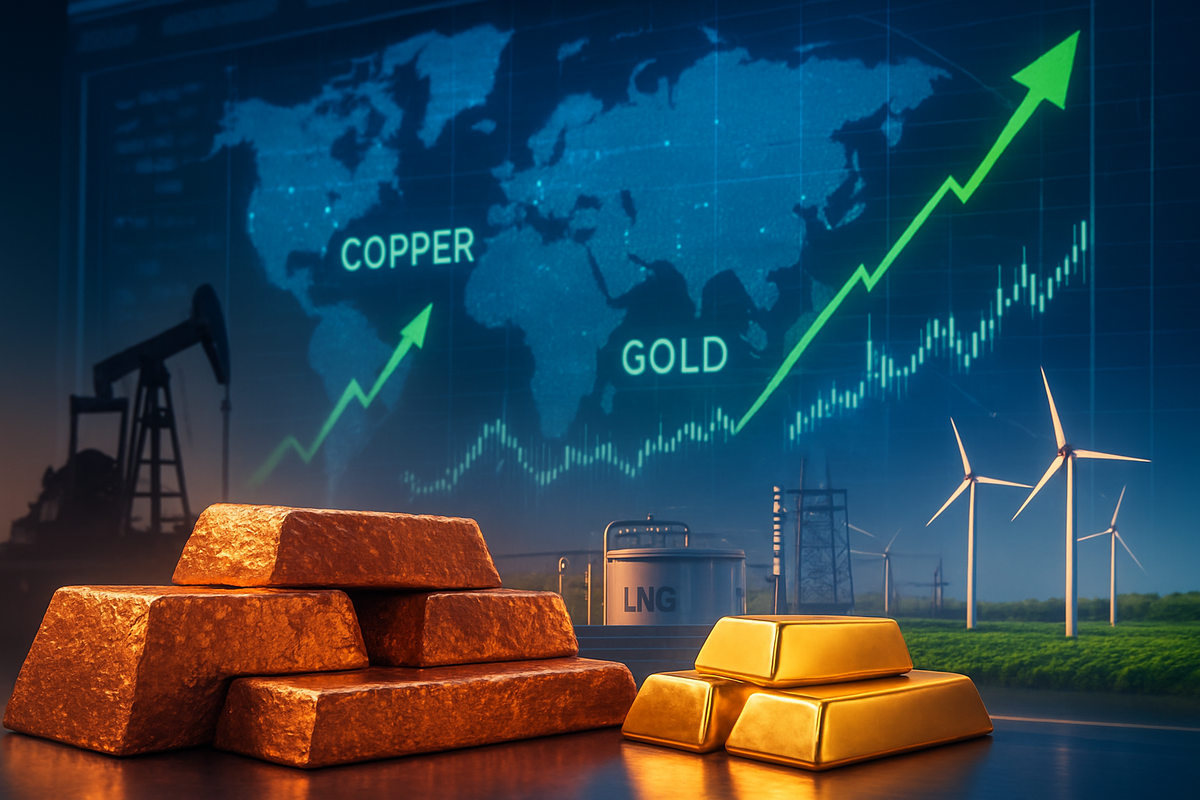
As the calendar turns to the final days of 2025, the global financial landscape is witnessing a profound shift in the commodities sector. A general improvement in key commodity prices—led by a historic rally in precious and industrial metals—is beginning to lift major resource companies and fundamentally alter analyst sentiment. While the "all-commodities-up" narrative of previous decades has been replaced by a more nuanced divergence, the sheer strength in metals and natural gas is providing a powerful tailwind for the materials sector, offering a counterbalance to a structural oversupply in the crude oil market.
This trend is not merely a price fluctuation but a structural realignment of the global economy. As of December 30, 2025, gold has shattered previous records, trading near $4,550 per ounce, while copper has surged to approximately $11,700 per metric ton. These gains are being driven by a "perfect storm" of geopolitical instability, the relentless demands of the green energy transition, and a shift in central bank reserves. For investors and public companies, this divergence is creating a new hierarchy of winners and losers, with significant implications for global inflation and the stability of the broader market.
The Bifurcated Boom: A Timeline of the 2025 Recovery
The road to the current price environment began in mid-2024, following a period of stagnation caused by high interest rates and a sluggish post-pandemic recovery in China. However, 2025 has seen a dramatic reversal. The primary catalyst was the acceleration of the "electrification of everything." As AI data centers and electric vehicle (EV) infrastructure moved from pilot projects to massive global rollouts, the demand for industrial metals like copper and lithium outstripped supply. Copper, often called "Dr. Copper" for its ability to predict economic health, has seen its price nearly double over the last 18 months as global inventories hit decade lows.
Simultaneously, the energy sector has experienced its own internal divergence. While crude oil prices have remained under pressure, trading between $59 and $62 per barrel due to record production from non-OPEC+ nations like the U.S., Brazil, and Guyana, natural gas has seen a late-year surge. In December 2025, Henry Hub natural gas prices broke $5.00/MMBtu, driven by a severe early-winter cold snap across the Northern Hemisphere and a massive expansion in U.S. liquefied natural gas (LNG) export capacity. This has created a windfall for domestic producers even as the "Big Oil" narrative faces headwinds from a cooling global demand for transportation fuels.
The agricultural sector, meanwhile, has provided a stabilizing, albeit fragile, floor for the commodity index. After a "season of plenty" in 2025 that saw record-breaking corn and wheat harvests in the U.S. and Brazil, prices have stabilized at lower levels—corn at $4.42 per bushel and wheat at $5.13. However, analysts at major firms like Goldman Sachs and J.P. Morgan warn that this stability is precarious. With La Niña weather patterns threatening South American yields in early 2026, the agricultural market is currently viewed as a "coiled spring," ready to join the metals rally at the first sign of a supply disruption.
Corporate Champions: Who Wins in the New Resource Era?
The primary beneficiaries of this commodity shift are the diversified mining giants and pure-play gold producers. Barrick Gold (NYSE: GOLD) has emerged as a standout performer, with its shares up significantly year-to-date. The company reported a 170% surge in net earnings in its most recent quarterly filing, capitalizing on the flight to safety that has pushed gold to its current $4,550/oz peak. Similarly, Newmont (NYSE: NEM) has seen its market capitalization swell to approximately $115 billion, as it beats earnings forecasts and attracts investors looking for a hedge against sovereign debt debasement.
In the industrial space, Freeport-McMoRan (NYSE: FCX) is riding the copper wave to new 52-week highs. With copper prices near $12,000 per ton, Freeport’s role as a primary supplier for the global energy transition has made it a favorite among institutional analysts. Diversified majors like BHP Group (NYSE: BHP) and Rio Tinto (NYSE: RIO) are also seeing robust performance. While their iron ore divisions have faced some pressure due to China’s cooling property sector, their massive investments in "future-facing" minerals like copper and potash are beginning to pay off, with BHP reporting record underlying EBITDA margins of 53% in late 2025.
Conversely, the picture is more complex for the integrated oil majors. ExxonMobil (NYSE: XOM) and Chevron (NYSE: CVX) have maintained strong balance sheets and healthy dividends, but they are increasingly forced to find growth through operational efficiency rather than rising crude prices. While Exxon’s expansion in the Permian Basin has provided a buffer, the company’s stock performance has lagged behind the mining sector as Brent crude struggles to maintain a $60 floor. Meanwhile, agricultural powerhouses like Archer-Daniels-Midland (NYSE: ADM) are navigating a margin squeeze, as high yields keep prices low for the crops they process and trade.
Macro Significance: Inflation, Policy, and the Green Transition
The 2025 commodity divergence is having a paradoxical effect on global inflation. On one hand, the slump in oil prices has been a "gift" to central banks, driving headline inflation lower and allowing the Federal Reserve to cut interest rates to a target range of 4.25%–4.5% in late 2025. This "energy-driven disinflation" has provided the necessary cover for a "soft landing" in the U.S. economy. On the other hand, the record cost of metals is creating a "structural inflationary floor." This "green inflation" is being passed through to consumers in the form of higher prices for EVs, renewable energy hardware, and high-tech electronics, keeping core inflation stickier than central bankers would prefer.
This trend fits into a broader historical precedent: the transition from a fossil-fuel-intensive economy to a mineral-intensive one. Much like the oil shocks of the 1970s reshaped global geopolitics, the "copper and gold shocks" of 2025 are shifting the balance of power toward mineral-rich nations and the companies that control their extraction. This has prompted a wave of regulatory shifts, with the U.S. and EU implementing more aggressive "critical mineral" policies to secure supply chains away from geopolitical rivals, further driving up the "risk premium" on these essential commodities.
Furthermore, the rise in gold prices reflects a growing skepticism toward traditional fiat currencies and rising global debt levels. Central banks in China and India have been aggressive buyers of gold throughout 2025, viewing it as the ultimate "debasement hedge." This shift suggests that the current commodity trend is not just a cyclical move but a fundamental re-evaluation of hard assets in an era of geopolitical fragmentation and fiscal expansion.
The Road Ahead: Scenarios for 2026 and Beyond
Looking into 2026, the market faces two primary scenarios. In the "Bullish Consolidation" scenario, metals prices remain elevated as supply deficits persist, while oil prices stabilize as OPEC+ successfully manages the global glut. This would lead to a sustained period of high profitability for companies like Freeport-McMoRan (NYSE: FCX) and BHP Group (NYSE: BHP). However, the risk of a "Supply Shock" remains high in the agricultural sector. If weather disruptions materialize in early 2026, we could see a rapid "catch-up" rally in grain prices, which would reignite headline inflation and force central banks to pause their rate-cutting cycles.
Strategically, resource companies are likely to accelerate their pivot toward "energy transition" minerals. We expect to see a surge in M&A activity as cash-rich oil majors seek to diversify their portfolios by acquiring copper or lithium producers. The recent performance of Barrick Gold (NYSE: GOLD) also suggests that gold miners may look to expand into "copper-gold" porphyry deposits, blurring the lines between precious and industrial mining to maximize their exposure to the current market tailwinds.
Conclusion: A New Era for Investors
The commodity landscape of late 2025 is a study in contrasts. The "general improvement" in prices is actually a sophisticated realignment where metals and gold are the new market leaders, while energy undergoes a structural transformation. For investors, the key takeaway is that the "commodity supercycle" is no longer a monolith. Success in this market requires a discerning eye for companies with high-quality assets in copper, gold, and natural gas, rather than a broad bet on all raw materials.
Moving forward, the market will be defined by the tension between energy-driven disinflation and metal-driven "green inflation." Investors should closely monitor central bank commentary regarding core inflation and watch for any signs of supply tightness in the agricultural sector. As we enter 2026, the resource sector is no longer just a "value play"—it has become a critical component of the growth narrative for the modern, electrified global economy.
This content is intended for informational purposes only and is not financial advice.