The U.S. economy received a much-anticipated data point today as the Bureau of Labor Statistics released the December 2025 Consumer Price Index (CPI) report, showing a headline inflation rate of 2.7% year-over-year. This cooling, which outperformed economist expectations of 3.1%, arrives at a critical juncture for the retail sector. As consumers finish a record-breaking holiday shopping season that is projected to surpass $1 trillion in total spending for the first time, the softer inflation print provides a sigh of relief for both Wall Street and Main Street, signaling that the Federal Reserve may finally have the "green light" to prioritize labor market stability over aggressive rate hikes as we enter 2026.
However, the headline numbers carry a heavy asterisk. Due to a historic 43-day government shutdown that paralyzed federal agencies in October and early November, nearly half of the data in today’s report was "imputed" or estimated. While the market initially rallied on the news, analysts are cautioning that the true state of the consumer might be more complex than the 2.7% figure suggests. The immediate implication is a "risk-on" environment for major retail stocks, but the underlying reliance on credit and a shifting "trade-down" culture suggest that the retail landscape of 2026 will be defined by a battle for the budget-conscious shopper.
The "Imputed" CPI: Navigating the Data Fog of 2025
The December 2025 CPI report is perhaps one of the most unusual in recent history. The 2.7% headline figure and the 2.6% Core CPI (which excludes food and energy) represent the slowest pace of price increases since 2021. Yet, the timeline leading to this release was fraught with administrative chaos. The 43-day government shutdown earlier this fall meant that the Bureau of Labor Statistics missed several key collection windows in October. Consequently, the Bureau reported a 0.2% increase over a combined two-month period rather than the standard month-over-month change, leaving some institutional investors skeptical of the report’s precision.
Despite the data gaps, the downward trend in energy and food costs is undeniable. Gasoline prices have finally dipped below the $3.00 national average, and "food at home" inflation slowed to 1.9% year-over-year. Shelter costs, which remained a stubborn inflationary thorn throughout 2024 and most of 2025, showed a surprisingly modest 0.2% increase over the two-month period. This cooling in essentials has freed up a marginal amount of discretionary income, which appears to have flowed directly into the holiday coffers.
The initial market reaction was swift. The S&P 500 jumped 0.9% in early trading, led by a surge in consumer discretionary and technology sectors. Investors are betting that this report, regardless of its "imputed" nature, gives the Federal Reserve the cover it needs to pivot toward interest rate cuts in early 2026. The narrative has shifted from "how high will rates go" to "how fast will they fall," a sentiment that is currently acting as a tailwind for major retail platforms.
The Retail Divide: Winners and Losers in a K-Shaped Economy
As we head into 2026, the retail sector is witnessing a stark divergence between those who cater to the "trade-down" shopper and those stuck in the middle. Walmart Inc. (NYSE: WMT) has emerged as the clear winner of this cycle. By leveraging its massive scale to keep grocery prices low, Walmart has successfully captured a significant share of higher-income households—those earning over $100,000—who are now seeking value to offset the cumulative inflation of the past three years. Similarly, The TJX Companies, Inc. (NYSE: TJX) and Dollar General Corporation (NYSE: DG) have seen increased foot traffic as "treasure hunting" for discounts becomes a mainstream consumer behavior.
On the digital front, Amazon.com, Inc. (NASDAQ: AMZN) continues to dominate, bolstered by the integration of "Agentic AI" shopping assistants that helped drive Cyber Monday 2025 sales to a record $14.25 billion. Amazon’s ability to offer rapid delivery and competitive pricing via AI-driven logistics has made it nearly indispensable for the modern household. Conversely, mid-tier department stores like Macy's, Inc. (NYSE: M) and Target Corporation (NYSE: TGT) face a more challenging outlook. While Target has made strides in its private-label offerings, it continues to struggle with a consumer base that is increasingly bifurcated between extreme value and high-end luxury.
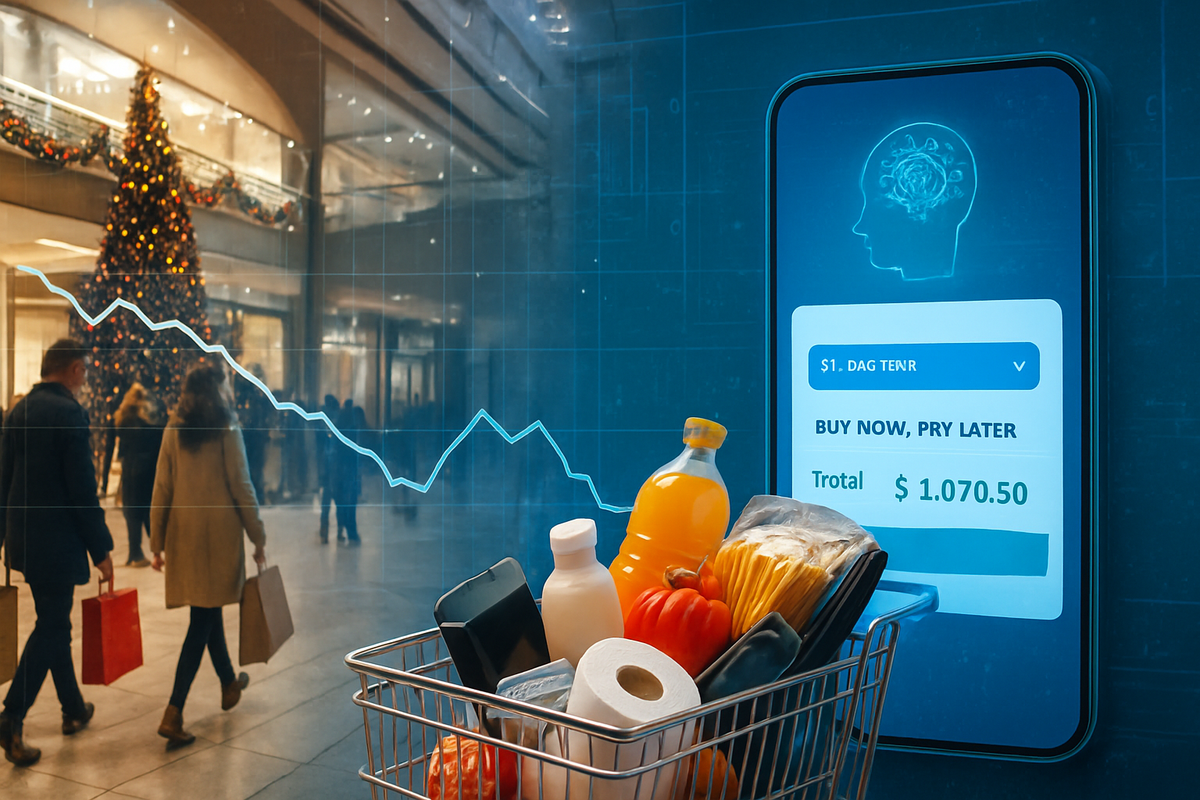
The "losers" in this environment are likely to be retailers focused on discretionary durables, such as high-end electronics and home furnishings. As the labor market shows signs of softening, households are prioritizing "needs" over "wants." Companies that failed to adapt to the "Buy Now, Pay Later" (BNPL) trend are also losing out; a staggering $18.2 billion in holiday purchases was made through BNPL services this year, a trend that has benefited fintech-integrated retailers but created a potential "debt hangover" for the first quarter of 2026.
Beyond the Checkout: AI, Debt, and the Policy Pivot
The current retail environment is not just a story of prices; it is a story of a fundamental shift in how Americans shop. The rise of Agentic AI—AI agents that can autonomously find, compare, and purchase goods for users—has introduced a new level of price transparency that is squeezing profit margins for retailers who lack a clear value proposition. This technological shift is occurring alongside a broader industry trend toward "retail media networks," where companies like Walmart and Amazon are increasingly acting as advertising platforms to supplement their thinning retail margins.
Historically, periods of cooling inflation following a sharp spike are often met with a "normalization" of consumer behavior. However, the 2025-2026 transition is unique due to the massive reliance on consumer credit. The record usage of BNPL and credit cards during the $1 trillion holiday season suggests that while inflation is slowing, the consumer's "real" purchasing power may be stretched to its limit. This mirrors the post-2008 recovery in some ways, but with the added complexity of a much faster, AI-driven marketplace.
Furthermore, the shadow of trade policy looms large over the 2026 outlook. Potential new tariffs are expected to be a primary driver of "imported inflation" in the coming year. Retailers are already beginning to front-load inventory to avoid anticipated price hikes in the second half of 2026. This creates a regulatory and policy environment where the Fed’s job is far from over; they must balance the current cooling of domestic prices against the potential for a new wave of tariff-induced cost increases.
The 2026 Horizon: Strategic Pivots and Market Scenarios
Looking ahead to 2026, the retail sector must prepare for a "low-growth" reality. Analysts at Moody’s project that real consumer spending growth will slow to roughly 1.5% next year. To survive, retailers will likely pivot toward "loyalty ecosystems"—subscription models and personalized AI experiences—to lock in customers. We should expect to see more aggressive partnerships between traditional retailers and tech giants like Nvidia Corporation (NASDAQ: NVDA) to power the backend of these AI shopping experiences.
In the short term, the first quarter of 2026 will be a "cleansing" period. The market will be watching for the "BNPL hangover"—whether consumers can actually pay off their holiday debts or if a spike in delinquencies will force a sudden contraction in spending. If the labor market remains resilient and the Fed begins cutting rates by March, we could see a "soft landing" where retail growth stabilizes. However, if the imputed data from today’s CPI report masked a deeper underlying weakness, the retail sector could face a sharper-than-expected downturn by mid-2026.
Strategic adaptations will be mandatory. Retailers will need to focus on "value-added" services rather than just product sales. This could include more robust in-store experiences, enhanced circular economy initiatives (like trade-in programs), and a deeper integration of AI to manage inventory more efficiently. The companies that can maintain margins in a 1.5% growth environment will be the ones that have mastered the art of operational efficiency.
Conclusion: A Fragile Resilience
The December 2025 CPI report marks a symbolic victory in the long fight against post-pandemic inflation. A 2.7% rate, coupled with a trillion-dollar holiday season, suggests a consumer base that is remarkably resilient. However, this resilience is built on a foundation of estimated data, record-high credit usage, and a "trade-down" mentality that favors the giants of the industry while leaving mid-tier players in the cold. The market is moving forward with optimism, but it is an optimism tempered by the realities of a softening labor market and the potential for new geopolitical trade tensions.
For investors, the coming months will be a period of "watching the watcher." All eyes will be on the Federal Reserve's January meeting to see if they validate the market's "risk-on" reaction to today's data. Key metrics to monitor include BNPL delinquency rates in February and the first "clean" CPI report of 2026, which will lack the imputed data issues of the current release.
Ultimately, the significance of today’s report lies in its timing. It provides a psychological floor for the market as it transitions into a new year. While the "trillion-dollar holiday" is a milestone to be celebrated, the true test for the retail sector will be how it manages the "inflation hangover" and the technological disruptions that await in 2026.
This content is intended for informational purposes only and is not financial advice.