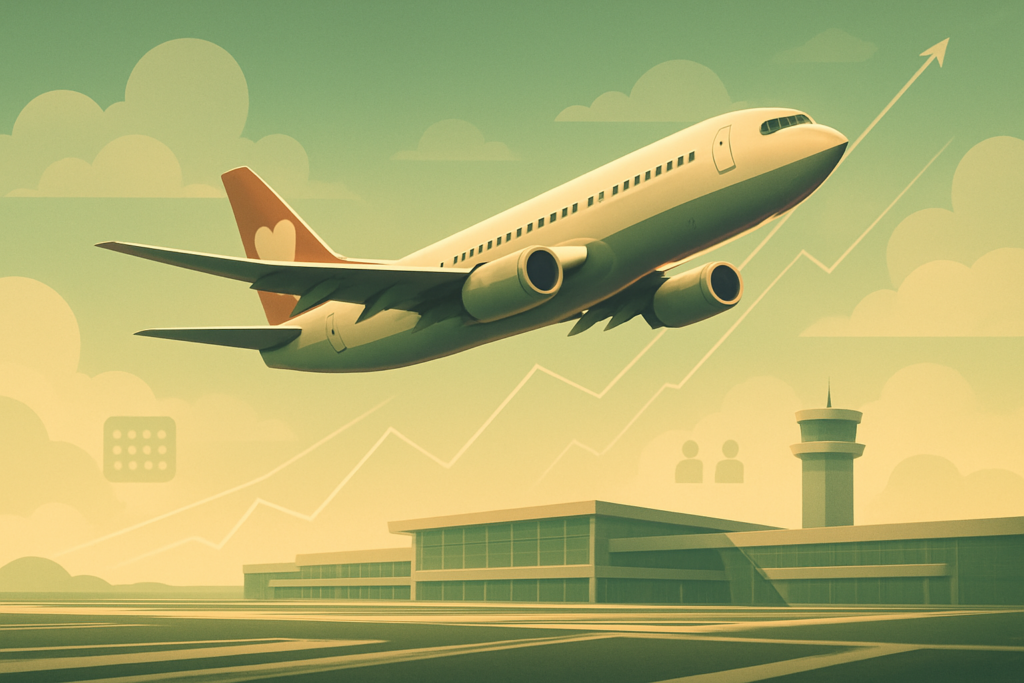
As of January 26, 2026, Southwest Airlines (NYSE: LUV) stands at the most significant crossroads in its 55-year history. Known for decades as the "Maverick" of the skies—a carrier that defied industry norms with open seating, a point-to-point network, and a refusal to charge for checked bags—Southwest is currently in the midst of a radical metamorphosis. This transition is not merely a marketing shift but a fundamental restructuring of its DNA, driven by a catastrophic operational failure in 2022, a bruising battle with activist investors in 2024, and a changing consumer appetite for premium travel.
Tomorrow, January 27, 2026, marks the official launch of assigned seating across the Southwest network, ending an era that defined the airline's brand. As the company works to regain its footing and prove its operational resilience, investors are closely watching whether "the new Southwest" can maintain its cost-efficiency while capturing the high-margin revenue of legacy competitors.
Historical Background
The Southwest story began in 1971, founded by the legendary Herb Kelleher and Rollin King. Originally serving the "Texas Triangle" (Dallas, Houston, and San Antonio), the airline spent its first years fighting legal battles against established carriers that sought to ground it. This "underdog" mentality became the core of Southwest’s culture.
Throughout the 1980s and 1990s, Southwest revolutionized the industry with its point-to-point model, avoiding the expensive "hub-and-spoke" systems favored by rivals like United Airlines (NASDAQ: UAL) and Delta Air Lines (NYSE: DAL). By flying only the Boeing 737, Southwest kept maintenance and training costs at industry-leading lows. This efficiency allowed for 47 consecutive years of profitability—a feat unmatched in aviation history. However, this success arguably led to complacency, as the airline’s backend technology failed to keep pace with its rapid national expansion.
Business Model
Southwest’s business model has traditionally rested on three pillars: high aircraft utilization, low complexity, and customer-friendly policies. Unlike legacy carriers, Southwest operates a point-to-point network, which allows for more direct flights between mid-sized cities.
In late 2024 and throughout 2025, this model underwent a "hybridization." While still maintaining its 737-only fleet for operational simplicity, Southwest has introduced tiered pricing and ancillary revenue streams. The "Bags Fly Free" policy, once a sacred cow, was modified in May 2025 with the introduction of a "Basic" fare that charges for checked luggage, while "Choice" and "Premium" tiers maintain the free-bag perk. This shift represents a move away from a pure Low-Cost Carrier (LCC) model toward a segmented strategy designed to compete with both ultra-low-cost carriers and premium legacy brands.
Stock Performance Overview
Over the last decade, LUV has experienced a volatile journey:
- 10-Year Performance: As of Jan 2026, the stock has returned approximately 23%. This significantly underperforms the S&P 500, which has surged over 180% in the same period. Much of this drag came from the 2020-2022 period.
- 5-Year Performance: The stock is down approximately 5% over five years, still struggling to reclaim the highs seen before the COVID-19 pandemic and the 2022 operational crisis.
- 1-Year Performance: In a sharp reversal, LUV is up roughly 35% over the past 12 months. This rally was ignited by the settlement with Elliott Investment Management in October 2024 and subsequent excitement regarding the revenue potential of assigned seating and premium cabins.
Currently trading near $41.95, the stock is at a two-year high, reflecting investor optimism about the "Transformation Plan" led by the current management.
Financial Performance
Southwest’s recent financial results suggest a company in recovery. In its Q3 2025 earnings report, the carrier posted record revenue of $6.9 billion. For the full year 2025, EBIT (Earnings Before Interest and Taxes) is projected to land between $600 million and $800 million, a marked improvement from the break-even levels seen in early 2024.
The company’s balance sheet remains one of the strongest in the industry, maintaining an investment-grade rating. However, cost per available seat mile (CASM) excluding fuel remains a concern, as labor costs have risen following new contracts for pilots and flight attendants. The push for assigned seating and "Extra Legroom" seats is expected to generate an incremental $1.5 billion in annual revenue by 2027, which analysts believe will be the primary driver for margin expansion.
Leadership and Management
The leadership at Southwest underwent a tectonic shift in late 2024. Following a campaign by Elliott Investment Management, long-time Executive Chairman Gary Kelly retired in November 2024. CEO Bob Jordan remained at the helm but is now supported by a heavily refreshed Board of Directors, including five members appointed by Elliott.
Under Jordan, the management team has pivoted from a defensive posture to an aggressive modernization strategy. Chief Operating Officer Andrew Watterson has been credited with the "Tactical Operational Plan," which successfully overhauled the airline’s crew-scheduling software and winter weather preparedness, preventing a repeat of the 2022 "Holiday Meltdown."
Products, Services, and Innovations
The most visible innovations at Southwest are occurring within the cabin. For the first time, the airline is offering:
- Assigned Seating: Removing the "boarding scramble" that many corporate travelers cited as a reason for avoiding the carrier.
- Premium Seating: "Extra Legroom" seats with 35 inches of pitch are now available in the front of the aircraft and exit rows.
- Red-Eye Flights: Launched in 2025, these overnight flights allow Southwest to increase aircraft utilization by flying during hours when planes previously sat idle.
- Tech Resilience: The airline has replaced its legacy "SkySolver" system with a cloud-based network recovery engine that can re-route thousands of crew members in minutes during weather disruptions.
Competitive Landscape
The U.S. aviation market is currently split into two camps: the "Premium" giants (Delta and United) and the struggling "Ultra-Low-Cost Carriers" (Spirit and Frontier). Southwest is carving out a middle ground.
By adding assigned seats and premium legroom, Southwest is directly targeting Delta and United’s "Economy Plus" customers. Meanwhile, by maintaining some free-bag options and a robust domestic network, it aims to remain more attractive than the "fee-heavy" ULCCs. Its primary competitive advantage remains its dominant market share in key cities like Dallas (Love Field), Chicago (Midway), and Las Vegas, where its point-to-point network offers more non-stop options than competitors.
Industry and Market Trends
The "Premiumization" of travel is the dominant trend of 2026. Post-pandemic, travelers have shown a willingness to pay more for comfort and reliability. This trend made Southwest’s old "one-class-fits-all" model obsolete. Additionally, the industry is grappling with Boeing (NYSE: BA) delivery delays. Because Southwest only flies the 737, any slowdown in Boeing’s production line directly limits Southwest’s ability to grow its capacity or retire older, less fuel-efficient aircraft.
Risks and Challenges
Despite the recovery, Southwest faces several headwinds:
- Boeing Dependency: As a 737-only operator, Southwest is uniquely vulnerable to Boeing’s manufacturing hurdles. Delays in the 737 MAX 7 certification have already forced the airline to adjust its capacity forecasts for 2026.
- Cultural Identity Crisis: Transitioning to assigned seating and charging for bags (in some tiers) risks alienating "Southwest Loyalists" who valued the airline’s simplicity.
- Labor Costs: New union contracts have significantly raised the floor for operating expenses, meaning Southwest must maintain high load factors and premium yields to remain profitable.
- Execution Risk: Tomorrow's launch of assigned seating is a massive logistical undertaking. Any technical glitches in the seat-assignment engine could result in immediate reputational damage.
Opportunities and Catalysts
- Ancillary Revenue: The move to assigned seating and premium rows is a massive revenue lever. If Southwest can achieve even 50% of the per-passenger ancillary revenue that United earns, it would result in a significant earnings beat.
- Global Distribution: Southwest recently began listing its flights on major Global Distribution Systems (GDS) and aggregators like Expedia. This opens the door to high-spending corporate travelers who previously could not book Southwest through their company portals.
- Network Optimization: The introduction of red-eye flights and better aircraft utilization provides a path to growth that doesn't rely solely on new aircraft deliveries.
Investor Sentiment and Analyst Coverage
Wall Street sentiment has shifted from "Skeptical" to "Cautiously Bullish" over the past year. Analysts from firms like J.P. Morgan and Morgan Stanley have upgraded the stock, citing the "Elliott-induced" urgency for change. The consensus 12-month price target currently sits around $48.00, suggesting room for further growth if the seating transition goes smoothly. Institutional ownership remains high, with Vanguard and BlackRock holding significant positions, while retail sentiment on platforms like Reddit has been mixed, with long-term "LUV fans" mourning the end of open seating while investors cheer the potential for dividends and buybacks.
Regulatory, Policy, and Geopolitical Factors
Southwest continues to operate under the watchful eye of the Department of Transportation (DOT). Following the 2022 meltdown, the DOT issued a record $140 million fine. While most of this has been settled, the airline remains under a "probationary" period where it must prove its passenger protection systems are robust.
Additionally, environmental regulations are tightening. The push for Sustainable Aviation Fuel (SAF) will increase costs across the industry. Southwest has committed to replacing 10% of its total jet fuel consumption with SAF by 2030, a goal that requires significant capital investment in a currently undersupplied market.
Conclusion
Southwest Airlines enters 2026 as a company that has finally embraced the modern realities of aviation. The "operational resilience" that was tested and found wanting in 2022 has been fortified by a multi-billion dollar investment in technology and infrastructure. However, the true test begins now.
Investors should watch the Q1 and Q2 2026 earnings closely for "Revenue per Available Seat Mile" (RASM) growth. If the new assigned seating and premium tiers are embraced by the public without a spike in operational costs, Southwest could reclaim its title as the "Gold Standard" of airline stocks. For now, it is a high-conviction turnaround story that has successfully weathered the storm but must now prove it can fly in a new, more competitive direction.
This content is intended for informational purposes only and is not financial advice.