When markets are range-bound, it can be difficult to predict where stocks are going. Short option strategies may benefit from uncertainty, though they can also carry massive risks. Directionally-bound credit spreads may work, though, it requires a solid belief in your anticipated market direction.
So where does that leave the risk-averse investors? Well, there are short iron condors, a four-legged income-generating strategy that pays off if the stock stays within a specific price range.
What is a short iron condor?
A short iron condor, often just called an iron condor, is an options strategy designed to profit from a market staying within a certain range. It involves selling an out-of-the-money call spread above the current price (bear call spread) and an out-of-the-money put spread below the current price (bull put spread) at the same time, collecting premiums on both sides while limiting your risk. The strategy gets its name from the shape it takes on an options profit/loss chart.
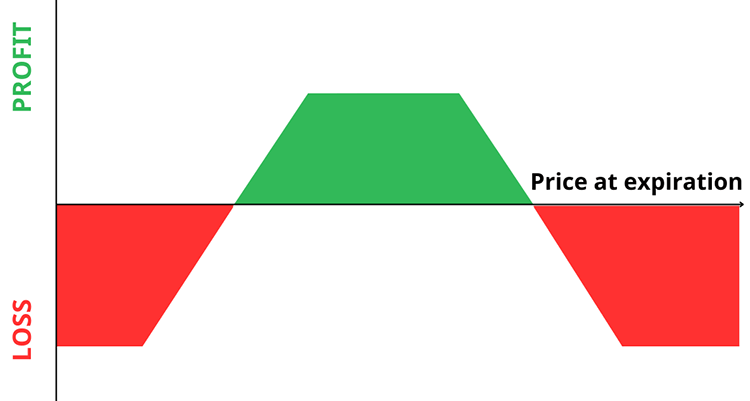
The overall goal of an iron condor is for the underlying asset to trade between the short strike prices at expiration.
The maximum profit on an iron condor is the total premium you collect when opening the trade. This happens when the underlying asset stays between your short call and short put strikes at expiration.
The maximum loss of an iron condor is the difference between the strike prices of the call spread or put spread minus the net premium received, and it happens if the underlying moves beyond your long call or long put strikes at expiration.
The breakeven points are calculated by subtracting the net premium received from the short put strike to get the lower breakeven, and adding the net premium received to the short call strike to get the upper breakeven.
Factors to consider when selling short iron condors
As with any other options trade, you have to consider several factors before trading them.
The first and most important factor is looking at implied volatility. Implied volatility (IV) is a measure of the market’s expectation of how much the price of an underlying asset will move over the life of an option. These are available from any stock’s profile page or in any specific option strategy screener as part of the P/L charting feature.
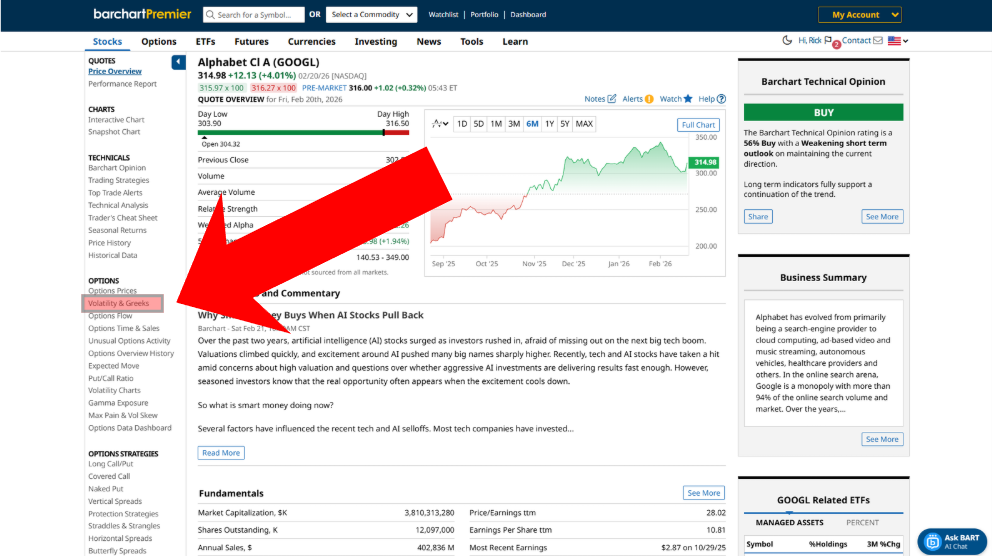
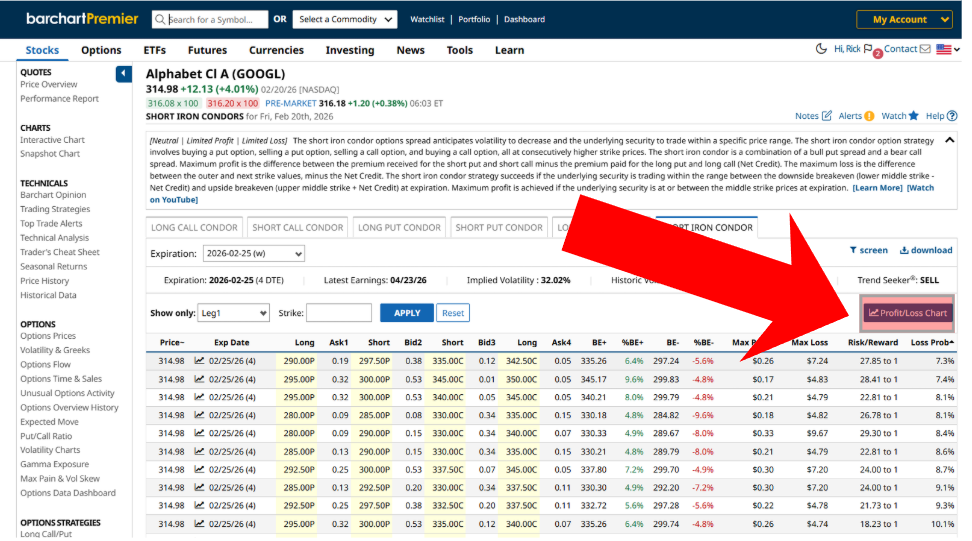
Volatility information for GOOGL stock can also be found on its new Options Data Dashboard, which you can find right here:
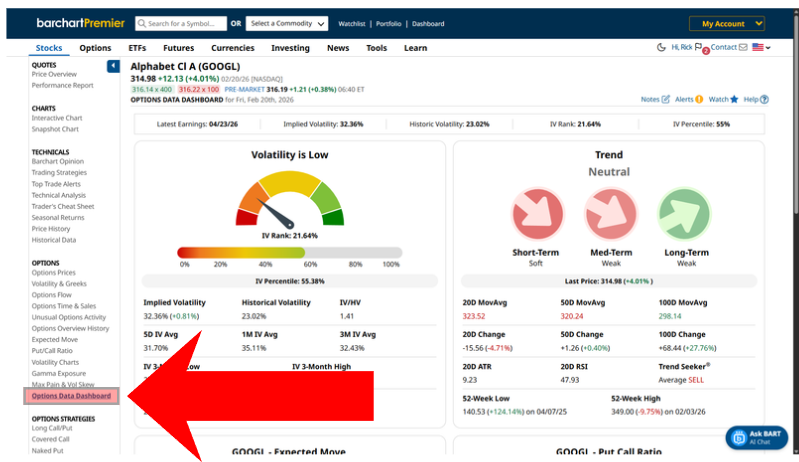
In an ideal world, it’s best to sell options when IV is high but falling. However, you may not be able to find such trades all the time, so you can make adjustments to this criterion as you see fit.
Second, market outlook and trend matter; this strategy works best in a range-bound or neutral market where the underlying is unlikely to move sharply beyond your short strikes.
Finally, earnings announcements, economic data, and geopolitical events can create sudden volatility spikes, so it’s important to be aware of upcoming catalysts that could push the underlying outside your profitable range.
How to look for short iron condor trades
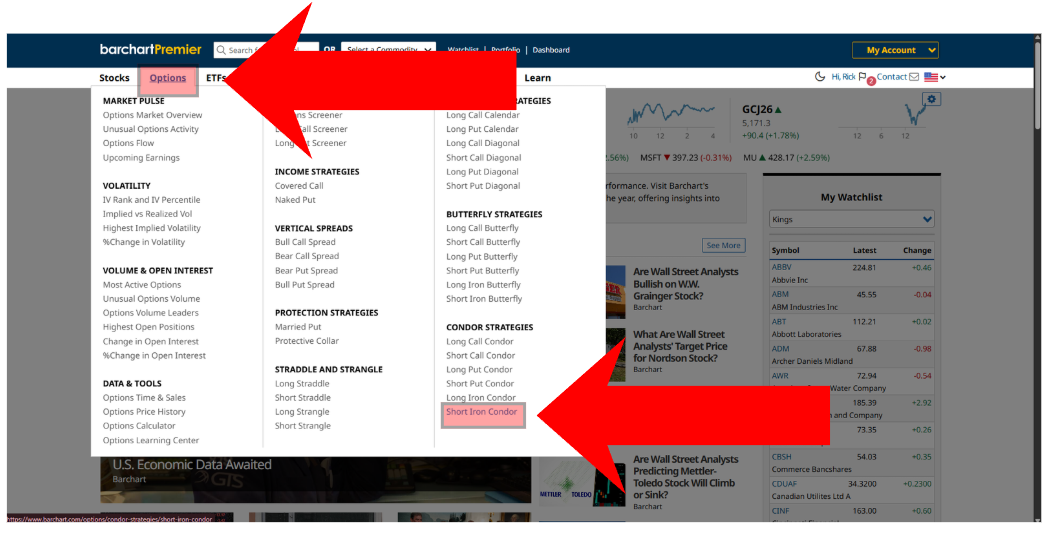
To find potential short iron condor trades, you can click the Options section at the top of Barchart.com’s main page, then click Short Iron Condor.
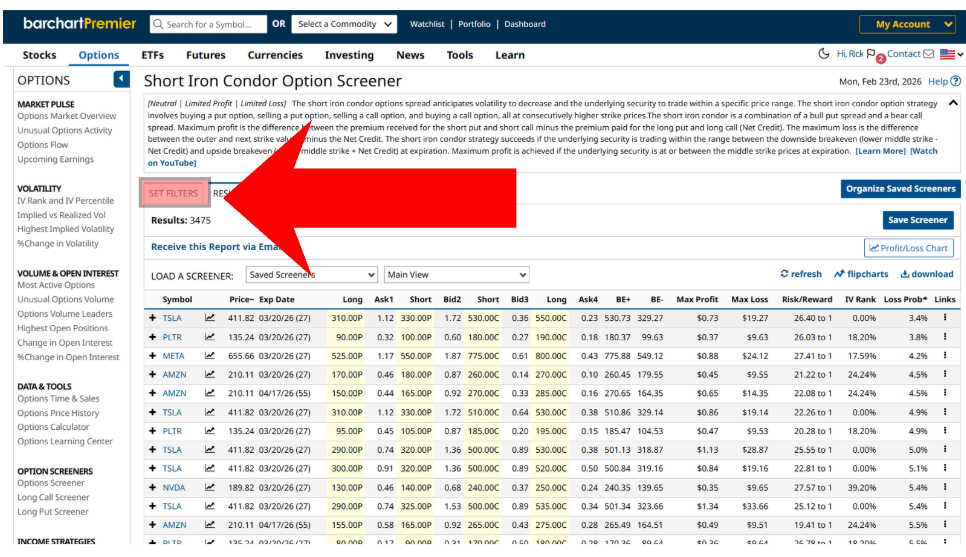
Once there, you’ll be brought to the results page where you can check likely iron condor trades with relatively balanced outlooks. However, if you want to fine-tune your screen, you can click the Set Filters tab right here:
Suggested filters
Now, all Barchart option screeners come with default filters that give you a balanced list of potential trades. However, I like to add a couple of filters when I’m screening for short iron condors. It often depends on how granular I want the screens to be, but here's a quick example of what I usually default to.
- Short-Term Buy/Sell/Hold Signal: Hold. This filter limits results to stocks with weak to neutral technical indicator scores, according to Barchart Opinion.
- Probability of Loss: Between 20% and 30%. This “high-probability” setup offers potentially good trades with decent premiums, without excessive risk.
- Market Cap: $10 billion and above. Higher-cap companies are more actively traded than lower-cap ones, potentially leading to higher liquidity.
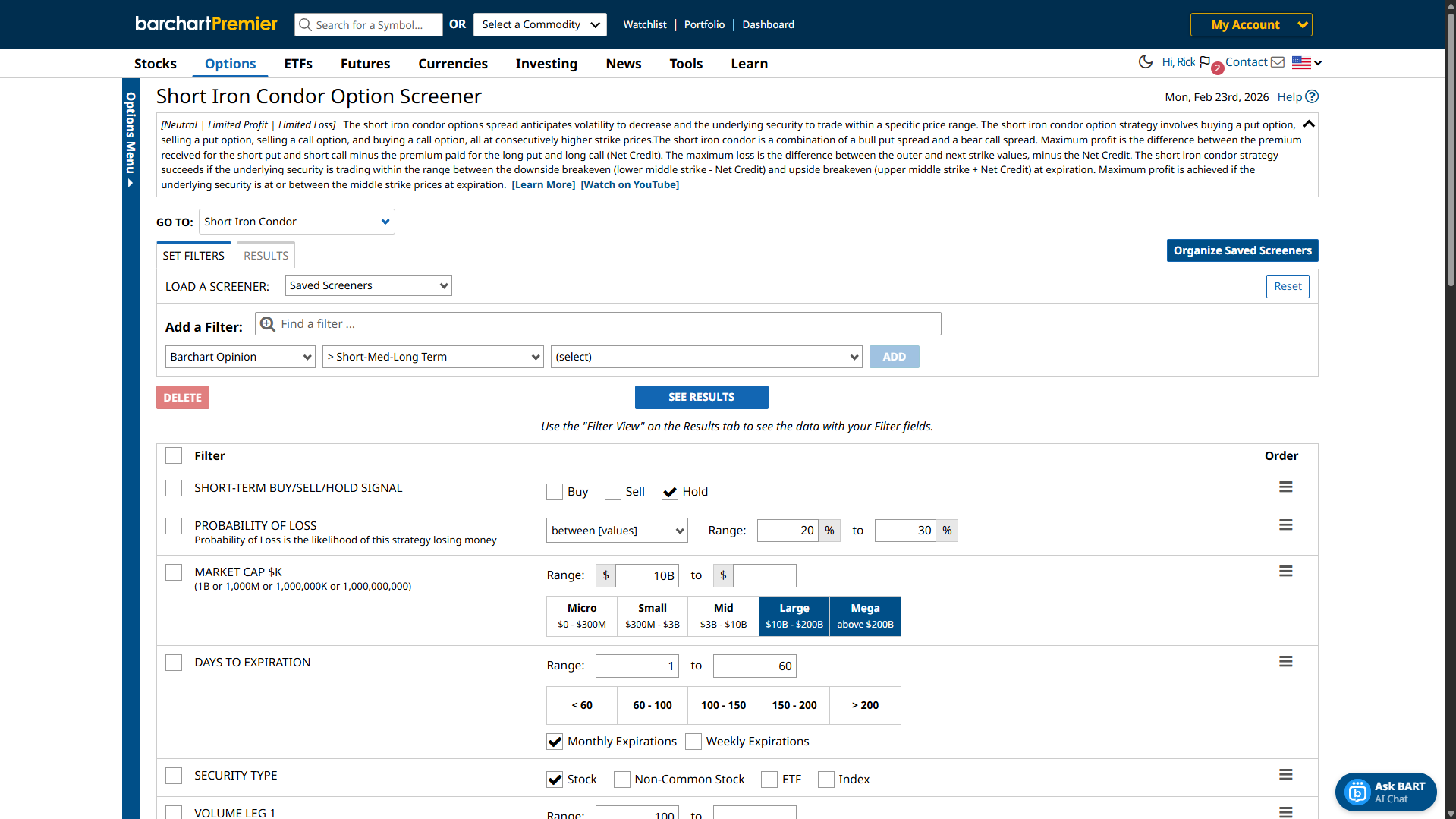
And with those changes and the default filters in place, I ran the screen and got the following results:
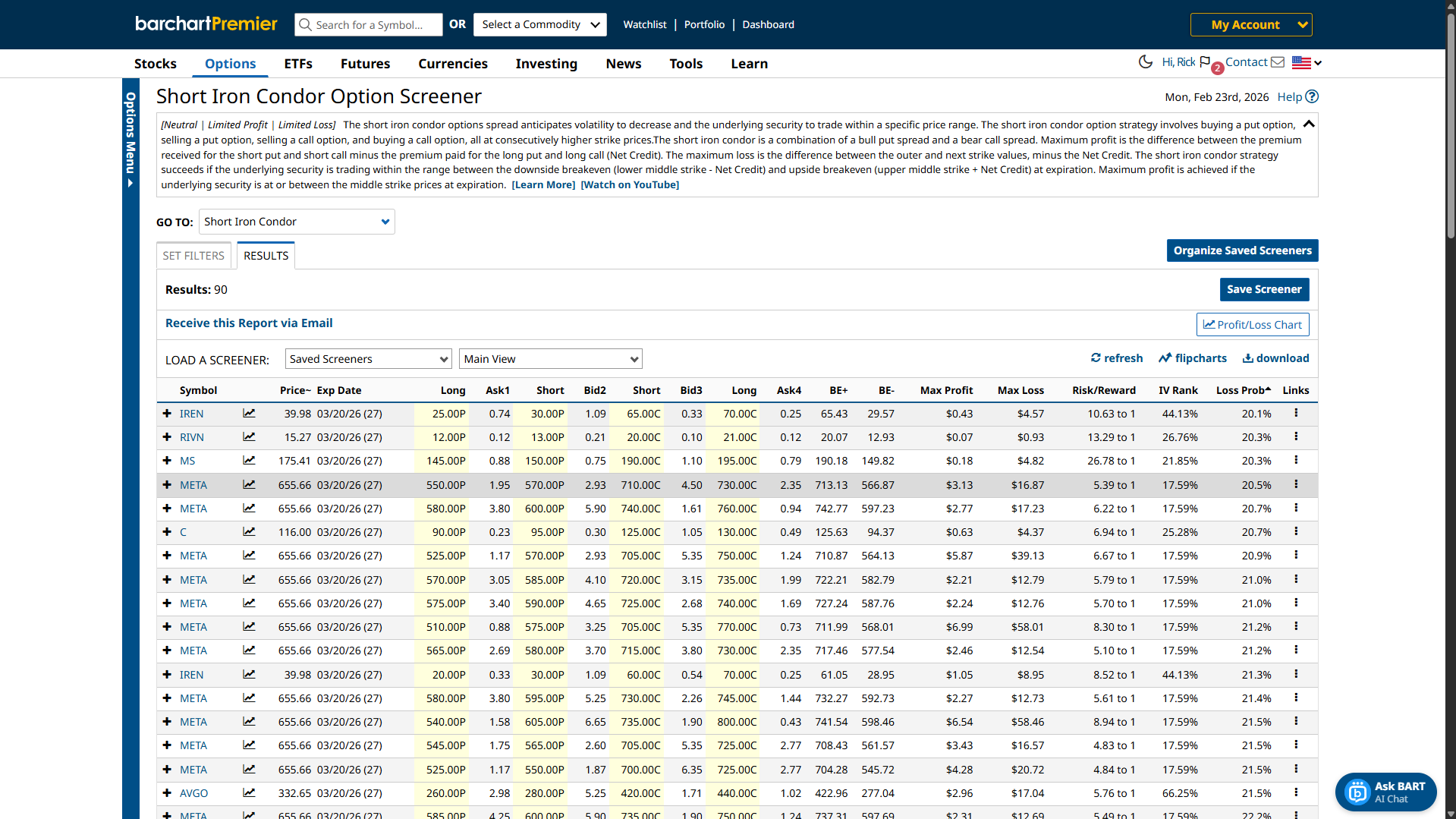
The fourth trade on the list looks promising as it seems to balance risk and reward. So let’s break it down.
Trade details

According to the screener, you can sell a 550-570/710-730 strike short iron condor on Meta, which is currently trading around $657. This spread is quite wide, giving the underlying asset lots of room to move for the trade to stay profitable.
On this trade, you’d receive $7.43 for the short call and put, and pay $4.30 for the long call and put, for a net premium of $3.13 per share or $313 per iron condor. This spread is quite wide, giving the underlying asset ample room to move before the risk of loss becomes evident.
All the options expire on March 20, 2026, 27 days from now, and the trade has a 20% chance of ending at a loss, with a relatively conservative 5.4:1 risk/reward ratio.
As long as Meta trades between $570 and $710 by March 20, 2026, all options expire worthless, and you get to keep the premium without further obligation.
The breakeven prices are $713.13 on the upside and $566.87 on the downside. If Meta trades above $713.13 or below $566.87 by expiration, your trade will end at a partial loss.
However, if Meta trades below $550 or above $730 by expiration, this iron condor will end with a maximum loss of $16.87 per share, or $1,687 per contract sold.
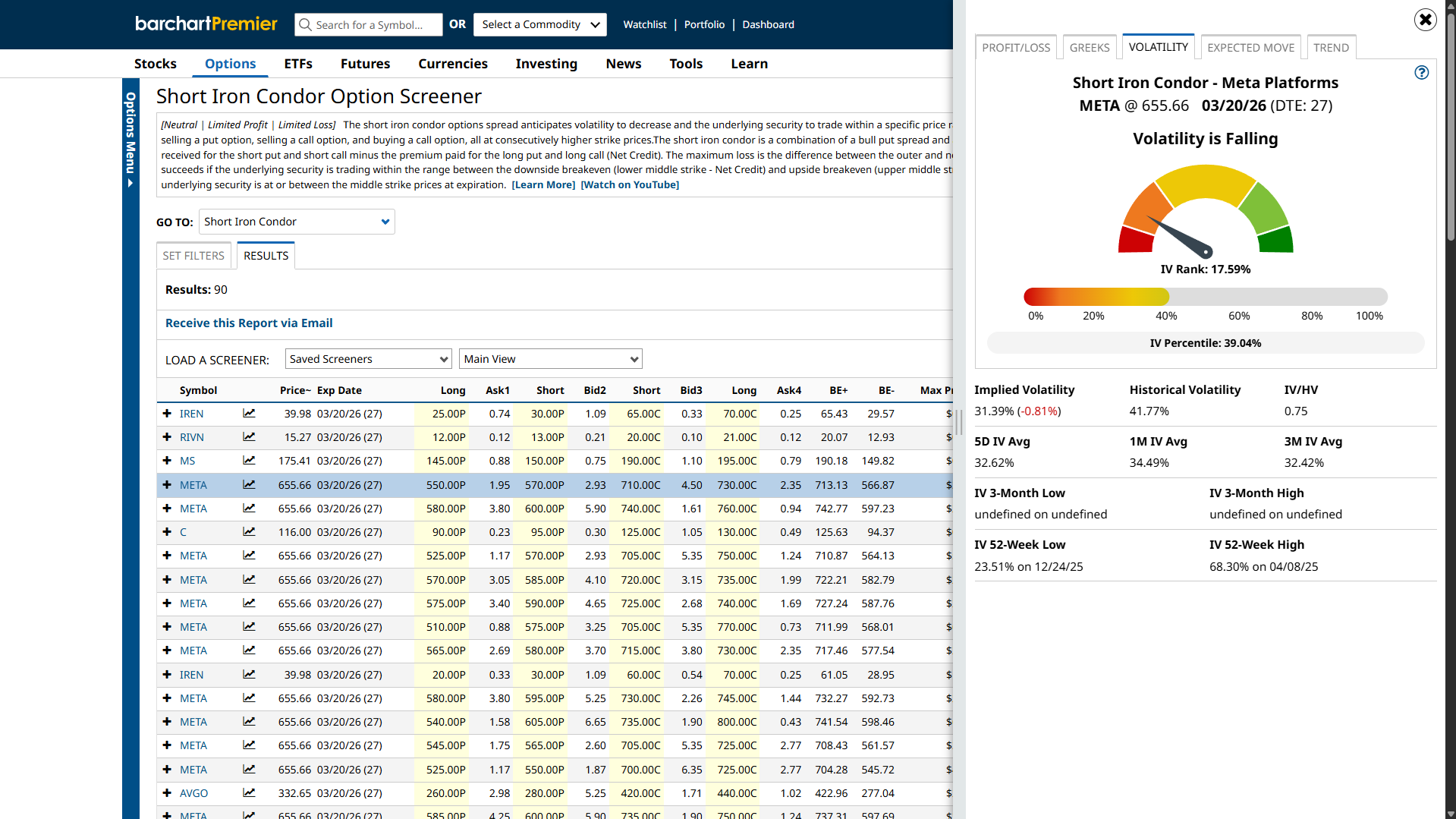
Now, if we check the P&L tab and click Volatility, we can see that overall volatility isn’t too high, with IV rank overing just over 17% and a IV/HV ratio of 0.75, but it is falling, generally positive for a short iron condor since declining implied volatility helps the sold premiums decay faster, even if the reward is more modest when compared to higher-volatility assets.
Final thoughts
Short iron condors can be a powerful tool for generating income in range-bound markets, but they require careful due diligence and a keen eye for opportunities. And of course, maximize your chances of winning by using tools like Barchart’s Option Screener.
On the date of publication, Rick Orford did not have (either directly or indirectly) positions in any of the securities mentioned in this article. All information and data in this article is solely for informational purposes. For more information please view the Barchart Disclosure Policy here.
More news from Barchart
- How to Optimize Your Option Screener Results for Put Selling Strategies
- Domino's Pizza Hikes Its Dividend By 14.3% After Free Cash Flow Rises 29% - Value Buyers Love DPZ Stock
- $350+ Nvidia Stock Price Target? This Options Strategy Pays You No Matter What Happens Next.
- A Technical ‘Hold’ in Meta Platforms Stock Signals a Perfect Iron Condor Opportunity