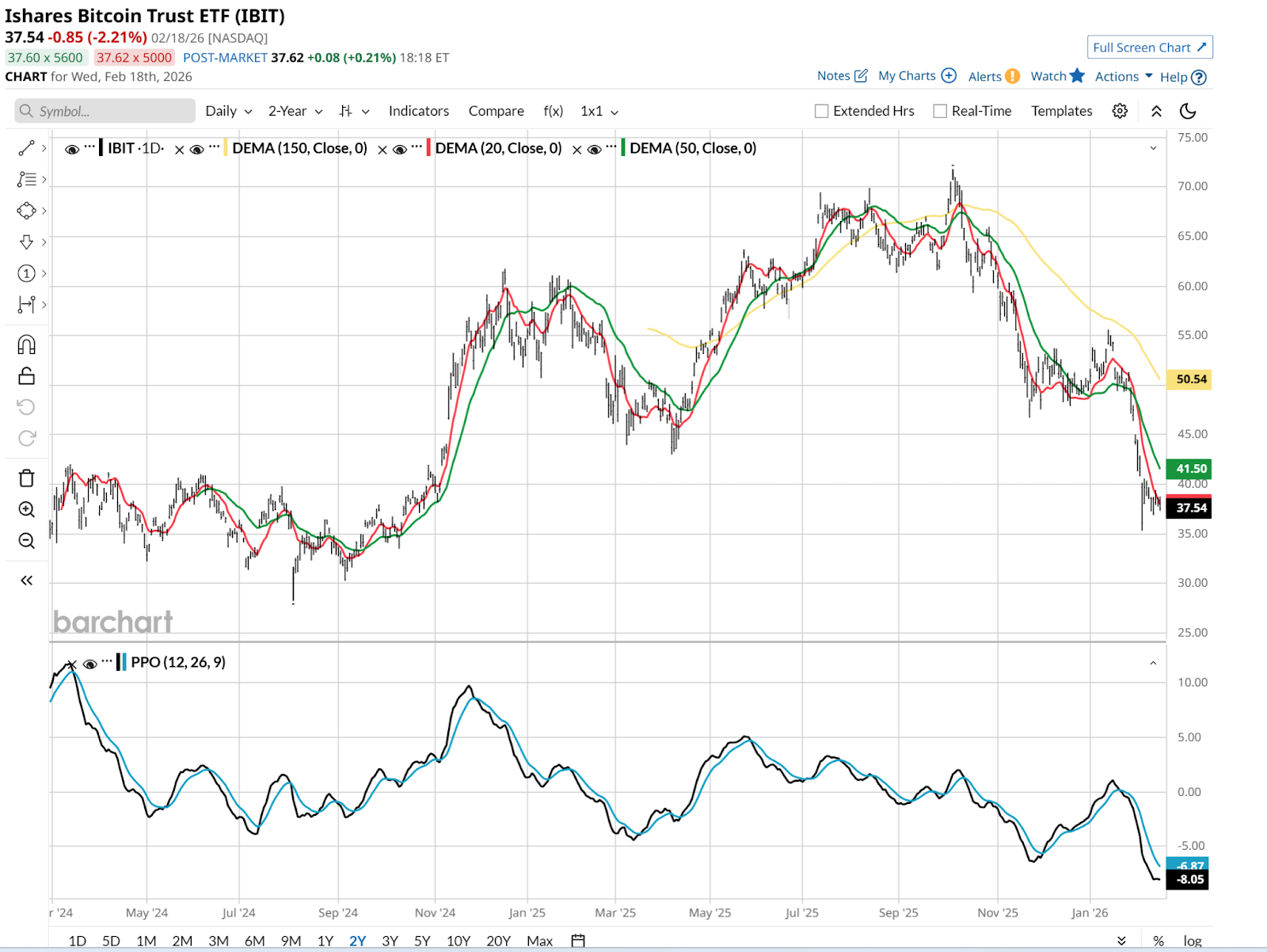
As a technician to the core, I can’t help but look at the below chart and think to myself, “That’s one way to be a store of value.” Ishares Bitcoin Trust ETF's (IBIT) price is flat over two years. But yes, I’m burying the lead there. Lots of gyrations to get to zero returns over that time.
My assessment of this daily chart is simple. This might be Bitcoin’s (BTCUSD) last stand, in that if its price gets buried at the next level down ($30? Below $30?), it could take a long time to recover.
If at all. By the way, that’s about 20% down from here. Or in Bitcoin price terms, about $53,000.
After a few decades in and around financial markets, and making more investment decisions than I could ever remember, I’ve developed several features of modern markets that I refer to as “facts of life.” Among them is this: Popular assets, be they stocks, exchange-traded funds (ETFs) or other assets, don’t always just go away.
They hang around, often for decades, as once uber-popular places for traders and investors to partake in. But essentially, they are demoted to forgotten tickers, if you will.
I cannot say with any certainty that Bitcoin will be one of those. But if it doesn't get its act together soon, it could risk being one of the more notable “facts of life” victims I can recall.
I’ve lived and invested through:
- Dot-com stocks
- Underground cable stocks
- Collaterized debt obligations (CDOs)
- Junk bonds — when they really were junk
- Special purpose acquisition companies (SPACs)
- 3D-printing stocks( and at least 1 ETF)
One day, I wonder if ETFs like IBIT and its many peers will adorn that historical list. Not to mention other crypto products. Because as I see it, the debate surrounding Bitcoin has shifted from, "Will it survive?" to "What is its actual purpose?”
This, in a world where digital finance is becoming the norm. As the original cryptocurrency faces a stagnant price range and mounting competition from traditional assets, the narrative is split between those seeing a final exit and those seeing a structural evolution.
The Case for the Last Stand
There is a slow trickle of evidence that the basic pillars supporting the Bitcoin-to-the-moon narrative are beginning to crumble under the weight of a changing global economy. Bitcoin was long touted as the ultimate hedge against inflation and a falling dollar. But during the recent bouts of global inflation, Bitcoin often behaved more like a high-risk tech stock than some sort of digital gold. When the Nasdaq 100 fell, Bitcoin fell in sympathy, even as interest rates rose.
In addition, governments across the globe have transitioned from ignoring crypto to aggressively regulating it. The introduction of central bank digital currencies (CBDCs) and stricter anti-money-laundering rules has stripped away some of that very outsider appeal that originally drove Bitcoin's adoption.
And, now more than 15 years into its life, Bitcoin is still rarely used for everyday transactions. To be clear, I do not have a horse in this race, so to speak. I’ve done nicely just “renting” crypto ETFs and options on them the past couple of years to try to catch up and down waves.
And boy, have there been a lot of both! Still, the lack of a real-world use case beyond speculation suggests that the market may finally be running out of new buyers to keep the price afloat.
The Case for a New Chapter
But as others will argue, perhaps Bitcoin isn't dying. Maybe it is simply maturing into a boring, reliable institutional asset. The launch of spot ETFs and the inclusion of Bitcoin in corporate treasuries have created a structural floor for the price. Major financial institutions are no longer debating its existence; they are building the plumbing to offer it to every retirement account in America.
And, while its correlation with tech is high, some investors still view Bitcoin as a lifeboat-like asset in regions with failing currencies or unstable banking systems. In this view, Bitcoin doesn't need to be a currency; it just needs to be a portable, un-hackable vault.
What I’m Watching: The ETFs
The line in the sand for Bitcoin is institutional flow. If the daily inflows into Bitcoin ETFs begin to turn into sustained outflows, it will signal that the market has lost interest in the digital gold narrative, and the other positive cases for long-term holding of crypto in public market-traded form.
I imagine somewhere they still trade 3D-printing stocks “in size.” But after all the fuss about Bitcoin ETFs coming to market, and the deluge of demand we saw for a while, this would likely be the biggest case of a “fact of life” asset going down I can recall.
Rob Isbitts created the ROAR Score, based on his 40+ years of technical analysis experience. ROAR helps DIY investors manage risk and create their own portfolios. For Rob's written research, check out ETFYourself.com.
On the date of publication, Rob Isbitts did not have (either directly or indirectly) positions in any of the securities mentioned in this article. All information and data in this article is solely for informational purposes. For more information please view the Barchart Disclosure Policy here.
More news from Barchart